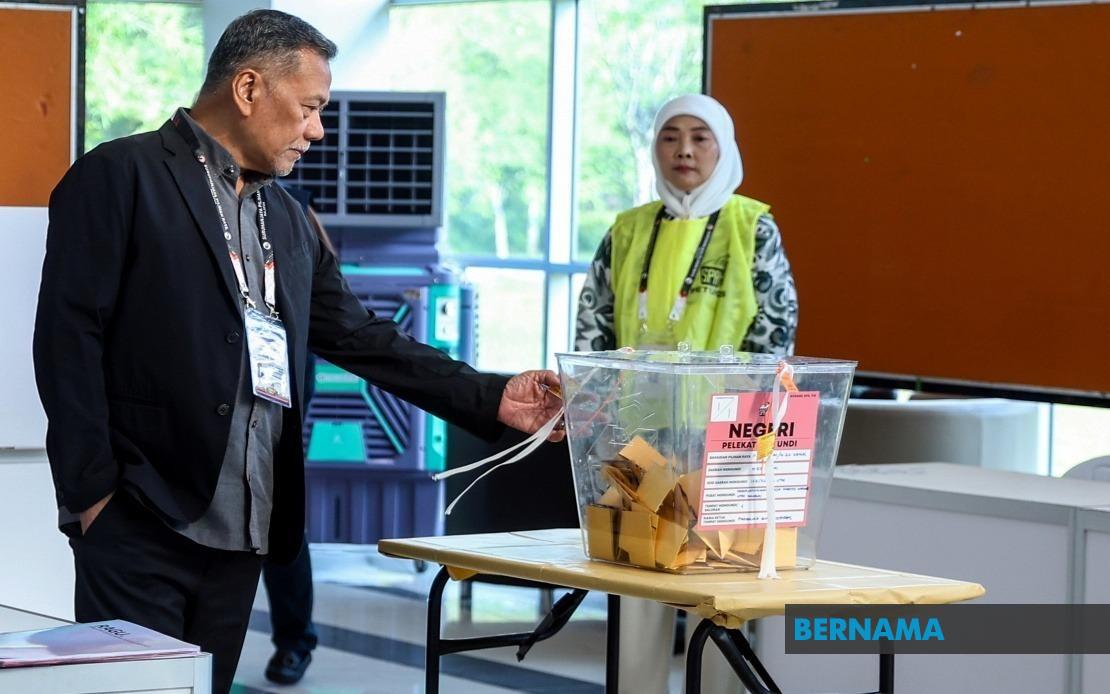
Election Commission chairman Datuk Seri Ramlan Harun made an unannounced tour of polling centres across Johor Bahru on July 11 to verify that the 16th Johor state election was operating without disruption and adhering to electoral standards. His inspection itinerary covered four distinct voting locations spread across different constituencies, reflecting the commission's commitment to maintaining oversight during the polling day.
Ramlan's first stop took him to Dewan Raya Taman Ungku Tun Aminah, designated as the polling centre for the Skudai constituency. This venue had been configured with seven separate polling streams to manage voter throughput efficiently. The chairman arrived shortly before 8.50 am, positioning his inspection during the initial hours of voting when facility strain and procedural compliance issues are most likely to surface. His early-morning timing allowed election officials and polling station staff to implement any necessary corrective measures well before mid-day voting peaks.
From Skudai, Ramlan proceeded northward to the Raja Zarith Sofiah Library located within the Universiti Teknologi Malaysia campus in Senai. This academic venue served the Senai constituency with a more modest setup of two polling streams, reflecting the constituency's voter density and expected turnout patterns. The choice of a university library as a polling location provided voters with familiar, accessible facilities while maintaining the security protocols required for electoral integrity. Ramlan's visit to this location underscored the commission's attention to how institutional spaces were being utilised for democratic participation.
The chairman's third destination was Sekolah Agama Taman Bukit Mewah in the Kempas constituency, which operated six polling streams throughout voting day. Religious schools across Malaysia have become standard polling venues, given their centrality to community life, established security infrastructure, and capacity to accommodate multiple simultaneous voting stations. Ramlan's inspection at this location would have included verification of how prayer times and religious activities were being accommodated alongside electoral operations.
Ramlan concluded his inspection circuit at Sekolah Menengah Kebangsaan Bandar Uda Utama in the Perling constituency, which was configured with the largest number of polling streams among the four visited centres—nine in total. This secondary school was clearly handling a significant portion of Perling's voter population, requiring robust coordination between polling officials and school administration. The size of this operation meant that queuing management, voter privacy, and ballot security protocols were being tested at scale.
During each of his visits, Ramlan received detailed briefings from election officials stationed at the respective centres. These briefings would have covered aspects such as voter turnout rates up to that point, any irregularities or complaints registered, the functioning of voting machines or manual counting systems being employed, and the conduct of polling personnel. By engaging directly with officials on the ground, the commission chairman could assess real-time conditions rather than relying solely on administrative reports filtered through bureaucratic channels.
Beyond procedural discussions, Ramlan also conducted hands-on facility inspections. This aspect of his tour examined the voting booths themselves, ensuring adequate privacy screens and ergonomic design. He would have verified that facilities for voters with disabilities met accessibility standards, checked that election personnel had adequate rest areas and refreshment provisions, and confirmed that ballot security measures—including storage, distribution, and counting protocols—were being maintained. These facility reviews are critical because poor infrastructure or inadequate support systems can lead to procedural delays, voter frustration, or security vulnerabilities.
The timing of Ramlan's inspection during the early voting hours reflected best practices in electoral administration. Morning visits allow commissioners to identify problems while corrective action remains feasible. Had serious issues been discovered—inadequate staffing, equipment malfunctions, or security breaches—the commission chairman's presence would have enabled immediate escalation and remedy rather than discovering problems only in post-election reviews. This proactive approach demonstrates how direct oversight mechanisms can enhance electoral credibility.
For Malaysian electoral observers and voters concerned with democratic standards, such high-level inspections serve multiple purposes. They signal that election management is being taken seriously at the most senior levels, providing assurance that irregularities are not being tolerated. They also create accountability pressure—polling staff aware that the commission chairman might visit are likely to maintain higher standards throughout the day. Furthermore, such visits generate media attention that focuses public awareness on the election's conduct rather than solely on campaign narratives or political rivalry.
The inspection of four diverse polling locations—ranging from community halls to university libraries to schools—provided a cross-sectional sample of how the electoral machinery was functioning across different Johor constituencies. This geographic and institutional variety meant Ramlan could assess whether challenges were localised or systemic. A problem at a single location might reflect specific staff issues or facility constraints; similar problems at multiple locations would indicate broader structural deficiencies requiring commission-wide response.
Ramlan's scheduled press conference following the inspection tour represented an opportunity for public communication. Election commission statements after such visits typically provide voter reassurance about electoral integrity while carefully avoiding any commentary that could appear to favour particular candidates or parties. His public remarks would have focused on procedural compliance and the smooth functioning of voting mechanisms rather than predictions about election outcomes.
The 16th Johor state election was being administered under procedures and standards established through Malaysia's electoral framework. The commission's inspection protocols reflect institutional learning from previous elections and incorporation of best practices in democratic administration. Such oversight mechanisms contribute to public confidence in electoral outcomes, which remains essential for democratic legitimacy regardless of which candidates ultimately prevail.
As the Johor election unfolded on July 11, such commission oversight activities reinforced the principle that election administration is a professional, continuously monitored endeavour rather than a one-day exercise in voting. The chairman's presence across multiple constituencies signalled that the electoral commission remained engaged and vigilant throughout polling day, maintaining the standards upon which electoral credibility ultimately rests.

