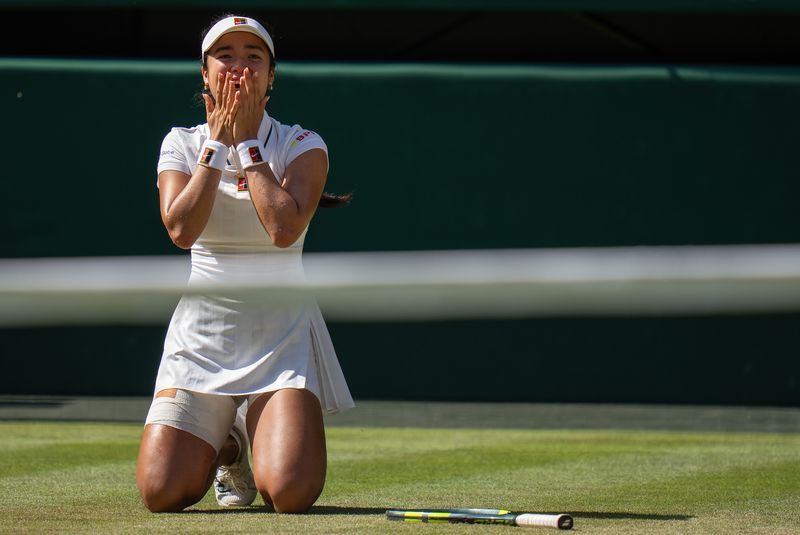
Philippine tennis has found a fresh icon in Alexandra Eala, who stunned world No. 1 Iga Swiatek on Saturday at Wimbledon to secure her place in the last 16 of a Grand Slam tournament. The 21-year-old's victory marks a watershed moment for women's tennis in the Philippines, a nation where boxing legend Manny Pacquiao has long dominated the sporting consciousness. Eala's fearless performance and composed demeanor off the court have captivated audiences at the All England Club and beyond, positioning her as a potential torchbearer for a new generation of Filipino athletes.
Eala's ascent through professional tennis ranks has been meteoric, drawing comparisons to other young breakout talents who have reshaped the sport's landscape. What distinguishes her narrative, however, is her conscious effort to frame her success not as an endpoint but as an invitation for others to discover their own potential. The 29th seed has become acutely aware that her platform extends far beyond tournament victories, reaching into households across the Philippines where young girls may be inspired to take up rackets and pursue excellence in a sport previously lacking indigenous champions at the highest level.
During her post-match press conference, Eala articulated a philosophy that transcends typical athlete platitudes. She emphasized the importance of authenticity and remaining true to personal values while navigating the pressures of international competition and public scrutiny. Her message to aspiring athletes centers on individuality rather than imitation—a crucial distinction that acknowledges the unique circumstances, talents, and opportunities that each person possesses. By encouraging young women to become "the first me" rather than "the next Alex Eala," she champions a developmental mindset that values originality and self-discovery.
The emotional intensity of Eala's victory over Swiatek, evidenced by tears shed immediately after the final point, demonstrated the profound significance of this breakthrough. However, she was careful to contextualize her celebration within a broader competitive framework. Rather than viewing emotional release as an endpoint, she presented it as a natural response that must be quickly compartmentalized as she prepares for subsequent matches. This psychological dexterity—the ability to honor emotions while maintaining championship focus—represents a hallmark of athletes who sustain success across multiple seasons.
Eala's next challenge pits her against Jasmine Paolini, the 2024 Wimbledon runner-up, in what will constitute another significant test of her development. The 29th seeding reflects her steady climb through the rankings, though recent performances suggest her actual capabilities may exceed what seeding committees anticipated. For Malaysian and Southeast Asian tennis enthusiasts, Eala's trajectory offers valuable perspective on how regional players can compete at the sport's highest levels, challenging narratives that position Asian tennis development solely through players from established tennis powerhouses like China and Japan.
The broader implications of Eala's emergence extend beyond individual accomplishments. Her success at Wimbledon, tennis's most prestigious venue, occurs at a moment when Southeast Asian sports are experiencing renewed investment and infrastructure development. Nations throughout the region are cultivating homegrown talent pipelines, and Eala's pathway—marked by international junior tournaments, strategic coaching relationships, and gradual exposure to elite competition—provides a template that other federations can study and adapt. Her rise demonstrates that Grand Slam success is achievable for players from smaller tennis nations when combined with strategic planning and unwavering commitment.
Eala's character has emerged as integral to her appeal and market value. Large crowds have followed her progression through Grand Slam tournaments, attracted not merely by competitive outcomes but by her approachable demeanor and evident enjoyment of tennis as a sport rather than purely as a vehicle for glory. This relatability distinguishes her from more imperious champions and creates a foundation for sustained fan engagement across Filipino communities globally and throughout Southeast Asia, where large diaspora populations provide both emotional support and potential commercial opportunities.
The psychological maturity Eala displays regarding the distinction between celebration and complacency offers instructive lessons for aspiring athletes across the region. She articulated an intuitive understanding that competitive excellence requires the capacity to compartmentalize emotions—celebrating achievements while maintaining the hunger and focus necessary for continued improvement. This mindset, which she suggests emerges naturally from her character rather than deliberate training, may reflect developmental benefits of her international exposure and the competitive environments in which she has trained.
As Eala navigates the latter stages of Wimbledon, the Philippine sports establishment and media infrastructure face opportunities to amplify her narrative responsibly. Her explicit desire to inspire rather than to be blindly emulated suggests a maturity uncommon among athletes her age. The challenge for sports institutions throughout Southeast Asia involves leveraging her visibility to build sustainable structures—coaching academies, junior development programs, tournament infrastructure—that enable future generations to pursue tennis without the exceptional individual circumstances that characterized Eala's own path to prominence.
The contrast between Eala's emergence and Pacquiao's dominance of Philippine sporting discourse reflects broader shifts in global sports consumption and athlete branding. Where boxing previously offered the most viable pathway for Filipino athletes to achieve international prominence, diversification of sporting opportunities has created openings in previously underrepresented disciplines. Eala's success validates investment in women's tennis development and suggests that Philippines sports federations should continue pursuing excellence across multiple domains rather than concentrating resources within traditional strongholds.

