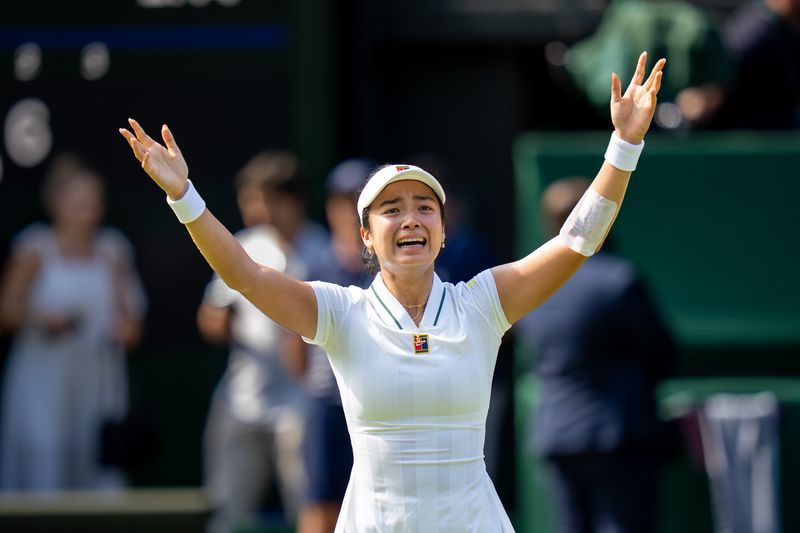
Philippine tennis sensation Alexandra Eala delivered one of the tournament's most significant shocks on Saturday by eliminating defending champion Iga Swiatek in a display of fearless attacking tennis, while second seed Elena Rybakina's exit at the hands of Belgian Elise Mertens sent further tremors through the women's draw at the All England Club.
Eala, seeded 29th, outlasted the Polish third seed in a grueling first-set encounter that extended nearly 90 minutes before she triumphed 7-6(9) 6-2. The battle for the opening set proved pivotal, with Eala demonstrating composure under pressure by saving a set point in the tiebreak when Swiatek's forehand sailed into the net. Having weathered that critical moment, the Filipino player seized control in the second set, moving fluidly across the grass to impose her will and secure a memorable victory. The win represents a watershed moment for Southeast Asian tennis, as Eala becomes the first player from the Philippines to reach the fourth round of a Grand Slam tournament.
Swiatek, a six-times Grand Slam champion seeking to retain her title, appeared frustrated throughout the encounter. The defending champion struggled to find her rhythm against an opponent who refused to be intimidated by reputation or ranking. Following her dismissal, Swiatek acknowledged the need for fundamental reassessment. "Honestly, I don't care anymore about the results. I've been so focused on them that it's hard to continue like that," she told reporters, suggesting the weight of defending her crown had begun to affect her mental state and approach to competition.
The day brought equally dramatic developments at the upper end of the seeding. Rybakina, who won the Australian Open earlier this year and was positioning herself to reclaim the world number one ranking with a strong run at Wimbledon, suffered an even more emphatic collapse against Mertens. The Belgian player, reaching the last 16 for the fourth time, secured a 7-6(4) 6-1 victory that proved far more one-sided than the scoreline of the first set suggested. After competing closely in that opening set, Rybakina deteriorated markedly in the second, managing just one game against her opponent's relentless pressure. The 2022 champion admitted her tactical approach required overhaul, recognizing that her current methodology was yielding diminishing returns on grass.
On the American side of the women's draw, mixed fortunes emerged on a day when the United States marked 250 years since the Declaration of Independence. Madison Keys, the 26th seed riding momentum from her title triumph at Eastbourne the previous week, delivered a rousing performance by defeating sixth-seeded Amanda Anisimova 3-6 6-2 6-3 in an all-American matchup that thrilled Centre Court. Keys' progression demonstrated that her grass-court form had translated seamlessly to the Wimbledon stage, where eight American women competed in singles. Ashlyn Krueger, arriving as a qualifier, overwhelmed Ukraine's Daria Snigur 6-3 6-2 in another encouraging result for the American contingent, though 23rd seed Emma Navarro suffered elimination at the hands of Ukrainian rival Marta Kostyuk in a three-set affair.
A poignant moment punctuated the American presence when Serena Williams withdrew from her eagerly-anticipated doubles pairing with sister Venus due to injury. Williams, whose return to competitive tennis after a four-year absence had captured widespread interest, had already exited the singles draw following a loss to Maya Jiga. The seven-times Wimbledon champion conveyed her disappointment through an Instagram post, expressing that she was "heartbroken to have to withdraw" from the doubles competition that would have marked a symbolic reunion with her sibling on the grass courts where they had achieved such historic success together.
By contrast, the men's draw experienced greater stability at its summit, with second seed Alexander Zverev, the newly-crowned French Open champion, maintaining his formidable trajectory through a commanding 6-2 7-6(4) 6-4 victory over American Marcos Giron. Zverev's performance underscored his current ascendancy across clay and grass surfaces, demonstrating the adaptability required of elite professionals. With defending champion Jannik Sinner already advancing, Italy harbored realistic ambitions of placing four men in the last 16 of a Grand Slam for the first time since the 1947 French Open, representing a significant milestone for Italian tennis.
Italian fortunes were mixed, however, as ninth seed Flavio Cobolli, the French Open runner-up, recovered from a disastrous opening-set whitewash against Russia's Karen Khachanov to engineer a remarkable five-set comeback, ultimately prevailing 0-6 7-6(4) 6-7(5) 6-2 6-2. Cobolli's resilience and mental fortitude in rescuing that match from the brink of defeat illustrated the psychological demands of Grand Slam competition. His compatriot Lorenzo Sonego proved unable to sustain the Italian momentum, faltering against sixth seed Taylor Fritz despite an encouraging opening in a 4-6 6-3 6-4 7-6(5) defeat that prevented the anticipated cascade of Italian advances.
Eala's journey to the fourth round carries profound significance for Philippine sport and Southeast Asian representation at the highest level of tennis. The 29th seed carries a personal motto in Tagalog etched upon her cap—"once it grows, it cannot be stopped"—a philosophy born from her formative years training with her brother and grandfather after school in Manila. That very slogan faces its ultimate test when she confronts 13th seed Jasmine Paolini, the 2024 runner-up who dismantled Greece's Maria Sakkari 6-1 6-2 in her own commanding display. Eala's victory over Swiatek resonates beyond mere tournament progression; it represents validation for the development pathway that has produced her talents and offers inspiration across an Asian sporting landscape perpetually seeking homegrown champions on the world's premier stages.
The wider implications of Saturday's results center on the emergence of unpredictability in a women's draw traditionally dominated by European and American players. Eala's advancement signals that established hierarchies, while meaningful, remain vulnerable to determined competitors operating without the psychological constraints of expectation. Her composed demeanor throughout the Swiatek encounter, particularly when navigating high-pressure situations in the tiebreak, demonstrated the mental maturity required to execute upset victories against experienced opponents. As she transitions toward meetings with seeded players possessing vastly different playing styles and tournament pedigree, Eala's ability to maintain that equilibrium between emotional investment and technical execution will determine how far she can extend this remarkable run.

