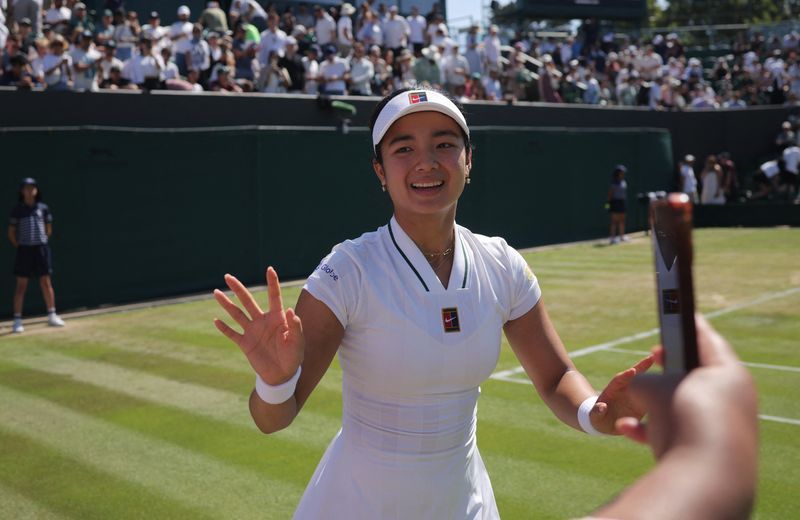
Alexandra Eala has etched her name into Philippine sporting history by becoming the first player from her country to advance to the third round of a Grand Slam tournament. The 21-year-old from Quezon City achieved the milestone at Wimbledon on Thursday with a commanding victory over Australia's Maya Joint, recovering from a sluggish opening set to secure a 3-6, 6-2, 6-0 triumph. The performance marks a watershed moment for tennis in the Philippines and caps what has been a remarkable ascent for Eala in the professional ranks.
Eala's comeback against Joint demonstrated the mental fortitude and technical prowess that have become hallmarks of her game during a career trajectory that shows no signs of plateauing. After dropping the first set, she shifted gears entirely, winning 12 consecutive games across the second and third sets to overwhelm her opponent. The 29th seed's dominance in the latter stages underscored why she has become such a competitive presence on the grass court circuit, having already claimed the Birmingham title last month and reached the semi-finals in Berlin.
The emotional weight of this achievement cannot be overstated for a player who carries her national pride onto the court with deliberate intentionality. Eala revealed that her Nike apparel was customised with a Tagalog phrase meaning roughly "once it grows, it cannot be stopped," a personal mantra that captures both her trajectory and her determination to chart new territory for Philippine tennis on the world's biggest stages. The sponsorship arrangement speaks to how seriously both athlete and brand view her cultural representation, treating her appearance at major tournaments as a vehicle for national pride.
Such conscious expressions of heritage extend beyond mere slogans on her outfit. At her Wimbledon debut the previous year, Nike supplied her with a custom hair tie adorned with a sampaguita blossom, the national flower of the Philippines. These subtle but meaningful touches reflect Eala's conviction that representing her country is inseparable from her personal identity as a competitor. She has spoken openly about how important it is to wear and carry aspects of her culture onto the court, viewing her position on the international tennis stage as an opportunity to honour where she comes from while pursuing her own athletic ambitions.
Eala's next challenge will test her resolve further when she faces defending champion Iga Swiatek of Poland on Saturday. The matchup represents a significant leap in competition, as Swiatek, a six-time Grand Slam champion, ranks among the sport's elite. However, Eala's recent performances suggest she approaches such encounters without trepidation. In characteristically measured language, she acknowledged the formidable challenge ahead while expressing confidence in her readiness to compete at that level. Her dismissal of Williams' first-round conqueror Joint with such clinical efficiency provides a foundation for cautious optimism about her prospects against Swiatek.
The broader context of Eala's rise is instructive for understanding her significance to Philippine sports. Only two years prior, she broke into the top 50 rankings, yet she has sustained consistent improvement throughout the current campaign. This is merely her sixth Grand Slam tournament, meaning she is still in the early stages of her major championship education. The comfortable manner in which she has adapted to grass surfaces—her preferred terrain—suggests she may well become a fixture in later rounds at Wimbledon for years to come.
Eala trains at the Rafa Nadal Academy in Mallorca, benefiting from the world-class facilities and coaching infrastructure available at one of tennis's premier development centres. This geographical separation from her homeland does not diminish her connection to the Philippines; rather, it enables her to pursue the intensive training regimen necessary to compete against the world's best players. The sacrifice of being based abroad, often away from family and the familiar comforts of home, carries particular resonance given her emphasis on representing her nation.
When asked about the magnitude of her achievement, Eala demonstrated humility tempered with awareness of what her breakthrough means for Philippine tennis. She acknowledged that describing her milestone as impactful carries emotional weight, yet she insisted on viewing her progress through the dual lens of personal accomplishment and national representation. This balancing act—pursuing individual sporting goals while conscious of broader implications for one's country—reveals a maturity in her approach that extends beyond her years.
The reality that Eala is the sole Philippine player in the Wimbledon main draw amplifies both the significance of her presence and the burden of singular representation. She must carry the expectations and aspirations of an entire tennis-following nation on her shoulders, yet she approaches this responsibility as an extension of her values rather than an external imposition. This philosophical stance—refusing to become someone she is not or to abandon her principles in pursuit of victory—may ultimately be the most distinctly characterising element of her emergence as a sporting figure in Southeast Asia and beyond.

