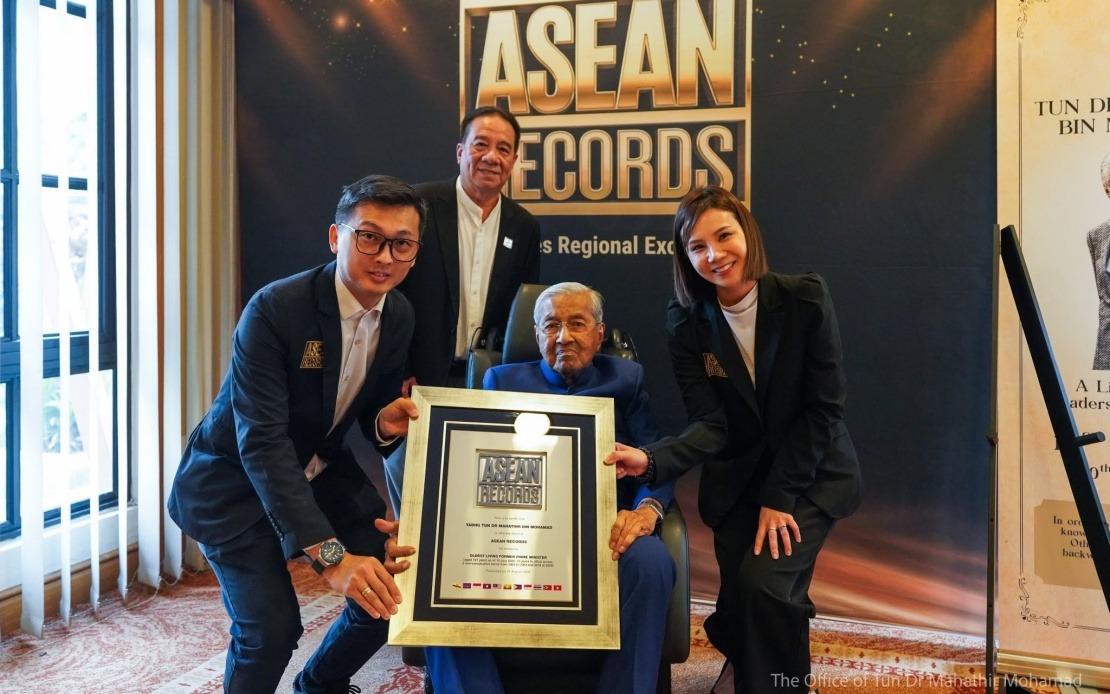
Tun Dr Mahathir Mohamad and Tun Dr Siti Hasmah Mohd Ali have entered the record books for a trio of historic achievements, with both spouses now recognised as centenarians in a distinction that has no documented parallel across the ASEAN region and broader Asian markets. The 101-year-old former Prime Minister and his 100-year-old wife received official certification at a ceremony held at the Perdana Leadership Foundation in Kuala Lumpur, marking an extraordinary personal milestone that underscores both their individual longevity and their enduring partnership.
The formal recognition involved three separate record designations, each highlighting a different dimension of their remarkable trajectory. Dr Mahathir was certified by ASEAN Records as the Oldest Living Former Prime Minister, a title reflecting his sustained health and vitality well over a century into his life. Separately, Dr Siti Hasmah received recognition as the Oldest Living Spouse of a Former Prime Minister, acknowledging her own exceptional longevity and the vital role she has played throughout Dr Mahathir's political career and beyond. The couple jointly received a third distinction from ASIA Records as the First Former Head of Government and Spouse to Both Become Living Centenarians, a achievement that sets them apart even within the rarefied category of long-lived political figures.
The timing of these recognitions carries particular resonance given the concentration of significant milestones the couple has experienced in recent weeks. Dr Mahathir celebrated his 101st birthday on July 10, with Dr Siti Hasmah following seven days later on July 12 when she turned 100. Their celebrations did not end there—the couple marked their 70th wedding anniversary on August 5, demonstrating that their achievement extends far beyond individual longevity to encompass seven decades of sustained partnership. This convergence of milestone moments speaks to a life lived together across dramatic transitions in Malaysian politics and society.
The adjudication process undertaken by ASEAN Records and ASIA Records involved rigorous verification procedures to ensure the authenticity and uniqueness of these claims. The records' specialist team confirmed through their investigation that no similar achievement had been publicly documented anywhere across the ASEAN region or within major Asian markets, establishing a genuinely unprecedented distinction. This careful validation underscores that these are not merely symbolic honours but represent genuine historical firsts in the longevity achievements of political couples in this geopolitical sphere.
The formal presentation of certificates at the Perdana Leadership Foundation ceremony was conducted by Tan Sri Danny Ooi, who chairs the ASEAN Records Advisory Board, alongside chief adjudicators Gillian Ooi and Eldrick Koh, who serve as directors for both the ASEAN and ASIA Records organisations. The involvement of such senior officials in the recognition process reflects the significance attributed to this achievement within Malaysian and regional contexts. Dr Mahathir subsequently shared details of the recognition through a Facebook post, ensuring wide public awareness of the honour bestowed upon himself and his wife.
The significance of these records extends beyond mere numerical achievement. Dr Mahathir's tenure as Prime Minister, spanning 22 years across two separate periods, coincided with Malaysia's transformation into a more developed economy and significant regional power. The fact that he has now lived for 101 years, with 70 of them spent married to Dr Siti Hasmah, creates a tangible link to nearly a century of Malaysian political, social, and economic development. His continued vitality and public engagement across this span represents a living connection to multiple eras of the nation's history.
Dr Siti Hasmah's recognition carries equally substantial weight. As the spouse of Malaysia's longest-serving Prime Minister, she has been instrumental in supporting key political and diplomatic functions throughout a transformative period. Her centenarian status, achieved seven days after her husband's 101st birthday, demonstrates that their exceptional longevity is not anomalous but representative of a shared commitment to health and wellbeing maintained across their decades together. Her role as an accomplished physician in her own right, prior to her role as Prime Minister's spouse, adds another dimension to her significance as a public figure.
The achievement of simultaneous centenarian status by a political couple holds particular resonance for Southeast Asian societies where respect for elders and family continuity represent deep cultural values. The Mahathir-Siti Hasmah example demonstrates that sustained partnership, active engagement with public affairs, and commitment to health and vitality can extend life meaningfully into the second century. Their records arrive at a moment when demographic shifts across Asia are creating larger elderly populations, potentially making their example more culturally relevant to broader audiences contemplating longevity and intergenerational legacy.
For Malaysian audiences, these records also serve as a reminder of the nation's political trajectory over the past seven decades. The couple's 70-year marriage encompasses Malaysia's independence, the formation of the Federation, constitutional development, economic transformation, and successive waves of political change. Their presence as centenarians creates a biological and personal continuity with this extended historical period, embodying through their survival and sustained partnership the resilience and adaptability that have characterised Malaysian society across rapid transformation.
The recognition by ASEAN and ASIA Records also positions Malaysia prominently within regional records frameworks, reflecting the nation's demographic achievements and the health standards that have enabled such longevity. As Southeast Asia continues to grapple with an ageing population, the Mahathir-Siti Hasmah records exemplify possibilities for productive, sustained engagement by elderly citizens in public life and family relationships. Their achievement establishes a new benchmark against which other regional figures and families might measure their own longevity achievements, potentially inspiring broader discussion about healthy ageing across Southeast Asian societies.
Looking forward, the significance of these records may extend beyond the immediate moment of certification. As the couple continues to age, their sustained partnership and engagement with public affairs will likely continue attracting both scholarly and popular interest. The records serve as official documentation of an extraordinary personal and political legacy, ensuring that the Mahathir-Siti Hasmah achievement remains part of permanent historical record for Malaysia and the broader region.

