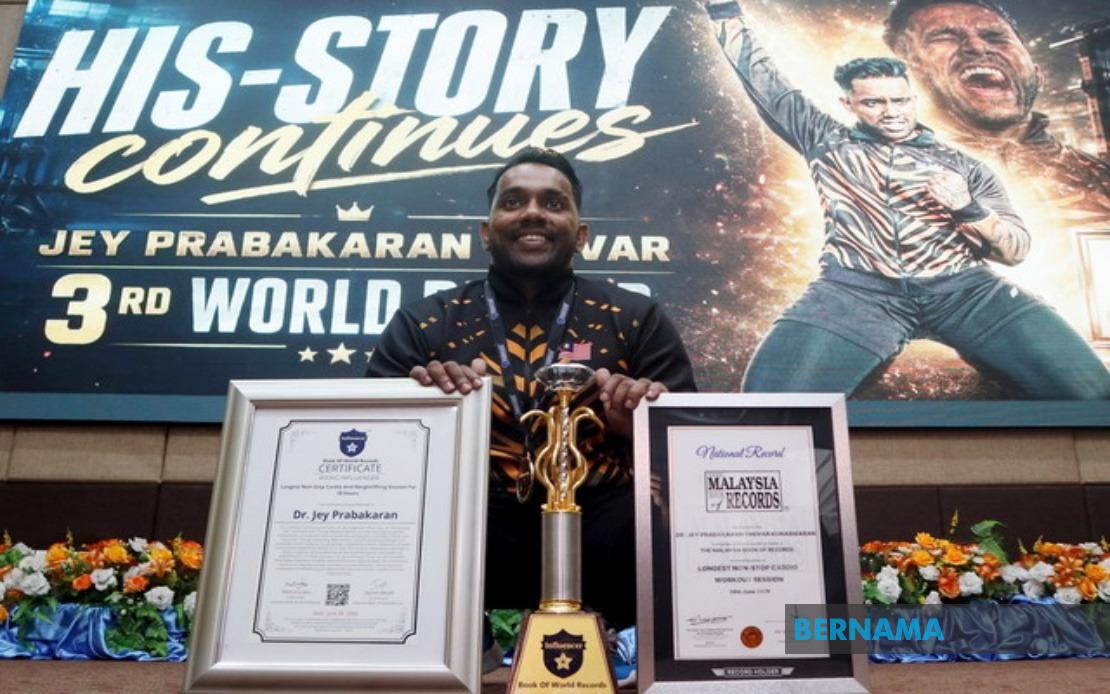
Fitness athlete K. Jey Prabakaran Thevar, professionally known as Dr Kjey, has marked a significant milestone in his athletic career by securing his third world record through an extraordinary 18-hour continuous cardio and weightlifting challenge. The 29-year-old athlete from Kuala Lipis, Pahang, completed the gruelling feat last Sunday at Healthland Kuala Lipis, beginning at 4 am and concluding at 11 pm, a performance that has now been immortalised in both the Malaysia Book of Records and the Influencer Book of World Records.
What sets this latest achievement apart is the profound emotional significance attached to the record attempt. Dr Kjey dedicated his record-breaking performance to his late father, Kunasigaran Suppiya Thevar, who passed away on March 3, 1999, when Jey was merely a child. In reflecting on his accomplishment, the athlete articulated how the absence of paternal presence, rather than diminishing his spirit, became a wellspring of determination. He articulated to reporters that despite the loss which defined much of his formative years, this setback transformed into the very catalyst propelling him forward. The dedication underscores how personal tragedy can forge resilience and drive individuals toward excellence on the global stage, a narrative that resonates powerfully with Malaysian audiences familiar with tales of overcoming adversity.
This third record represents the continuation of a remarkable trajectory of achievements that Dr Kjey has established within a relatively short timeframe. His previous accomplishments include setting world records through 12-hour and 15-hour non-stop cardio and weightlifting challenges in 2023 and 2024 respectively, both of which secured recognition from the Malaysia Book of Records. Additionally, he holds an Asian record with a 13-hour completion time, positioning him as one of the region's most accomplished endurance fitness athletes. The progression from these earlier milestones to the current 18-hour achievement demonstrates not merely athletic improvement but an escalating commitment to pushing the boundaries of human physical capacity.
The preparation phase for this record attempt commenced immediately following Dr Kjey's participation in the national record challenge during National Sports Day celebrations in October of the preceding year. This relatively compressed preparation timeline, coupled with the magnitude of the challenge itself, underscores the meticulous planning and conditioning required to undertake such an extraordinary physical endeavour. The transition from one record attempt to the next reflects a professional approach to athletic development that many aspiring Malaysian athletes might aspire to emulate.
During his account of the challenge, Dr Kjey revealed the multifaceted obstacles he encountered throughout the 18-hour ordeal. Beyond the obvious physical exhaustion inherent in such prolonged exertion, he faced the insidious challenges of maintaining focus whilst battling persistent drowsiness and the mental strain of sustained effort. To optimise his physical condition for this attempt, he undertook a comprehensive dietary transformation, shifting entirely to a vegetarian eating pattern. This nutritional overhaul yielded substantial results, with Dr Kjey shedding 32 kilogrammes prior to the record attempt—a considerable weight loss that required disciplined execution and speaks to his commitment to peak physical conditioning.
Beyond his personal achievements, Dr Kjey holds a broader leadership role within Malaysia's fitness community as president of the Malaysian India Fitness Association. This position amplifies the significance of his record-breaking exploits, extending their impact beyond individual accomplishment to serve as institutional representation and community inspiration. He has articulated his hope that his achievements will catalyse a broader movement among Malaysian youth toward adopting healthier lifestyles and embracing fitness as a viable avenue for personal development and national pride. In an era when lifestyle diseases increasingly burden Southeast Asian populations, such advocacy from accomplished athletes carries particular weight.
Looking ahead, Dr Kjey has signalled his ambitions to expand his record-breaking portfolio further. He has announced plans to attempt a national record involving 5,000 jumping jacks completed within a five-hour timeframe, scheduled to coincide with next October's National Sports Day celebrations. This forthcoming challenge suggests that his current 18-hour record may represent merely another waypoint rather than a culmination of his ambitions. The regularity with which he targets National Sports Day events demonstrates a deliberate strategy to align personal achievement with national commemorations, thereby weaving his accomplishments into the broader fabric of Malaysian sporting culture.
For Malaysian readers, Dr Kjey's trajectory represents an intriguing case study in contemporary achievement. His records have garnered international recognition through established bodies such as the Influencer Book of World Records, reflecting how individual Malaysian athletes can now achieve global prominence through digital platforms and alternative recognition systems beyond traditional gatekeepers like Guinness World Records. Furthermore, his journey—marked by childhood loss, dietary discipline, and relentless physical challenge—embodies values of resilience and perseverance that align closely with contemporary Malaysian narratives around personal excellence and national representation. His achievements suggest that world-class athletic accomplishment is accessible to motivated individuals regardless of geographic location, a message with considerable resonance for aspiring athletes across Southeast Asia seeking international platforms for recognition.

