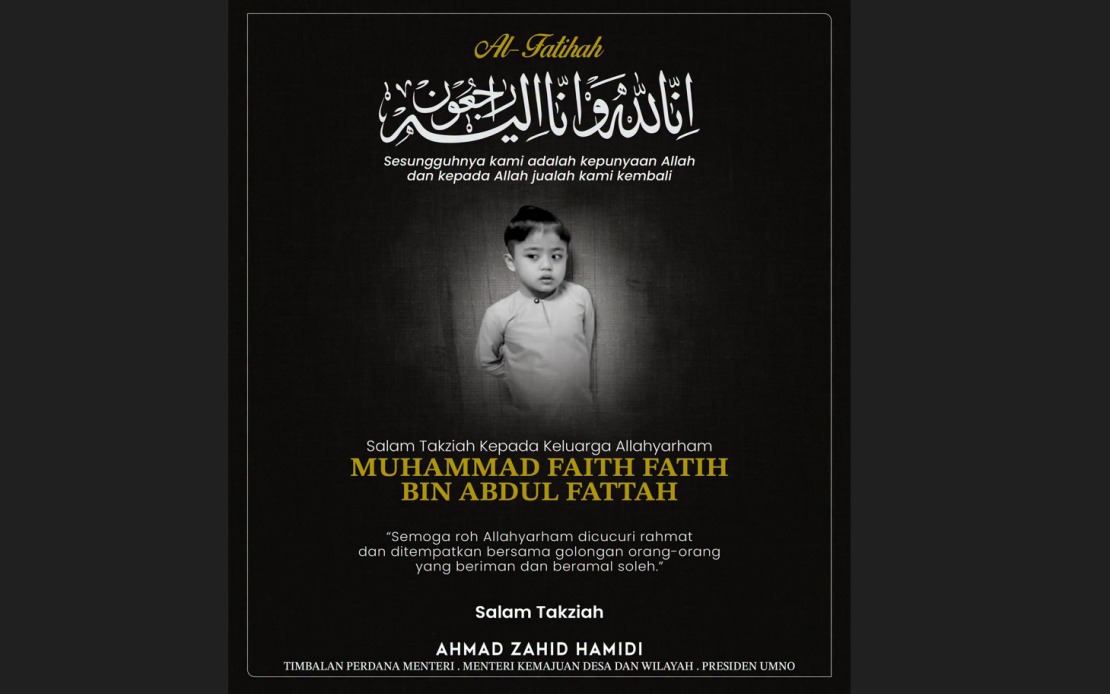
Deputy Prime Minister Datuk Seri Dr Ahmad Zahid Hamidi has offered his sympathies to the family of Muhammad Faith Fatih Abdullah Fattah, a six-year-old boy with autism whose body was found in an oil palm plantation area near Sungai Sumun in Hutan Melintang, Perak, on the evening of June 30. The discovery marked the tragic conclusion to a search and rescue operation that began after the child went missing from his home.
Through a social media statement released on July 1, Ahmad Zahid, who represents Bagan Datuk as its Member of Parliament, described the incident as deeply distressing, particularly given that the victim was a young child with special needs. His remarks reflected the profound emotional toll such incidents inflict on families and communities, underscoring the vulnerability of children with autism who require heightened supervision and care. The Deputy PM's public acknowledgement of the tragedy served to bring national attention to the incident and recognised the family's loss during their time of grief.
In his message, Ahmad Zahid conveyed deepest sympathies specifically to the parents, acknowledging that the loss of a child represents one of life's most severe trials for any mother and father. His statement emphasised the unique difficulty of losing a beloved son or daughter, a sentiment that resonates across cultures and communities. The Deputy PM's choice to highlight the parental dimension of the tragedy underscored the personal dimension of the loss beyond the broader community impact.
The search operation that led to the discovery unfolded on the evening of June 30, when police initiated a coordinated rescue effort following the initial missing persons report. According to Bagan Datuk police chief Supt Mohammad Ali Mohd Jali, authorities received notification of the disappearance at approximately 4.54 pm, with information indicating that the child had last been seen in the living room of his family home. This timeline suggests a relatively short window between when the child was last observed and when the alarm was raised, indicating prompt parental response to the situation.
The discovery of the child's body occurred at 10.08 pm the same evening, when search and rescue personnel located him in a drain situated within the oil palm plantation area. The presence of the drain within agricultural land suggests potential hazards in the vicinity of residential areas in rural Perak, raising questions about environmental safety and the accessibility of such dangerous locations to young children. The setting of the tragedy in an oil palm plantation area highlights the intersection of agricultural activity and residential zones in certain parts of Malaysia, where industrial land use exists in proximity to family homes.
Ahmad Zahid concluded his statement with a prayer for the family, requesting that those in the community offer recitations of Al-Fatihah, the opening chapter of the Quran, as an expression of sympathy and spiritual support. His invocation of Islamic prayer customs reflected the predominantly Muslim context of Malaysian society and provided a framework through which the community could participate collectively in mourning the child's passing. This spiritual dimension of his statement addressed both the immediate family's needs and the broader community's desire to express condolences in culturally appropriate ways.
The incident draws attention to persistent challenges surrounding child safety in Malaysia, particularly for children with autism and other developmental disabilities who may face additional vulnerabilities. Children with autism often experience difficulties with communication, spatial awareness, and response to danger, factors that can place them at heightened risk in environments with potential hazards such as drainage systems or agricultural areas. The incident underscores the importance of enhanced supervision, community awareness, and environmental modifications to protect vulnerable children.
The loss also raises broader considerations regarding rural safety infrastructure and the need for greater attention to potential dangers in mixed residential-agricultural areas. Drainage systems, water bodies, and other features of plantation landscapes present significant risks to young children who may wander from home, particularly those with conditions affecting risk perception and impulse control. The incident may prompt local authorities and community leaders to examine safety protocols and hazard mitigation in areas where families with children reside near industrial agricultural operations.
For the autism community in Malaysia and Southeast Asia more broadly, such tragedies underscore the ongoing need for support services, respite care, and community resources dedicated to assisting families raising children with special needs. The visible show of sympathy from high-level government officials like Ahmad Zahid helps elevate public consciousness regarding the challenges faced by such families and may contribute to stronger advocacy for enhanced support systems. These moments of national mourning often serve as catalysts for broader policy discussions around child protection, disability services, and community safety infrastructure.

