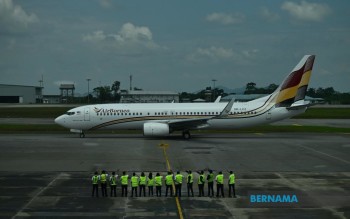
Deputy Prime Minister Datuk Seri Fadillah Yusof formally received Sarawak's newly-minted commercial airline at Kuala Lumpur International Airport's Terminal 1 today, marking a symbolic moment in the East Malaysian state's long-running effort to establish indigenous air connectivity. Flight MY5005 from Kuching touched down with an impressive roster of dignitaries, including Sarawak Premier Tan Sri Abang Johari Tun Openg, state ministers, and senior federal government representatives, underscoring the political weight attached to AirBorneo Airways' transition from regional feeder operator to mainline carrier status.
The ceremony reflects a broader strategic initiative within Sarawak's leadership to wrest greater control over air transport infrastructure and reduce the state's dependence on national carriers for domestic connectivity. AirBorneo, wholly owned by the Sarawak state government, had previously operated as a smaller regional player, but the acquisition of two wet-leased Boeing 737-800 aircraft represents a decisive leap into commercial jet operations. This expansion signals confidence in the airline's ability to compete on major intercity routes and positions it as a credible alternative to incumbent operators on the lucrative Kuching-Kuala Lumpur corridor.
Chairman Datuk Amar Mohamad Abu Bakar Marzuki, who also serves as Sarawak's state secretary, articulated the strategic rationale for the airline's expansion, framing aviation capacity as fundamental to the state's economic development strategy. His remarks about strengthening connectivity and supporting long-term economic aspirations reflect a recognition that reliable air links are essential infrastructure for a state with significant geographic spread and limited ground transportation networks. For Sarawak, aviation represents far more than passenger convenience—it functions as an economic connector linking resource-rich interior regions to Malaysia's commercial hubs and global markets.
The timing of AirBorneo's commercial launch carries additional significance given regional airline competition and the evolving Southeast Asian aviation landscape. With major carriers reassessing networks and capacity following pandemic disruptions, a well-capitalized state-backed airline entering the market enjoys distinct advantages. Sarawak's decision to invest in its own carrier also reflects lessons from neighbouring jurisdictions and a desire to capture economic value that would otherwise flow to Kuala Lumpur-based operators. The strategy parallels moves by other regional governments to establish aviation champions as tools for economic development and political autonomy.
From July 21, 2026, AirBorneo will deploy daily double services on the Kuching-Kuala Lumpur route, positioning itself to capture meaningful market share from this high-traffic corridor. Introductory fares of RM375 for Economy Class and RM736 for Business Class represent competitive pricing designed to attract passengers away from established competitors. These price points suggest AirBorneo has calculated its cost structure carefully and is willing to engage in pricing competition to establish market presence, though the sustainability of such fares will depend on achieving high load factors and operational efficiency.
The airline's immediate expansion roadmap targets Singapore as its first international destination, a logical choice given that city's role as Southeast Asia's aviation hub and the established business and leisure travel demand from Sarawak. This sequencing—establishing domestic dominance before venturing internationally—reflects prudent operational strategy for a newly-commercialized carrier. Singapore also offers valuable access to connecting traffic and positions AirBorneo within regional networks that could eventually extend to other international markets.
Federal government representation at today's ceremony, including Tourism Minister Datuk Seri Tiong King Sing, Women, Family and Community Development Minister Datuk Seri Nancy Shukri, and Deputy Transport Minister Datuk Hasbi Habibollah, signals Putrajaya's support for the initiative despite potential competitive implications for Malaysia Airlines or other national carriers. This backing likely reflects broader federal strategies to encourage economic development in East Malaysia and the recognition that regional aviation competition ultimately benefits consumers and regional connectivity.
The broader implications for Malaysia's aviation sector warrant careful monitoring. AirBorneo's entry into the commercial mainline market introduces competitive pressure that could reshape route economics and pricing on several key domestic corridors. However, the airline's state ownership and clear development mandate distinguish it from purely commercial operators driven solely by profit maximization. This hybrid model—combining commercial discipline with government backing—increasingly characterizes aviation in the region, as demonstrated by carriers in Indonesia, Thailand, and the Philippines.
For Malaysian travellers, particularly those with regular business and leisure traffic between Sarawak and the peninsula, AirBorneo's launch offers genuine benefits through increased frequency and competitive pricing. The double-daily service will ease scheduling constraints that previously forced some passengers toward inconvenient flight times or ground alternatives. Load distribution across multiple carriers also potentially improves reliability and reduces the risk that capacity constraints on any single operator disrupt travel patterns.
The sustainability of AirBorneo's commercial operations will ultimately depend on several interconnected factors: maintaining rigorous safety and service standards, achieving high aircraft utilization rates, managing fuel and staffing costs effectively, and gradually expanding the network in ways that drive organic growth rather than relying indefinitely on subsidized pricing. The airline's stated commitment to delivering safe, reliable, and high-quality service provides the essential foundation, though competitive market pressures will test management's ability to balance service aspirations with commercial viability.
Sarawak's investment in AirBorneo also reflects confidence in sustained travel demand within Malaysia and the region. The state's economy, underpinned by oil and gas production, forestry, and increasingly tourism and technology sectors, generates sufficient business travel to support competitive airline operations. As East Malaysian tourism develops and international connectivity improves, AirBorneo could position itself as a preferred carrier for both domestic connections and eventual regional expansion, provided it executes competently during this critical early phase of commercial operations.

