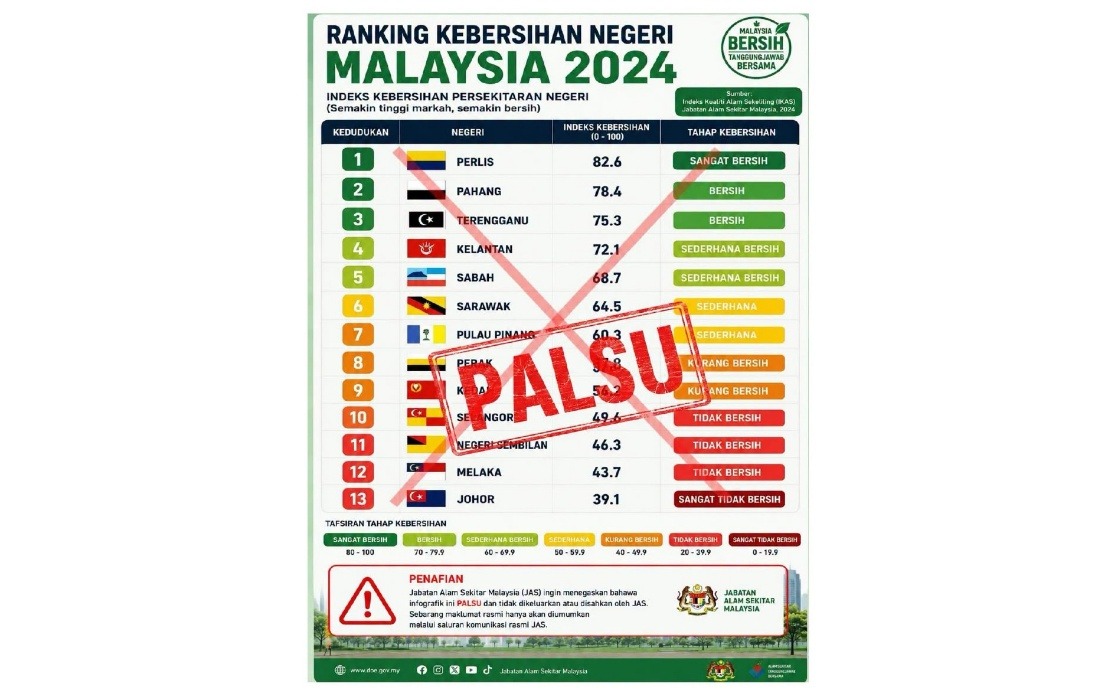
The Department of Environment (DOE) has issued a categorical denial regarding a cleanliness ranking infographic circulating extensively across social media and messaging platforms in Malaysia. The graphic, titled "Ranking Kebersihan Negeri Malaysia 2024", has gained significant traction online, but the DOE confirmed it holds no connection to the document whatsoever. In a statement issued from its headquarters in Putrajaya on July 7, the department clarified that it never released, published, or verified the controversial ranking.
The rapid spread of the infographic highlights a growing challenge facing government agencies in Malaysia: the difficulty of controlling misinformation in an age where digital content moves faster than official corrections. The viral nature of the document suggests it resonated with public interest in environmental conditions across states, yet its unverified origins represent exactly the kind of threat authorities increasingly warn against. The DOE's response underscores the institutional anxiety surrounding false attribution, particularly when government logos or implied official endorsement lend credibility to claims that lack substantiation.
According to the department's official statement, no media release, formal report, or documented response regarding any state-level cleanliness ranking has ever emanated from DOE channels. This distinction matters considerably, as the infographic's circulation likely benefited from assumptions that it represented official government assessment. The department emphasised that members of the public bear responsibility for verifying information before accepting or sharing it, suggesting a shift in how authorities expect citizens to engage with claims originating from unconfirmed sources. This cautionary approach reflects broader concerns about digital literacy and the spread of misleading content in Malaysian society.
The DOE expressed particular concern about the reputational and institutional damage caused when unverified environmental data circulates unchecked. Environmental management and conservation efforts depend substantially on public trust in official data and institutional credibility. When spurious rankings masquerade as authoritative assessments, they potentially undermine confidence in genuine environmental reports and policy communications issued by the department. The stakes extend beyond mere embarrassment; false environmental claims can distort public understanding of actual conditions and divert attention from legitimate conservation priorities.
To prevent future confusion and establish clear boundaries around its official communications, the DOE has reiterated that all legitimate statements, reports, statistics, infographics, announcements and data will be distributed exclusively through its official portal and recognised government communication channels. This centralised approach aims to create a single, verifiable source that the public can trust. By restricting official information to these authorised platforms, the department seeks to establish an authentication mechanism that helps citizens distinguish between genuine government output and fraudulent materials bearing departmental branding.
The department has signalled its intention to take legal action against any parties found misusing its name, logo, or corporate identity in connection with misleading information. This enforcement stance reflects a hardening of institutional boundaries around state agency branding and the growing legal recognition that false attribution to government bodies constitutes a distinct category of harm. Malaysian authorities increasingly understand that allowing such misuse to proceed unchecked sets dangerous precedents and invites further imitation by bad actors seeking to lend false authority to their claims.
For Malaysian environmental observers and policy advocates, the incident underscores an important reality: state-level cleanliness rankings, while potentially useful metrics, do not currently form part of the DOE's official monitoring and reporting framework. Any genuine comparative assessment of environmental conditions across Malaysian states would require substantial methodological rigour, consistent measurement standards, and transparent documentation. The emergence of a viral ranking without these elements should have prompted immediate scepticism, particularly given that such a significant environmental assessment would logically receive prominent coverage in official channels.
The broader implications for Malaysian governance extend beyond this single incident. As digital platforms amplify the speed and reach of unverified information, government agencies face mounting pressure to maintain information authority and public trust. Citizens increasingly encounter conflicting claims about official policy, environmental conditions, public health matters, and regulatory positions. The DOE's response exemplifies how agencies must now operate simultaneously on multiple fronts: managing genuine information provision, correcting misinformation, educating the public about verification, and maintaining legal defences against misattribution.
Regional observers may note that similar dynamics play out across Southeast Asia, where rapid digital penetration has outpaced institutional capacity for information management. Malaysia's experience with the cleanliness ranking infographic reflects patterns seen elsewhere in the region, where official branding and government logos provide powerful social currency that bad actors exploit. The challenge of distinguishing authoritative information from plausible imitations has become a defining feature of contemporary governance throughout the region, requiring sophisticated public communication strategies and heightened public awareness.

