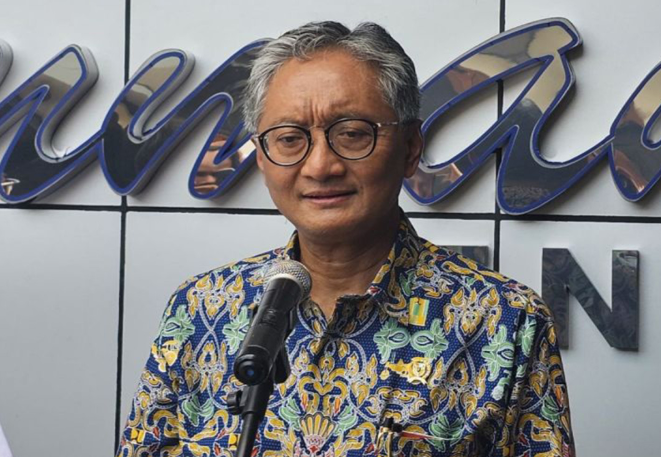
Indonesia's Public Works Ministry is gripped by mounting internal friction following the leak of a confidential travel document that exposed plans to include Minister Dody Hanggodo's wife and daughter on an official delegation to New York in July. The revelation has sparked allegations of improper use of government facilities and prompted what ministry insiders allege are retaliatory personnel reassignments, raising fresh questions about governance and accountability within one of the nation's largest infrastructure bodies.
The controversy began when a memo bearing the signature of the ministry's secretary-general Apri Artoto, dated June 29, circulated across social media platforms early in the month. The document outlined preparations for eight delegates to travel to New York from July 13 to 19 to participate in a United Nations-organised meeting scheduled for July 16 and 17. Notably, the delegation roster included not only ministry staff but also Irma Hermawati, identified as the minister's wife, and Aurellia Tsabitha Meidirama, his daughter. The inclusion of family members prompted immediate public backlash, with critics questioning the propriety of their participation and whether state resources would effectively subsidise their travel.
The ministry subsequently cancelled the trip altogether, apparently in response to the mounting criticism. However, the damage to institutional trust proved difficult to contain. Within days of the document going viral, social media users began circulating claims that Dody had orchestrated a series of personnel transfers targeting officials posted to regional locations, predominantly outside Java, as punishment for whoever had leaked the sensitive material. These allegations suggested a troubling pattern: that those perceived as disloyal or threatening to the minister's authority were being exiled to less desirable postings in the archipelago's more remote regions.
When questioned by journalists on Wednesday, Dody neither fully acknowledged the retaliatory motivation nor entirely refuted it. Instead, he adopted a defensive posture that underscored his authority over staffing decisions. "I have 38,600 employees, why shouldn't I be allowed to reassign them?" he said in remarks reported by Kompas.com. The statement appeared designed to normalize the transfers while avoiding direct engagement with allegations that they constituted retaliation. This rhetorical manoeuvre did little to quell speculation among observers that the reassignments served as a warning to ministry personnel about the consequences of disloyalty.
Apri mounted a separate defence of the arrangement during a press briefing on July 7. He contended that including the minister's family members on the diplomatic paperwork was necessary to facilitate their visa applications through the Foreign Ministry's standard processes. He further assured the public that state funds would not actually finance their participation, though this explanation failed to address the optics of their names appearing on an official government delegation at all. Apri pledged to investigate the source of the leak and threatened potential legal consequences for any official proven responsible, characterising the disclosure as a breach of confidentiality.
The staffing upheaval illuminates a broader pattern of organisational turbulence since Dody assumed the ministerial post in October 2024. The 60-year-old politician, who trained as an engineer and maintains business connections to South Kalimantan entrepreneur Andi "Haji Isam" Syamsuddin Arsyad, has presided over successive waves of personnel restructuring that have reshaped the ministry's hierarchy. Social media posts have documented more than 100 reassignments during his tenure alone, ranging from senior director generals to entry-level civil servants. Most recently, in May, Dody promoted seven high-ranking officials to new positions, including elevating Apri to secretary-general, displacing his predecessor Wida Nurfaida, who had occupied the role for less than a year following another major reorganisation in July 2025.
This relentless cycle of reshuffles has generated considerable unease among parliamentarians responsible for oversight. During a June meeting of the House of Representatives Commission V, which monitors infrastructure matters, lawmaker Yasto Soepredjo Mokoagow of the Indonesian Democratic Party of Struggle raised alarm about the human cost of these disciplinary measures. The practise of demoting ministry directors to non-structural positions, he warned, had created a climate of fear among civil servants that threatened to paralyse programme implementation. "Civil servants at the ministry are now afraid to carry out programs," Mokoagow stated on June 11, articulating concerns that operational efficiency was deteriorating as employees became increasingly risk-averse.
Dody has justified his aggressive restructuring as a necessary response to what he characterises as a "deep state" phenomenon embedded within the ministry's bureaucracy. Drawing an analogy to destructive insects, he has described these alleged entrenched interests as termites systematically weakening institutional capacity. This framing suggests the minister views his personnel moves not as punitive but as corrective measures essential to restoring organisational health. However, critics contend that his approach, whether well-intentioned or not, has created a climate of insecurity that may ultimately undermine the very institutional effectiveness he claims to be pursuing.
Complicated matters further, several senior ministry officials have become ensnared in a significant corruption investigation relating to water resources projects. In June, the Jakarta High Prosecutor's Office identified suspects in the case, including former water resources director general Dwi Purwantoro and former acting irrigation and swamp director Yosiandi Radi Wicaksono. Dody publicly pledged his commitment to supporting law enforcement action against potentially culpable subordinates, signalling that he would not shield anyone engaged in wrongdoing. This declaration, while outwardly principled, also raises questions about whether the corruption investigation may have motivated or justified some of his more aggressive personnel decisions.
Adding to the reputational damage, video footage documenting Dody's interactions with subordinates has surfaced on social media platforms in recent weeks. One particularly striking clip recorded during an April inspection of a school construction site in East Java captured the minister publicly berating an employee, directing pointed criticism at the staff member for making what he dismissed as "dumb excuses." The video's circulation amplified perceptions that a toxic management style, characterised by harsh public criticism and visible anger, has infected the ministry's operational culture. Such imagery, disseminated widely across digital platforms, shapes public and internal perceptions of institutional leadership and may further erode morale within an already embattled organisation.
For Malaysia and other Southeast Asian nations, Indonesia's Public Works Ministry turmoil carries implications for regional infrastructure cooperation. Cross-border projects, development initiatives, and technical exchanges depend upon stable institutional relationships and coherent policy frameworks. The current instability—marked by leadership anxiety, personnel insecurity, and corruption investigations—could complicate bilateral and multilateral infrastructure partnerships. Malaysian policymakers and business interests engaged with Indonesian counterparts on engineering and infrastructure matters would be wise to monitor how these internal dynamics resolve, as institutional dysfunction in Jakarta can ripple across the region's developing economies and delay joint initiatives that serve mutual interests.

