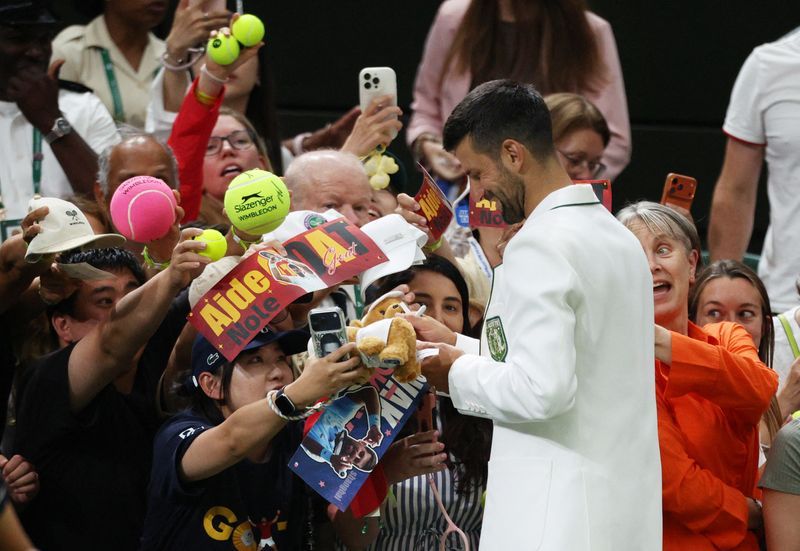
Novak Djokovic's crushing display at Wimbledon on Wednesday extended well beyond his clinical 6-3 6-4 6-2 dismantling of Stefanos Tsitsipas. The 24-time Grand Slam champion, evidently at ease against his Greek opponent, indulged in the kind of courtside mischief that emerges only when victory is already assured, offering glimpses of the personality that makes professional tennis compelling beyond the baseline exchanges.
During a routine equipment adjustment, Djokovic seized the opportunity to prank an unsuspecting ball girl tasked with trimming black tape from his right shoulder. As she carefully positioned scissors near his body following his instructions, the world number one suddenly cried out in pain, prompting an immediate and visibly panicked reaction from the young attendant. The girl recoiled sharply, clutching her chest in apparent horror at the prospect of having just injured one of tennis's greatest players in front of millions of viewers. The moment stretched just long enough to register genuine concern before Djokovic dissolved into laughter, leaving his inadvertent victim to recover from the shock and join in the amusement at having been successfully fooled.
The incident revealed something often obscured during matches of such consequence: the confidence and psychological comfort of a player operating at peak performance. Djokovic later reflected on the prank with characteristic self-awareness, acknowledging that such levity surfaces precisely when players have already commandeered control of a contest. "These kinds of things surface when you are two sets to love up rather than two sets to love down," he explained during his on-court interview, before offering a brief apology to his target. "I'm sorry if I scared her... it made me a bit more relaxed on the court. I was just having some fun," he added, suggesting that moments of theatrical playfulness can paradoxically enhance rather than detract from competitive performance.
The comprehensive nature of Djokovic's victory over Tsitsipas—dropping just six games across three sets—established the tone for the extended good humour that followed. Having thoroughly outplayed his opponent, the Serbian champion found himself in the unusual position of being able to enjoy the theatre of the moment rather than remaining locked in the grinding intensity that often characterises Grand Slam competition. For Malaysian and Southeast Asian tennis enthusiasts, such displays underscore how dominance at the highest level affords players the luxury of personality, something often sacrificed in tighter contests where every psychological edge matters.
The exchange with Northern Irish golfer Rory McIlroy, seated prominently in Centre Court's Royal Box, extended Djokovic's playfulness into unexpected cross-sport territory. Spotting McIlroy's distinctive green jacket—awarded to Masters champions—Djokovic could not resist commenting on the garment. Dressed in his own personalised cream blazer that has become a fixture of his Wimbledon presentation this year, Djokovic gestured toward McIlroy's prize jacket with the kind of mock covetousness that drew immediate appreciation from the crowd.
"Rory, what a beautiful jacket," he opened, before asking directly whether it was indeed the Masters jacket. When McIlroy confirmed with a nod, Djokovic escalated his pitch into a playful wager. "I want that jacket. I'll play you. This jacket for that jacket, we play tennis, no golf," he proposed, tugging at his own cream blazer while the audience roared approval at his audacity. The proposition, entirely tongue-in-cheek yet delivered with the confidence of someone who had just demolished a top-10 opponent, exemplified how sport's greatest competitors often display the ease to blur between genuine competition and theatrical entertainment.
For regional observers, the exchange underscores a notable dimension of professional sport at its apex: the intersection of serious achievement with personality and humour. Djokovic's interaction with McIlroy transcended the typical athlete interview format, instead creating a moment of spontaneous entertainment that transcended tennis itself. That a champion of Djokovic's stature—one preoccupied with matching or surpassing Roger Federer and Rafael Nadal's Grand Slam records—retains the psychological space to engage in such banter speaks to a particular kind of competitive maturity.
The prank and subsequent courtside theatre occur within the context of an increasingly demanding calendar for elite tennis players. The psychological and physical toll of competing at Grand Slam level typically leaves little room for levity, making Djokovic's apparent comfort all the more notable. His willingness to inject personality into these moments—whether through pranks on ball staff or cross-sport banter—provides oxygen to the sport at moments when it risks becoming overly serious or mechanical.
McIlroy's presence at Wimbledon itself reflects the broader ecosystem of elite sport, where competitors across different disciplines follow one another's performances with genuine interest. The golfer's appearance in the Royal Box underscores how major sporting events in London draw figures from across the sporting world, creating these moments of unexpected intersection between different competitive spheres. For Malaysian fans navigating an increasingly crowded sporting calendar, such instances remind us that sport's greatest moments often transcend individual competitions or disciplines.
The broader significance of Djokovic's performance extends beyond the particular match or the entertaining asides. His continued dominance at Wimbledon—now advancing further through the tournament—contributes to an ongoing narrative about his legacy and place within tennis history. Every convincing victory brings him mathematically closer to the Grand Slam records held by Federer and Nadal, records that have defined much of the contemporary sport's conversation. Yet moments like those on Wednesday suggest that Djokovic's impact on tennis transcends mere statistics or tournament victories.
The juxtaposition of Djokovic's clinical tennis excellence with his courtside personality reveals the multi-dimensional nature of sporting greatness. While his serve placement and court positioning secured the victory, his ability to engage authentically with the theatre of the moment—pranking a ball girl, bantering with a fellow champion—adds texture to his legacy. For regions like Malaysia with growing interest in professional tennis, such displays demonstrate why Djokovic's appeal extends beyond technical mastery to encompass the complete presentation of elite sport.

