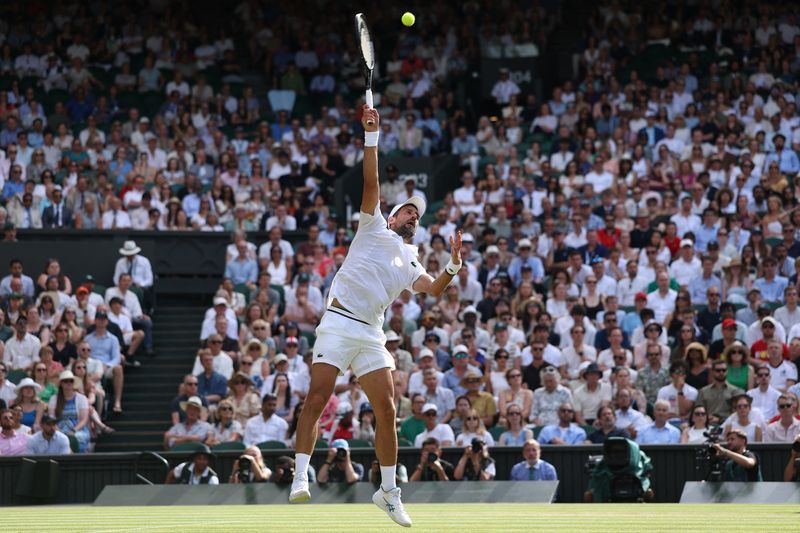
Novak Djokovic has cemented his place among tennis's greatest grass court competitors by claiming a historic 106th victory at Wimbledon, a milestone that now stands him above Roger Federer in the all-time record for match wins at the All England Club. The seventh-seeded Serb battled past Russian qualifier Roman Safiullin with a 7-6(6) 6-3 3-6 6-3 scoreline on Centre Court, demonstrating the resilience that has defined his career even as the tennis landscape continues to evolve around him.
At 39 years old, Djokovic remains very much in contention for glory at one of tennis's most storied venues, with his sights trained on both immediate and historical objectives. Beyond the symbolic significance of surpassing Federer's Wimbledon match record, Djokovic is pursuing an eighth title at the championship, which would equal the Swiss legend's unmatched haul. His broader ambition of capturing a 25th Grand Slam trophy continues to motivate his efforts, and his passage through the opening week suggests he possesses the game necessary to mount a serious challenge in the tournament's latter stages.
The path to victory against Safiullin proved considerably more arduous than seedings might have suggested. The Russian, ranked 132nd in the world but returning from several months sidelined by a hip injury, exhibited the kind of aggressive baseline game that has proven troublesome for many of Djokovic's contemporaries. Playing into swirling wind conditions on southwest London's famous lawns, Safiullin forced the Serbian to navigate difficult circumstances, compelling him to abandon his customary rhythm and adopt a more varied tactical approach.
Djokovic's uncharacteristic lapses in the opening set underscored just how much Safiullin had unsettled him. Twice surrendering his service games through mistakes that rarely define his play at this level, Djokovic found himself facing two set points whilst trailing 2-5. The ability to recover from such precarious positions—converting the tiebreak despite this deficit—highlighted the championship experience and mental fortitude that separates Djokovic from the field. These are precisely the qualities that have underpinned his dominance across three decades of elite tennis.
Having seized the first set through the tiebreak, Djokovic appeared poised to impose his superiority in the second set, and for a stretch he did precisely that. When Safiullin crumbled at 2-4 down with an ill-judged backhand, the momentum seemed decidedly in the Serbian's favour. Capitalising on this opening, Djokovic unleashed a sequence of serve-and-volley combinations that demonstrated the offensive weaponry he continues to maintain, briefly suggesting he would cruise toward victory. Yet the narrative shifted again when Safiullin broke serve to claim the third set, extending the encounter and testing Djokovic's patience.
The fourth set proved decisive, as Djokovic elevated his intensity and precision when it mattered most. After holding serve under pressure to open the final set, he lifted the quality of his play substantially, accelerating through the court with newfound conviction and ultimately closing out the match. His subsequent comments reflected a pragmatic assessment of his first-week performance: acknowledging that he had not felt entirely comfortable from the baseline against many opponents throughout his career, he credited his ability to adapt tactically and, crucially, his accuracy on first serves in extracting him from danger.
This victory capped a tumultuous opening week at Wimbledon during which Djokovic has surrendered sets in three of his four matches, a pattern that might ordinarily concern observers tracking his tournament trajectory. However, Djokovic's framing of these narrow escapes as evidence of a "survive to thrive" mentality deserves serious consideration. In Grand Slam tournaments, the ability to progress whilst playing less than one's best often presages stronger performances as the competition intensifies and fatigue becomes a factor for opponents. Several of Djokovic's greatest Wimbledon campaigns have followed similar scripts, with tentative early displays giving way to commanding tennis as the tournament advanced.
Looking ahead, Djokovic will face either third seed Felix Auger-Aliassime or Spain's Alejandro Davidovich Fokina in the quarter-finals, both opponents against whom he possesses substantial experience and advantage. The Auger-Aliassime pairing carries particular significance given the Canadian's recent trajectory on grass, whilst a meeting with Davidovich Fokina would pit Djokovic against a player whose claycourt prowess has not fully translated to the quicker surface. Either opponent would present a test, but neither ranks among the true challengers who might genuinely threaten Djokovic's continued march toward that elusive eighth Wimbledon crown.
The broader context of Djokovic's Wimbledon record underscores his singular dominance on grass over nearly two decades. His 106 match victories at the venue dwarf those of most competitors, and the fact that he has now surpassed even Federer's extraordinary tally speaks to the consistency he has maintained despite the passage of time. As South and Southeast Asian audiences have increasingly embraced tennis through the exploits of homegrown talent and the sport's global expansion, Djokovic's pursuit of historical records provides a compelling narrative thread. His quest for an eighth Wimbledon title and a 25th Grand Slam trophy represents the twilight of an exceptional career, and the All England Club remains the stage where his legacy is most firmly written.
For Malaysian and regional spectators invested in tennis, Djokovic's continued prominence at 39 years old carries particular significance as evidence that professional longevity at the highest levels remains achievable through meticulous conditioning, tactical flexibility, and mental resilience. The Serbian's ability to navigate younger, hungry challengers whilst managing the physical demands of elite competition offers a template that transcends sport, resonating with audiences across age groups and skill levels throughout Southeast Asia.

