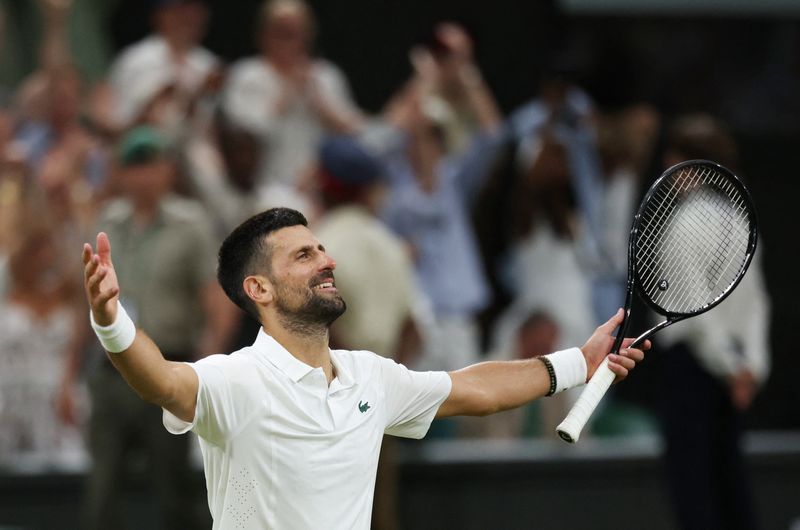
Novak Djokovic extended his remarkable Wimbledon run by advancing to the semi-finals for the eighth successive year, dismantling Canadian Felix Auger-Aliassime in an extraordinarily demanding contest that stretched across five hours and 15 minutes on Tuesday evening. The Serbian champion claimed the match 7-6(10) 3-6 6-3 6-7(4) 7-6(10-4), prevailing in a quarter-final that now stands as the longest in Wimbledon history. His opponent, Auger-Aliassime, proved to be a formidable adversary who pushed Djokovic to his absolute limits, forcing the 39-year-old to dig deep into his reservoir of experience and mental fortitude.
The victory carries profound significance for Djokovic's legacy at the All England Club. He has now recorded 106 match wins at Wimbledon across his career, surpassing the record previously held by Roger Federer. Beyond this statistical milestone, Djokovic became the first man in tennis history to reach the semi-finals of the same Grand Slam tournament eight times consecutively, further cementing his status as a singular force in the sport. These achievements underscore not merely his extraordinary longevity, but his capacity to maintain championship-level performance across nearly two decades of professional tennis.
Reflecting on the intensity of the encounter, Djokovic acknowledged the gruelling nature of the battle. "I won with a racket and a lot of heart," he remarked in his post-match comments, drawing attention to the psychological and emotional dimensions of such demanding competitions. He elaborated on the management of nerves and the psychological tension that accumulates when matches remain evenly balanced over extended periods. The scoreline remained remarkably level throughout the contest, with neither player establishing clear dominance. When the match ultimately reached a super tiebreak in the fifth set, the outcome remained genuinely uncertain, representing a test not only of physical endurance but of mental composure under extreme pressure.
The opening set encapsulated the quality and competitiveness of the clash. Djokovic found himself in a lengthy tiebreak that stretched to ten points, during which Auger-Aliassime squandered opportunities to close out the set decisively. The Canadian's volley sailed long, gifting Djokovic the set in a moment that could easily have swung the match in a different direction. The momentum subsequently shifted, with Auger-Aliassime breaking Djokovic's serve to build a 5-3 advantage in the second set. The Canadian consolidated this advantage by holding serve in the following game, drawing level in the match. It was at this juncture that the Centre Court roof was closed due to the late hour, with the contest continuing under artificial conditions from approximately 7.40 p.m. local time.
The roof closure prompted visible frustration from Djokovic, who expressed his displeasure with the decision. However, his capacity to compartmentalise emotion and refocus on the task at hand became evident as the third set commenced. Playing with noticeably cleaner stroke production and enhanced court positioning, Djokovic finally broke through Auger-Aliassime's formidable defensive wall in the sixth game of the set. Having seized this crucial break, he progressively tightened his control over the match, consolidating the set and appearing to gain meaningful momentum heading into the fourth set.
Auger-Aliassime, demonstrating the resilience that has characterised his career progression, refused to capitulate. He lost his service game at the outset of the fourth set, a development that appeared to signal Djokovic's imminent victory. Yet the Canadian mounted a determined response, his frustrations boiling over momentarily when he struck his chair with his racket—a release of the accumulated tension of the protracted struggle. Despite this momentary lapse, Auger-Aliassime regrouped and fought his way back into contention, ultimately forcing a fourth-set tiebreak which he captured, preserving his hopes by pushing the match into a decisive fifth set.
The fifth set evolved into a test of pure endurance and mental resilience. The two competitors remained inseparable through twelve games, with neither player able to manufacture the decisive break that would conclude the marathon encounter. The tension and uncertainty persisted until the inevitable match tiebreak. In this shortened format, Djokovic's accumulated experience and tactical sophistication proved decisive. He navigated the super tiebreak with sufficient composure to overcome Auger-Aliassime's spirited resistance, ultimately prevailing 10-4 in the tiebreak. The Centre Court crowd rose to acknowledge what had been an exceptional display of athletic and mental endurance from both competitors.
Djokovic's advancement sets the stage for a blockbuster semi-final confrontation with Jannik Sinner, the reigning Wimbledon champion and current world number one. This pairing represents a fascinating intersection of Djokovic's pursuit of glory and Sinner's establishment as the contemporary dominant force in men's tennis. Djokovic remains in pursuit of an eighth Wimbledon title to match Roger Federer's record, whilst simultaneously chasing a 25th Grand Slam trophy overall, which would move him beyond Margaret Court's historical benchmark of 24 major championship victories. The semi-final against Sinner will represent a formidable obstacle to realising these ambitious goals.
When addressed about the upcoming challenge, Djokovic deliberately downplayed the magnitude of the occasion, choosing instead to focus on immediate recovery and preparation. He characteristically deferred consideration of records and statistics until the completion of his career. "Right now, it's all business," he declared, emphasising his pragmatic approach to the tournament. He acknowledged the importance of physical recuperation following such an exhausting encounter, yet expressed confidence in his preparation for the semi-final against what he described as the best player in the world. The match against Sinner looms as another critical chapter in their emerging rivalry, with Djokovic attempting to defy his age and extend his Wimbledon odyssey further still.
The epic quarter-final victory carries broader implications for tennis enthusiasts across Southeast Asia and the wider global audience. It demonstrated the capacity of veteran athletes to compete at the highest levels despite chronological age, offering an instructive narrative about dedication, mental toughness, and the refinement of craft over decades. For Malaysian and regional audiences following professional tennis, the contest provided vivid evidence of the qualities that have distinguished Djokovic's career—his refusal to surrender, his tactical flexibility, and his ability to execute under maximum pressure when matches hang in the balance. His progression to the semi-finals and the prospective encounter with Sinner promise further compelling narrative development in the 2024 Wimbledon campaign.

