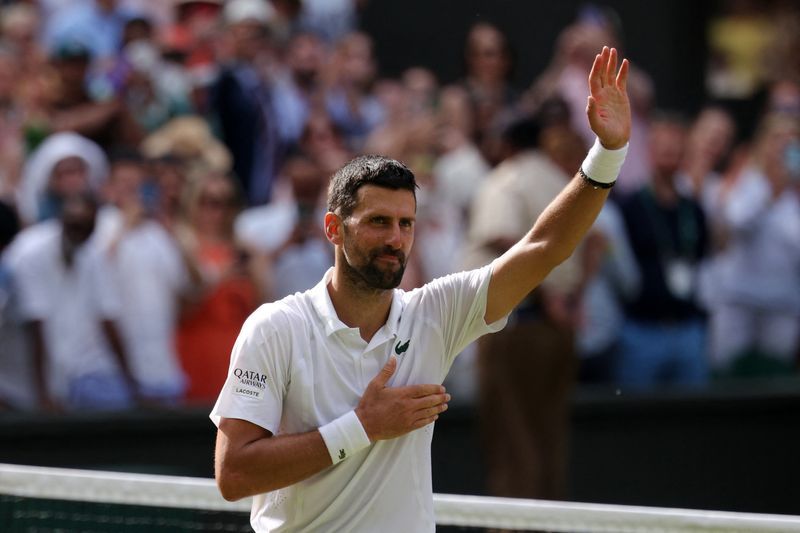
The All England Club enters a critical phase as the Wimbledon quarter-finals commence on Tuesday, featuring two of tennis' most compelling narratives: 24-time Grand Slam champion Novak Djokovic's relentless pursuit of history against Canadian third seed Felix Auger-Aliassime, and Japanese 14th seed Naomi Osaka's unexpected resurgence against Czech 10th seed Karolina Muchova. The day represents a crossroads for both established champions seeking to remind the sport of their championship mettle, yet it also underscores the shifting landscape of professional tennis where age and experience face the hunger of younger contenders.
Djokovic's journey through the early rounds has been characterised by grit rather than grace. His fourth-round victory over qualifier Roman Safiullin extended his Wimbledon record to 106 wins at the historic venue, but the three-and-a-half-hour contest exposed the toll demanded by his longevity. The 39-year-old Serbian has required four sets in each of his last two matches, a pattern that suggests an ageing body compensating through mental fortitude rather than physical dominance. Yet this grind appeals to Djokovic, who views suffering through close matches as essential to championship tennis. His philosophical acceptance of such struggles—neither inviting nor avoiding them—reflects the perspective of a player who has remained relevant across multiple tennis generations by adapting his approach rather than maintaining a single formula.
Auger-Aliassime represents the type of opponent who has previously troubled Djokovic: athletic, powerful, and unencumbered by the weight of expectations that sometimes paralyse challengers. The Canadian duo split their two encounters in 2022, demonstrating that while Djokovic maintains advantages through experience, he cannot simply assume victory against such opponents. Auger-Aliassime's youth—at 25, he sits in a sweet spot where he possesses sufficient experience to compete at the highest level but retains the physical explosiveness of his prime years. His recognition of Djokovic's unparalleled achievements, expressed through genuine admiration rather than intimidation, suggests a mature mindset that may prove dangerous to the Serbian legend.
On the women's side, Osaka has re-emerged as a tangible title contender following an emphatic fourth-round dismissal of world number one Aryna Sabalenka. The Japanese player's dominance over the Australian powerhouse—whose aggressive baseline game had previously victimised Osaka three times this year—signalled a recalibration of form that extends beyond mere athletic performance. Osaka's serve and blistering forehand neutralised Sabalenka's attacking potency, suggesting the 28-year-old has rediscovered technical elements that sustained her Grand Slam dominance during 2018 and 2019. Her mental approach also evolved; by reframing the high-pressure encounter as a practice match before a massive crowd, Osaka employed psychological tactics that younger players might perceive as resignation but which her experience recognises as liberation from paralysing expectations.
The last Grand Slam victory for Osaka came in 2021 at the Australian Open, a gap that contextualises her current run at Wimbledon as potentially significant for her career trajectory. Her fashion statements at the All England Club—receiving particular media attention—represent a parallel narrative of self-expression and confidence that often precedes sustained tennis success. The quarter-final against Muchova presents a different tactical challenge than Sabalenka; the Czech player's all-court capabilities and previous grass-court success against Osaka demand a more nuanced approach than pure baseline dominance.
Muchova arrives at the quarter-finals for a third consecutive appearance at Wimbledon, yet she carries the frustration of having never progressed beyond this stage. Her 2-3 record in grasscourt meetings with Osaka, including a loss at this year's Bad Homburg Open, suggests the Japanese player holds a marginal advantage. However, Muchova's deliberate pre-Wimbledon preparation—disputing the common practice of arriving under-match-ready—indicates tactical awareness and a methodical approach that potentially nullifies Osaka's current momentum. The Czech player's elimination of fellow countryman Barbora Krejcikova, a former Wimbledon champion, demonstrated that she possesses the tactical intelligence to dismantle players of the highest calibre.
Defending champion Jannik Sinner's quarter-final against German qualifier Jan-Lennard Struff underscores the tournament's unpredictability. The Italian four-time major winner has previously dominated Struff across three encounters, suggesting a straightforward path to the semi-finals. Yet Struff's achievement in reaching his first Grand Slam quarter-final at age 36—benefiting from Hubert Hurkacz's hip injury retirement—carries historical weight. As the oldest man in the Open Era to reach a Grand Slam quarter-final for the first time, Struff represents the everyman narrative that resonates across sports; his emotional gratitude and focus on recovery between matches betrays a player acutely aware that such opportunities may not recur.
For Malaysian and Southeast Asian readers, these matches carry broader significance. Djokovic's quest for a 25th Grand Slam extends beyond individual achievement; it represents the twilight of tennis' most dominant era, one that has lasted two decades. Whether younger players like Auger-Aliassime can begin to definitively supersede the Serbian legend—and his contemporaries—remains a question that shapes the sport's future. Simultaneously, Osaka's resurrection resonates particularly across Asia, where her achievements have inspired millions and her struggles with mental health have opened crucial discussions about athletic wellbeing. Her return to form suggests that comeback narratives, often deemed impossible in sports' youth-obsessed culture, remain attainable with proper mental and physical investment.
The quarter-final matches also illuminate the tournament format's current health. Multiple seeded players have departed, while age-defying veterans and resurgent champions share the latter stages alongside breakthrough performers. This competitive balance, though producing fewer predictable narratives, generates the uncertainty that appeals to global audiences and maintains tennis' relevance across demographic segments. The outcomes in these quarter-finals will substantially influence broader perceptions about whether the traditional powers can reassert dominance or whether a generational transition is genuinely underway.

