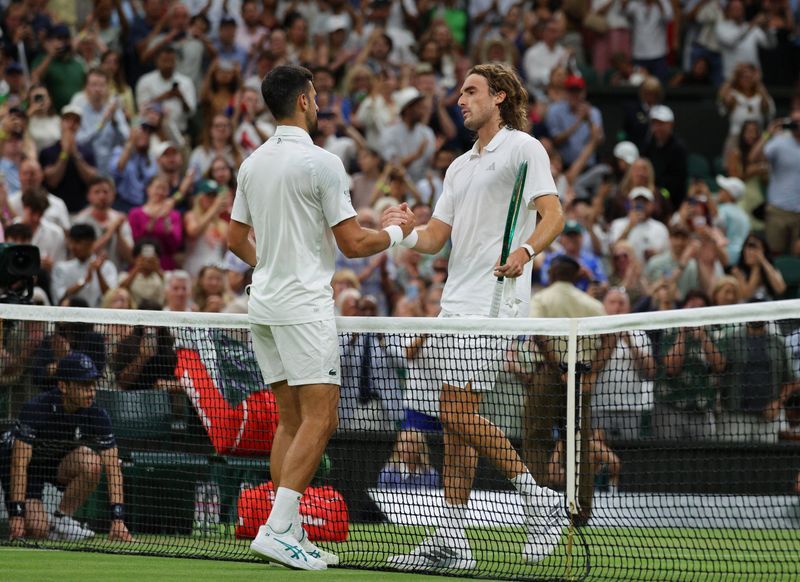
Novak Djokovic's mastery over Stefanos Tsitsipas reached new heights at Wimbledon on Wednesday, as the Serbian champion dispatched his Greek opponent with the ease of a player in complete command of his craft. The 39-year-old secured a 6-3 6-4 6-2 victory on Centre Court, advancing to the third round and maintaining a perfect record against Tsitsipas that now stretches to 12 consecutive wins. The match, billed as a heavyweight collision in the tournament programme, instead became a masterclass in precision and consistency from one of tennis's greatest competitors.
Tsitsipas entered the contest as a player in turmoil, his world ranking plummeting to 87th and his preparation marked by the firing of his coach—his own father, Apostolos—just days before arriving at the grass courts of London. The tumultuous circumstances surrounding his participation were difficult to ignore, given that the 27-year-old had come to Wimbledon seeking redemption after retiring injured from his first-round match at the same tournament last year. His chronic back pain had represented an existential threat to his career, making any return to Grand Slam competition fraught with uncertainty about both his physical readiness and mental fortitude.
Yet Djokovic offered no sympathy, methodically disassembling Tsitsipas's game from the opening moments. The decisive moment came at 4-4 in the second set when Tsitsipas faced a break point. With two overhead opportunities to win the point outright, the Greek player twice failed to convert, his overheads sailing off target in moments that would have dramatically shifted momentum. Djokovic capitalised ruthlessly on that lapse, breaking serve and subsequently winning eight of the final ten games to put the result beyond doubt. It was a pattern that defined the entire encounter: whenever Tsitsipas afforded himself a genuine opportunity to mount pressure, some combination of unforced error and Djokovic's sheer defensive brilliance conspired to snuff out the threat before it developed.
The scoreline itself tells only part of the story of Djokovic's supremacy. What was most striking was the manner in which he controlled play without appearing to extend himself excessively, a hallmark of his greatest performances across the past two decades. At an age when most players would be contemplating retirement or at least a gradual decline in competitive standards, Djokovic continues to operate at a level that renders even talented opponents like Tsitsipas functionally helpless. The 39-year-old's performance raises uncomfortable questions about whether the window for challengers to defeat him at tennis's most prestigious events has effectively closed.
For Tsitsipas, the loss represents a particularly bitter pill to swallow given the circumstances of his arrival at the tournament. The Athens native had reached Grand Slam finals at Roland Garros in 2021 and the Australian Open in 2023, only to fall short against Djokovic on both occasions. These subsequent losses have become an additional psychological burden that will prove difficult to shake. His ranking's descent and the fractious parting with his father as coach suggest that the next phase of his career will require substantial reconstruction, both tactically and emotionally.
Djokovic's victory brings him tantalizingly close to Roger Federer's men's record of 105 match-wins at Wimbledon, a milestone that will likely come within his next match or two at this tournament. The Serbian great's pursuit of an eighth Wimbledon title and a record 25th Grand Slam crown remains firmly on track, with each passing round making those objectives seem increasingly probable. His next opponent will be 25th-seeded Frenchman Arthur Rinderknech, a far less familiar foe than Tsitsipas, though the pattern established on Wednesday suggests Djokovic's path through the draw should remain relatively unobstructed.
Post-match, Djokovic reflected on the privilege of competing at the highest level in his fourth decade. Speaking to the Centre Court crowd, he expressed joy at the quality of his performance while offering characteristically philosophical observations about age and longevity in professional sport. The Serbian wore a cream blazer that would have seemed more appropriate on a much younger player, a sartorial choice that underscored his point about refusing to accept the typical limitations of advancing years. His apparent contentment with his form suggests that for as long as his body cooperates, Djokovic intends to remain a formidable obstacle for any potential challenger.
The match lasted just under two hours, a duration that speaks to the decisiveness with which Djokovic controlled proceedings. There were no lengthy baseline exchanges that might have favoured Tsitsipas's power, no extended rallies in which the younger player might have gradually worn down his opponent. Instead, Djokovic imposed his will through superior court positioning, service consistency, and an almost preternatural ability to be exactly where the ball was headed. For Malaysian and Southeast Asian fans following the tournament, the message was clear: when Djokovic is playing at this level, the path to victory against him requires not merely excellence but near-perfection from his opponent—a standard that Tsitsipas, despite his considerable talents, was simply unable to meet on this particular Wednesday afternoon at the All England Club.

