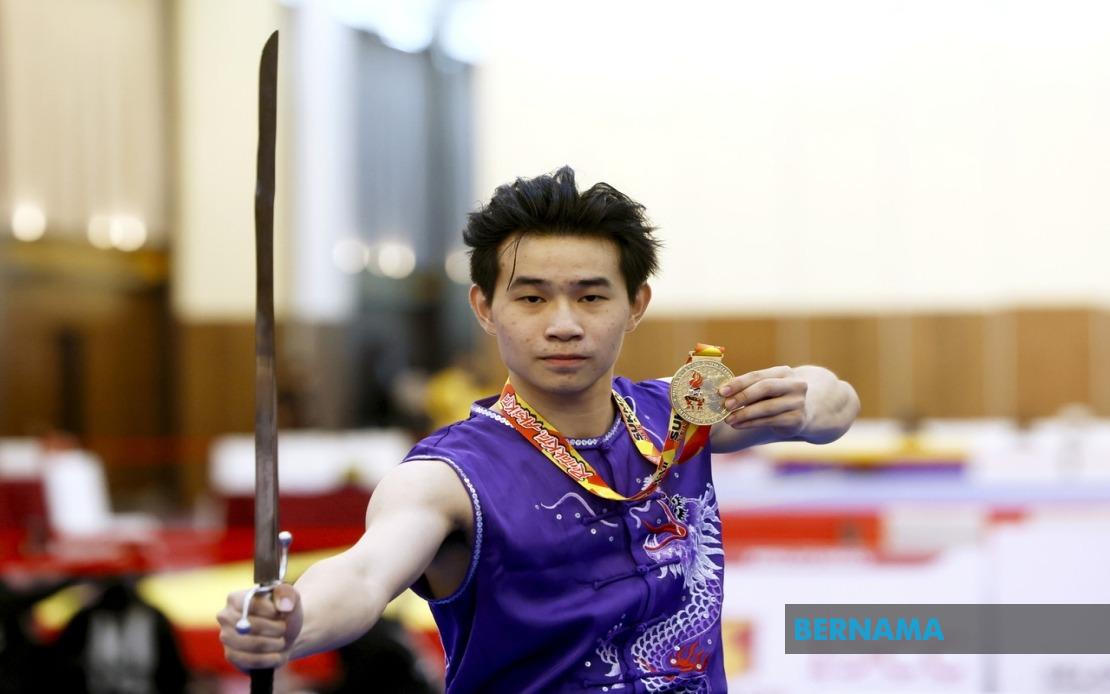
Wee Din Jun's journey to gold at the 2026 Malaysia Games has been anything but straightforward. The 21-year-old Penang wushu competitor claimed victory in the men's nandao nangun competition at the Ideal Convention Centre in Shah Alam on Wednesday, scoring 9.600 points to edge out Sarawak's John Phang, who finished with silver at 9.563 points. Selangor's Tan Yu Zhe rounded out the podium with bronze at 9.550 points. Yet this triumph carries particular significance for an athlete who has endured both physical adversity and the psychological weight of previous SUKMA disappointments.
The path to Din Jun's gold medal victory was complicated by injury just weeks before competition began. A hip injury sustained approximately one month before the Games threatened to derail his participation entirely, raising questions about whether the Bayan Lepas-born competitor could deliver at the level expected of him. Instead of allowing the setback to define his Games experience, Din Jun channelled his recovery into focused preparation, demonstrating the mental resilience required at the elite level of Southeast Asian sport.
This redemption narrative stands in sharp contrast to his previous two SUKMA experiences. At the 2022 edition held in Kuala Lumpur, Din Jun managed to secure bronze across his events, a respectable result that suggested promising potential. However, his return to competition at SUKMA 2024 in Sarawak proved far more challenging. The young athlete struggled significantly, committing multiple technical errors across his three competition events and departing the Games without securing any medal. That disappointment weighed heavily on both his confidence and his reputation within Malaysia's wushu community.
The transformation between 2024 and 2026 reflects not only improved technique but also a fundamental shift in Din Jun's psychological approach to competition. During interviews following his victory, the athlete attributed much of his success to coaching advice focused on emotional regulation and performance clarity. His coach's instruction to remain calm and embrace the moment rather than fixate on outcomes proved instrumental in unlocking the level of execution required to win gold. This philosophy represents a growing recognition within Malaysian sports of the critical importance of mental conditioning alongside physical training.
Beyond the immediate result, Din Jun's achievement carries deeper personal meaning rooted in his dedication to a former mentor. The athlete specifically chose to dedicate his gold medal to a previous coach who has since relocated to China. This coach had been unable to witness Din Jun earn medals during the 2022 and 2024 Games, creating an emotional debt that the young wushu competitor felt compelled to discharge. The gesture underscores the often-overlooked relationships between athletes and coaching staff that shape competitive trajectories across Malaysian sport.
Din Jun's victory in the nandao nangun event marks what he has designated as his final SUKMA appearance, lending particular poignancy to his success at this juncture in his career. Rather than retiring from elite competition following this Games, the athlete is transitioning toward other international platforms where wushu competitors represent Malaysia. The nandao nangun success thus functions as a capstone to his SUKMA legacy, reframing his overall record from one of inconsistency to one ultimately defined by perseverance and redemption.
Looking immediately ahead, Din Jun remains focused on maximizing his final days at SUKMA 2026. The nanquan event scheduled for the following day represents another opportunity to add to his medal tally and cement a stronger overall Games record. Should he succeed in that competition as well, his final SUKMA appearance would transform from a single-medal achievement into a double-gold performance, substantially elevating his standing within Malaysian wushu circles.
The broader context of Din Jun's success reflects ongoing developments in Malaysian wushu's competitive position regionally. While the sport maintains strong participation levels domestically, Malaysian wushu athletes frequently contend with well-established programs in China and other neighbouring nations. Din Jun's trajectory—marked by setback, adaptation, and eventual breakthrough—mirrors challenges faced across multiple Malaysian sports as the nation seeks to maintain competitiveness at Southeast Asian and international levels.
For Malaysian sports administrators and coaching bodies, Din Jun's experience offers instructive lessons regarding athlete development pathways. The combination of technical excellence, injury management, psychological resilience, and coaching quality all contributed to his ultimate success. His comeback from the 2024 disappointment suggests that structured support systems and candid feedback can help young athletes process failure constructively rather than allowing it to define their careers permanently.
As Din Jun prepares for the nanquan event and contemplates life beyond SUKMA competition, his gold medal in the nandao nangun event stands as validation of both his individual determination and the value of learning from previous setbacks. His final Games appearance has begun exactly as he hoped—with redemption, recognition, and renewed confidence that his abilities can deliver results when physical health and mental clarity align. Whether this represents merely the conclusion of a chapter or the beginning of an even more successful phase in his wushu career will become clear in the months ahead.

