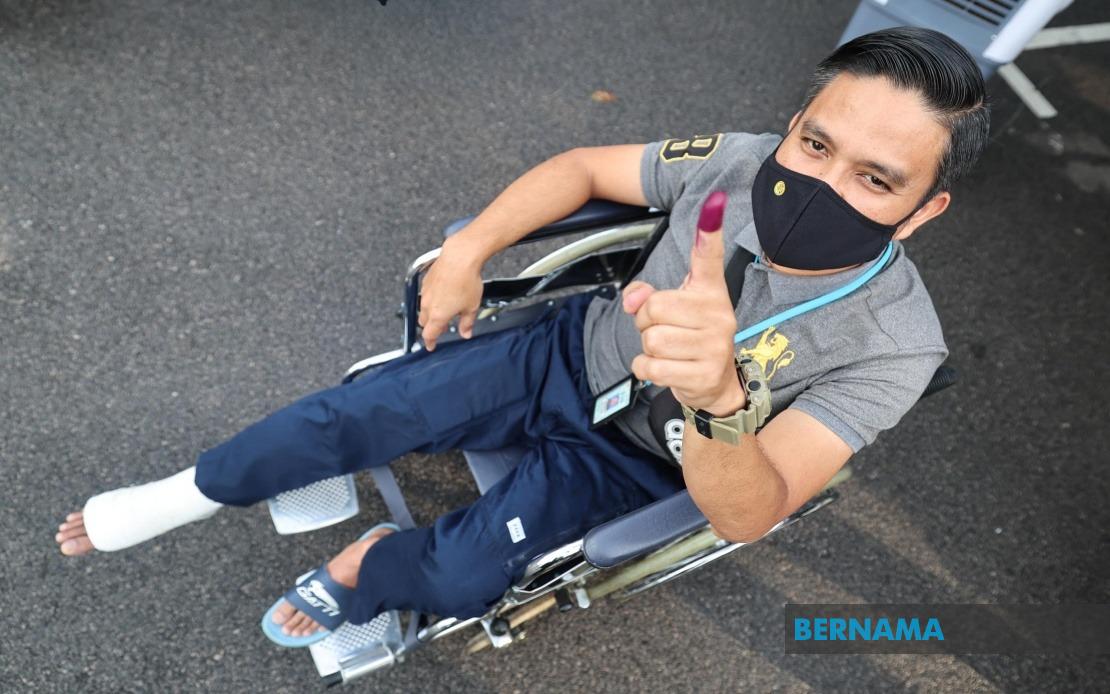
The commitment to democratic participation transcended physical adversity when Sergeant Syahrizal Musa, a 40-year-old police officer, arrived at the Johor Police Contingent Headquarters early voting centre on a wheelchair on July 7. Despite medical advice confining him to rest until mid-July following a ruptured Achilles tendon incurred during a sepak takraw match, Syahrizal refused to forgo his electoral duty in the 16th Johor state election, illustrating the resolve some Malaysian security personnel bring to their civic obligations.
The injury, diagnosed as a minor tear to the Achilles tendon, represented a significant impediment to mobility. Doctors had placed him on medical leave extending through July 16, yet this prognosis failed to deter the sergeant's determination. Accompanied by a friend from the Tampoi police quarters, Syahrizal navigated the logistics of accessing the voting centre despite his temporary disability, prioritising his franchise over personal comfort and medical constraints.
Syahrizal's service record underscores the character that motivated his appearance. Across more than two decades with the Royal Malaysia Police, he has maintained an unblemished voting history, never having missed an election opportunity. Assigned to the Internal Security and Public Order Department at Johor Police Contingent Headquarters, he joined the formation in 2014 after spending nine years stationed at Muar IPD, building a career rooted in institutional discipline and personal responsibility.
Sepak takraw, the traditional Southeast Asian sport requiring agility and coordination, remains close to Syahrizal's identity. Active since youth, he had represented the police contingent across multiple tournaments, demonstrating the athletic dedication typical of many in Malaysia's uniformed services. The injury arose not from negligence but from engagement with a sport embedded in local culture and police camaraderie.
When encountered by reporters at the voting centre, Syahrizal articulated a philosophy transcending personal circumstances. He emphasised that injury merely constrained movement, not resolve, and that participating in elections represented a fundamental responsibility incumbent upon all citizens. His statements carried implicit criticism of voter apathy, suggesting that Malaysians of varying physical capacity should prioritise electoral participation to shape their state and nation's trajectory.
The early voting exercise itself demonstrated substantial organisational scope. Across July 7, sixty-four polling centres operated nationwide to accommodate 24,751 early voters, predominantly composed of 12,041 Malaysian Armed Forces personnel and spouses, and 12,710 Royal Malaysia Police and General Operations Force members with their families. This structured provision enabled security sector workers to fulfil electoral obligations whilst maintaining operational readiness for ordinary polling day.
Johor's electoral contest involved 172 candidates competing for 56 state assembly seats, with ordinary voting scheduled for the following Saturday. The 2.7 million standard voters represented a substantial electorate, and the early voting mechanism enabled crucial institutional workers to participate without compromising their availability for maintaining public order during the primary electoral process. The separation reflected administrative sophistication in balancing democratic participation with governance continuity.
Syahrizal's participation carried symbolic weight extending beyond individual gesture. Police and armed forces personnel represent institutional embodiments of national authority and governance, and their voting behaviour signals institutional health and democratic legitimacy. When security sector workers demonstrate personal commitment to electoral participation despite physical hardship, they implicitly validate democratic systems and encourage civilian confidence in institutional neutrality.
The sepak takraw injury itself provided an unexpected lens through which to examine Malaysian workplace culture and occupational hazards within the security sector. Police personnel frequently engage in sporting activities as part of unit cohesion and fitness maintenance, yet such engagement carries injury risk. Syahrizal's decision to prioritise voting despite recuperation requirements suggested hierarchical ordering of values, with civic duty superseding even medical counsel.
Malaysia's electoral framework has evolved substantially toward accommodating diverse voter circumstances, from postal voting to early voting mechanisms. These provisions acknowledge that rigid polling day structures exclude significant populations—security personnel, medical workers, travellers, and the mobility-impaired. Syahrizal's participation validated these accommodations, demonstrating their practical utility in extending franchise access.
His 22-year service span encompassed transformative periods in Malaysian policing and governance. Veterans of such length typically develop sophisticated perspectives on institutional evolution and democratic processes. Syahrizal's determination suggested that extended service breeds deeper appreciation for democratic mechanisms, possibly because long-serving personnel witness the consequences of governance failures and appreciate political stability grounded in legitimate electoral processes.
The Johor state election itself carried significance for Malaysia's broader political trajectory. Following previous tumultuous state-level contests, electoral management and security personnel participation would influence outcome perception and institutional credibility. Individual acts of civic participation by serving officers like Syahrizal collectively reinforced democratic legitimacy, suggesting institutions functioned reliably and personnel respected electoral systems.
Syahrizal's example resonates particularly for younger officers and civilian voters observing institutional behaviour. When visible public servants overcome personal obstacles to vote, they model civic virtue and underscore that electoral participation transcends convenience or circumstance. For a nation navigating political polarisation and periodic institutional stress, such demonstrations of fundamental commitment to democratic processes carry cumulative significance beyond the single vote cast.

