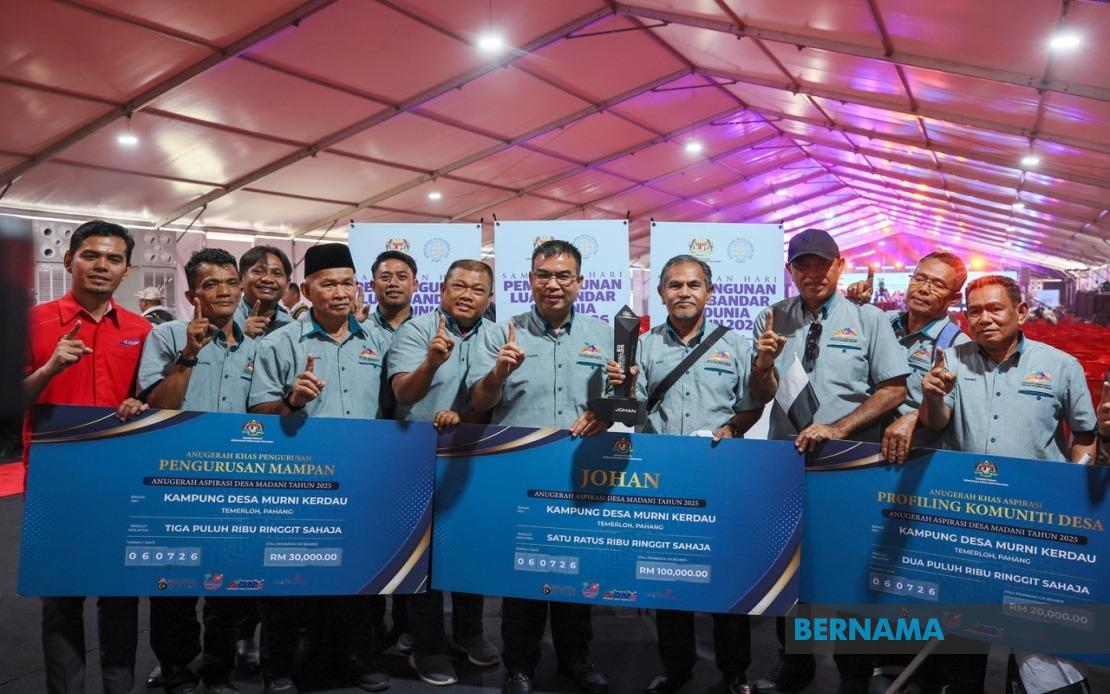
A rural village in Pahang has emerged as a shining example of successful grassroots development in Malaysia, sweeping three prestigious awards at the World Rural Development Day 2026 celebration held in Maran. Desa Murni Kerdau, located in Temerloh, clinched the 2025 MADANI Rural Aspiration Award Champion title along with recognition for rural community profiling and sustainable management practices, underscoring the nation's commitment to elevating living standards beyond urban centres.
The accolades were presented during a formal ceremony at Tun Abdul Razak Stadium in Jengka Sentral on July 6, with Deputy Prime Minister Datuk Seri Dr Ahmad Zahid Hamidi personally handing over the coveted MADANI Rural Aspiration Award Champion certificate. Deputy Minister of Rural and Regional Development Datuk Rubiah Wang presented the two remaining special awards, signalling high-level government recognition for the village's sustained development trajectory. This multi-tiered acknowledgement reflects the Malaysian government's emphasis on translating its MADANI (Madani, Agile, Inclusive) framework into tangible rural transformation.
According to Mohamad Fazrul Ahmad, chairman of Desa Murni Kerdau's Village Development and Security Committee (JPKK), the awards represent vindication of the community's collective efforts in establishing robust governance structures and fostering inclusive leadership. He emphasized that such recognition validates the strategic approach the village has adopted in balancing traditional values with contemporary development imperatives, an increasingly important consideration as rural Malaysia navigates the transition towards knowledge-based economies and digital integration.
The village has cultivated an entrepreneurial ecosystem that has spawned approximately 20 business owners operating across diverse sectors including small and medium enterprises, agricultural production, and the automotive industry. This entrepreneurial vitality distinguishes Desa Murni Kerdau from many counterparts where economic opportunities remain concentrated in primary sectors. The diversification of income sources within the community strengthens economic resilience and reduces dependence on single industries vulnerable to market fluctuations.
Beyond traditional enterprise, Desa Murni Kerdau has successfully positioned itself as a rural tourism destination through its "Kampung Stay" initiative, which capitalizes on growing domestic interest in authentic village experiences. This agritourism venture demonstrates how rural communities can monetize cultural heritage and natural assets without requiring major infrastructure transformation or external investment capital. The model has proven sufficiently successful to gain recognition as one of the country's notable rural tourism offerings, generating supplementary income while preserving community character.
The physical and demographic profile of Desa Murni Kerdau—comprising approximately 200 households housing over 600 residents—situates it within the mid-sized settlement category typical of organized rural communities. This scale permits manageable administration while maintaining sufficient population density to support cooperative ventures and collective initiatives. The maintenance of housing standards and community infrastructure across 200 units represents substantial organizational achievement, particularly given resource constraints frequently encountered in rural development.
Mohamad Fazrul indicated that prize monies awarded would be channelled directly to residents and allocated toward village improvement initiatives benefiting the broader community rather than concentrated in formal municipal budgets. This approach to fund distribution reflects commitment to participatory governance models where development benefits flow directly to constituents. Such transparent resource allocation fosters community ownership of development outcomes and strengthens institutional trust in local leadership structures.
The recognition carries particular significance within Malaysia's broader rural development context. As urbanization accelerates and youth migration to major metropolitan areas continues, preserving economically viable and socially cohesive rural settlements becomes increasingly critical. Desa Murni Kerdau exemplifies how strong village-level institutions, entrepreneurial spirit, and strategic utilization of local assets can create sustainable development trajectories that reduce urban-rural disparities.
The awards also reflect priorities embedded within federal rural development policy frameworks. The MADANI Rural Aspiration Award category emphasizes governance quality and community empowerment, signalling government preference for villages demonstrating institutional maturity alongside measurable development outcomes. This evaluation approach encourages replication of successful governance models and incentivizes communities to invest in leadership capacity and institutional development infrastructure.
For policymakers and rural development practitioners across Southeast Asia observing Malaysia's rural transformation initiatives, Desa Murni Kerdau provides instructive lessons regarding the viability of diversified economic strategies anchored to community-level governance. The village's success in generating entrepreneur activity while simultaneously developing heritage-based tourism demonstrates that rural prosperity need not depend on heavy industrial investment or large-scale agricultural mechanization. Instead, strategic combination of small business development, value-added agriculture, and experiential tourism can create sustainable livelihoods for dispersed populations.
Looking forward, the challenge confronting similar rural settlements involves replicating the governance frameworks and entrepreneurial culture that distinguish high-performing villages like Desa Murni Kerdau. Success requires not merely infrastructure investment but cultivation of institutional capacity, leadership development, and community participation mechanisms that mobilize local knowledge and resources. The three-award sweep suggests that holistic attention to governance, community organization, and sustainable resource management generates measurable development dividends that international recognition bodies validate and reward.

