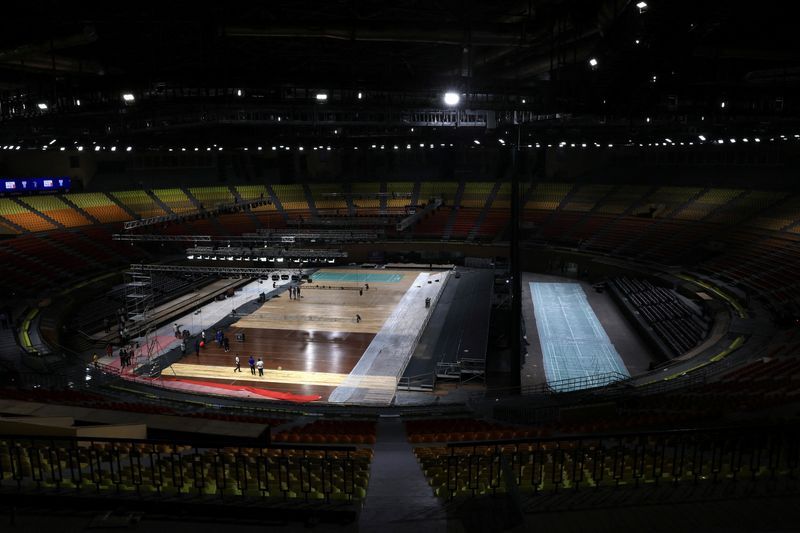
As New Delhi prepares to host the Badminton World Federation's marquee championship next week, organisers have assembled an unconventional workforce that extends well beyond the usual tournament logistics. Among the officials, volunteers, and technical staff working behind the scenes at the Indira Gandhi Indoor Stadium, a small cadre of trained specialists will fulfill a uniquely Indian role: mimicking the calls of langur monkeys to keep rhesus macaques at bay. This unusual staffing choice underscores the practical challenges that major sporting venues in India's sprawling capital must navigate, where urban wildlife management has become an inseparable part of event planning.
The problem itself is rooted in New Delhi's unavoidable coexistence with its primate population. Rhesus monkeys, which thrive in the city's dense neighbourhoods and office complexes, have earned a notorious reputation for their aggressive territorial behaviour. These animals routinely invade buildings, snatch food from unsuspecting residents, and in some cases launch unprovoked attacks on pedestrians going about their daily business. The threat is sufficiently widespread that organisations across the capital have adopted a pragmatic solution: the deployment of langurs, larger primates distinguished by their distinctive black faces, which are placed strategically within offices and public buildings. Langurs serve as natural deterrents, their presence alone enough to discourage rhesus monkeys from establishing themselves in spaces they might otherwise colonise.
The sophistication of this defence mechanism lies in the langurs' vocal repertoire. Specialists trained in reproducing langur calls have become essential security assets for venues hosting major public events. These 'monkey whisperers' possess the technical ability to emit the precise hooting and warning sounds that langurs use to establish territorial dominance, thereby replicating the psychological effect that a live langur would produce. The practice represents an ingenious low-cost adaptation to an urban wildlife challenge that afflicts many South Asian cities, though Delhi's density of both human and animal populations makes the problem particularly acute.
The Badminton Association of India's decision to engage these specialists reflects a specific incident that underscored the risks. During this year's Indian Open at the same stadium, a rhesus monkey was photographed wandering through the spectator gallery, a breach of venue security and animal control that embarrassed the organisation during a major international tournament. The incident exposed vulnerabilities in the facility's animal management protocols and prompted urgent remedial action ahead of the World Championships, an event that carries significantly higher visibility and prestige on the global badminton calendar. Zafar, one of the hired mimics, demonstrated his hooting techniques to journalists during a media facility visit on Monday, showcasing the vocalisation methods that will be deployed throughout the championship.
Zafar himself represents a multi-generational tradition of animal management expertise. As a third-generation monkey whisperer, he brings inherited knowledge of primate behaviour and communication to the role, knowledge that cannot be easily acquired through formal training programmes. In conversations with reporters, Zafar emphasised that the strategy underlying langur mimicry is fundamentally non-violent and animal-welfare conscious. The objective is not to harm the rhesus monkeys but rather to create a psychological barrier that discourages them from entering the stadium complex in the first place. His experience in government offices across the capital has provided practical familiarity with the technique's effectiveness in diverse urban settings.
Yet the animal management challenge extends beyond the primate threat. Delhi's pigeon population presents an equally vexing problem for indoor sports facilities, one that manifested dramatically during the Indian Open when matches were halted twice due to birds fouling the playing surface. Players objected not only to the disruption but to hygiene concerns arising from the animals' presence on the court. The incident highlighted how even seemingly minor wildlife issues can compromise the quality and safety of international competition, potentially damaging India's reputation as a reliable host for world-class sporting events. Organisers have since implemented pigeon control measures using non-toxic gel, a substance commonly deployed on railway infrastructure to prevent roosting, which has been applied to the stadium's roof and internal ducts to exclude pigeons from nesting sites.
The broader context for these preparations involves India's ambitious sporting infrastructure agenda. As the designated host of the 2030 Commonwealth Games and an active bidder for the 2036 Olympic Games, India views major international badminton championships as a proving ground for its capability to manage large-scale, high-profile sporting events. Successfully hosting the Badminton World Federation championship without animal-related disruptions sends a signal to the international sporting community and to the International Olympic Committee regarding India's attention to detail and problem-solving capacity. Conversely, repeated wildlife incidents would undermine confidence in India's ability to deliver the logistical perfection that Olympic hosting demands.
Sanjay Mishra, the Badminton Association of India's secretary general, has publicly asserted that the association has comprehensively addressed the deficiencies identified during the Indian Open. He credited the sports ministry with implementing facility improvements and expressed confidence that the Badminton World Federation's officials are satisfied with the current arrangements. This statement carries strategic importance, as it positions India as responsive to feedback and committed to continuous improvement in venue management. The monkey whisperers and anti-pigeon measures represent visible, concrete manifestations of this commitment, deployed not merely as practical solutions but as symbols of India's professional approach to international sporting obligations.
The deployment of monkey mimics also reflects broader patterns of wildlife adaptation across South and Southeast Asia, where rapid urbanisation has created unprecedented human-animal overlap in city centres. Countries throughout the region share similar challenges with urban primate populations, pigeon infestations, and other species that resist conventional pest control. India's formalisation of the monkey whisperer role, and its integration into major event planning, may offer lessons for other cities grappling with comparable dilemmas. The approach is simultaneously practical and culturally sensitive, avoiding lethal methods while achieving genuine behavioural modification in wild animal populations.
As the championship approaches, the success or failure of these wildlife management measures will be closely observed not only by badminton enthusiasts but by officials evaluating India's readiness for future mega-events. The monkey whisperers hired for next week represent an intersection of traditional knowledge, practical necessity, and strategic infrastructure planning that characterises modern Indian event management. Whether the langur calls prove sufficiently convincing, and whether pigeons respect the non-toxic gel barriers, will ultimately determine whether the Badminton World Championships unfolds as intended or becomes another chapter in the complex history of humans and animals navigating shared urban space.

