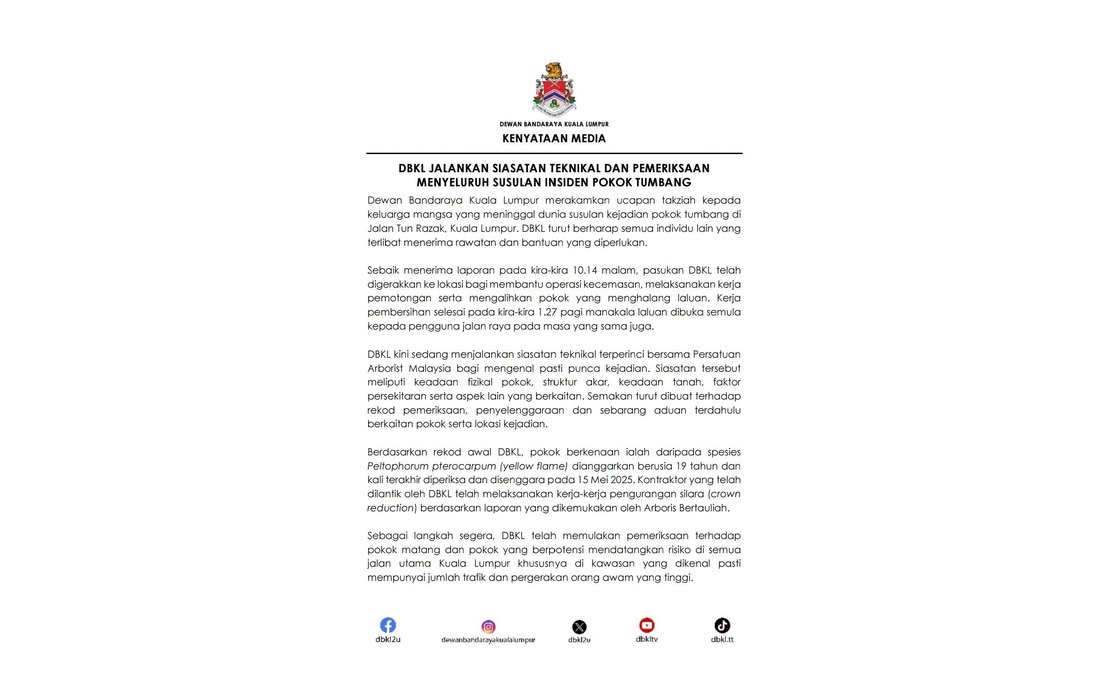
A deadly tree collapse on Jalan Tun Razak has prompted Kuala Lumpur City Hall (DBKL) to launch a comprehensive technical investigation aimed at understanding what caused the mature specimen to fall. The incident, which claimed the life of a man, has triggered both immediate and long-term safety responses across the capital, raising fresh concerns about urban tree management in Malaysia's fastest-growing city.
DBKL is partnering with the Malaysian Society of Arborist to conduct the inquiry, which will examine multiple dimensions of the tree's health and its environment. The investigation encompasses a full assessment of the specimen's physical integrity, its root system, the soil composition beneath it, relevant environmental conditions, and a thorough review of all inspection records, maintenance history, and previous complaints registered about either the tree or the area surrounding it. This multi-layered approach reflects the complexity of determining causation in tree failure cases, where structural weakness, environmental stress, and maintenance lapses often interact in ways that require expert botanical analysis.
The fallen tree was identified as a Peltophorum pterocarpum, commonly known as Yellow Flame, estimated to be 19 years old at the time of the incident. Records show the tree had undergone inspection and maintenance as recently as May 15, and a certified arborist had previously recommended and overseen crown reduction works. These measures suggest that DBKL was attempting to manage the specimen proactively, though the investigation will likely focus on whether such interventions were adequately executed or sufficiently frequent given the tree's age and location.
DBKL's emergency response team reached the scene within minutes of receiving the report at 10:14 pm and worked to remove the fallen timber and clear the roadway of debris. By 1:27 am, Jalan Tun Razak was reopened to traffic, demonstrating the city authority's capacity to respond swiftly to infrastructure emergencies. The authority has extended condolences to the victim's family and committed to assisting those affected by the incident, while pledging full cooperation with police and other agencies.
The incident has triggered a broader safety audit across Kuala Lumpur's arterial road network. DBKL has initiated inspections of all mature and potentially hazardous trees along major routes, prioritising thoroughfares with heavy traffic volumes and significant pedestrian movement. The scope of this immediate inspection programme includes Jalan Ampang, Jalan Sultan Ismail, Jalan Raja Laut, Jalan Datuk Keramat, and additional sections of Jalan Tun Razak itself. Eight teams, including five qualified arborists, have been mobilised to complete these assessments within a ten-week timeframe, reflecting the scale of DBKL's concern about tree stability across the city.
Looking beyond immediate interventions, DBKL is pursuing a more sophisticated approach to tree management through technology. The city authority is awaiting approval from SIRIM, Malaysia's national standards and industrial research institute, to deploy 400 tree-monitoring sensors at high-risk locations throughout Kuala Lumpur. These devices would represent a significant innovation in how Malaysian cities approach arboricultural safety, moving from reactive incident response and periodic inspections toward real-time data collection on tree health.
The sensors are designed to detect subtle changes in tree condition that might escape conventional visual inspection. They would monitor soil composition and moisture retention, measure structural stress and movement within the timber, and track how adverse weather events such as heavy monsoon rainfall or flooding affect root stability and nutrient uptake. Such data could enable DBKL to predict tree failure before it occurs, allowing for preemptive treatment, pruning, or removal. This preventive philosophy represents a significant shift in how Malaysian municipalities have traditionally managed urban forestry.
The initial rollout of the sensor network will concentrate on four strategically important locations: Jalan Bangsar, Dataran Merdeka, Jalan Ampang, and Jalan Raja Chulan. These routes represent a mix of high-traffic corridors and public gathering spaces where tree failure would pose acute risk to large numbers of people. The phased installation approach allows DBKL to assess the sensors' effectiveness and reliability before scaling up across the broader network.
For Malaysian readers and urban planners, the Jalan Tun Razak incident underscores a growing tension in Southeast Asian cities. Rapid urbanisation has created dense populations living and working beneath aging trees planted decades ago when density and climate stress were far lower. Many trees in Kuala Lumpur, George Town, Johor Bahru, and other major cities are reaching maturity simultaneously, meaning they face compound pressures from soil compaction, inadequate root space, changed drainage patterns, and intensifying monsoon rains. A single tree failure might appear isolated, but it signals systemic challenges that require coordinated responses from municipal authorities.
The cost and complexity of such responses cannot be underestimated. DBKL's commitment to 400 sensors, an expanded inspection regime, and increased arboricultural expertise represents substantial ongoing investment. Yet the alternative—accepting preventable fatalities—is politically and morally unacceptable. Similar incidents in other regional capitals have prompted comparable safety audits, suggesting that DBKL's response reflects emerging best practice across Southeast Asia rather than an isolated local reaction.
The investigation findings will likely generate significant interest among municipal administrators across Malaysia and the broader region. Whether the tree failed due to disease, poor soil conditions, inadequate maintenance, or structural defects will influence how other city authorities assess and manage their own urban forestry. The case also highlights the importance of involving certified arborists in both the investigation and ongoing management—a professional standard that not all Malaysian municipalities have consistently maintained.
As the investigation proceeds and DBKL rolls out its expanded inspection and monitoring programmes, the incident serves as a sobering reminder that public safety in rapidly growing cities requires constant vigilance, specialist expertise, and willingness to invest in preventive infrastructure. The sensors, once approved and installed, may prove transformative in how Kuala Lumpur and other Malaysian cities manage the tension between maintaining the green canopy that makes urban areas livable and ensuring that such greenery does not pose hidden risks to the public below.

