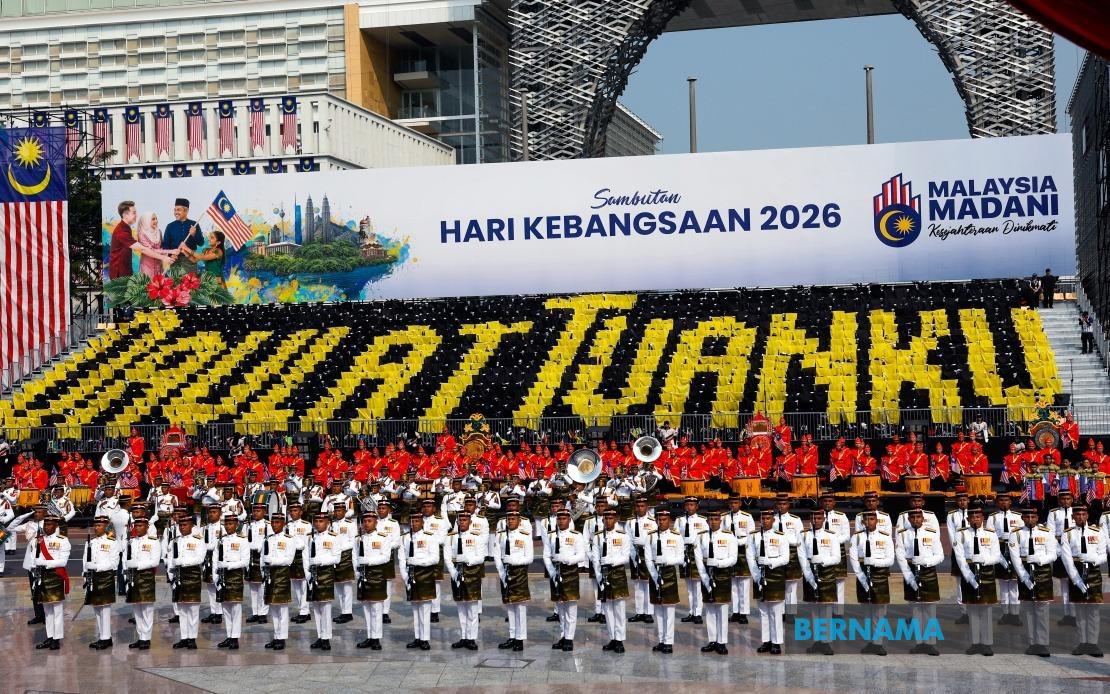
The administrative heart of Malaysia will pulse with patriotic fervour tomorrow as Dataran Putrajaya stages an expansive celebration of the nation's 69th independence milestone. Under the thematic banner of Malaysia MADANI: Kesejahteraan Dinikmati—translating to shared prosperity and collective wellbeing—the gathering represents a carefully orchestrated fusion of national symbolism, cultural identity, and contemporary Malaysian values. The occasion will draw His Majesty Sultan Ibrahim, King of Malaysia, and Her Majesty Raja Zarith Sofiah, Queen of Malaysia, alongside Prime Minister Datuk Seri Anwar Ibrahim and Cabinet members, underscoring the event's ceremonial importance and governmental commitment to national unity celebrations.
The scale of tomorrow's proceedings reflects meticulous logistical planning spanning months of coordination. Commencing at 8:00 am, the parade will mobilise 10,819 participants distributed across 76 contingents, 22 marching bands, and 11 specially designed float vehicles. The military and security apparatus will constitute a substantial component, with 328 land, naval, and air assets deployed to demonstrate Malaysia's defensive capabilities and organisational prowess. Additionally, 112 working animals and 22 electric vehicles will feature in the procession, signalling the government's commitment to environmental consciousness alongside traditional pageantry. This comprehensive mobilisation underscores how National Day celebrations serve as platforms for exhibiting state capacity and national infrastructure to both domestic audiences and international observers.
The ceremonial opening will introduce audiences to the Gema Inovasi MADANI performance, conceptualised by the National Department for Culture and Arts under the Ministry of Tourism, Arts and Culture. This segment ingeniously interweaves traditional percussion heritage with contemporary artistic innovation, employing 150 musical instruments and 700 kompang—traditional frame drums—to create a layered soundscape representing Malaysia's primary ethnic communities. By anchoring modern creative expression to established cultural forms, the performance embodies the Malaysia MADANI philosophy of honouring heritage while embracing progress. The kompang tradition itself carries historical resonance within Malaysian collective memory, making this symbolic choice particularly resonant for audiences familiar with classical Malay-Muslim cultural contexts whilst remaining accessible to younger, more cosmopolitan viewers.
Following this cultural prelude, the parade will unfold across multiple thematic components, each designed to communicate specific dimensions of national identity and governmental priorities. The statehood segment will foreground the Jalur Gemilang national flag, carried by contingents drawn from the armed forces' officer academies, including the National Resilience Leadership Academy and National Defence University of Malaysia (UPNM), along with National Service Training Programme (PLKN) participants. This deliberate emphasis on youth institutional participation signals governmental investment in grooming future leadership cadres whilst visibly demonstrating intergenerational transmission of patriotic commitment. Such staging choices communicate subtle but potent messages about national continuity and the institutionalisation of loyalty within formal state structures.
The sports component will showcase national athletes and medal-bearing competitors from the Glasgow 2026 Commonwealth Games, positioning athletic excellence as an extension of patriotic service and national representation. This linkage between sports achievement and national pride reflects how contemporary celebrations increasingly integrate competitive sporting success into broader narratives of national capacity and capability. For Malaysian audiences, particularly younger demographics engaged with sporting culture, this integration validates athletic endeavour as a legitimate expression of national contribution, elevating sports beyond mere entertainment to patriotic significance.
The public wellbeing and economy segment will gather commercial and service sector representatives, including Munchy's Malaysia, ZUS Coffee, Siti Khadijah Apparel Sdn Bhd, MR. D.I.Y Group (M) Berhad, Carsome Sdn Bhd, and various cooperative associations. This deliberate incorporation of private enterprise within state-choreographed celebration signals the symbiotic relationship between governmental narratives and commercial interests, demonstrating how Malaysia's MADANI framework encompasses private sector participation in nation-building rhetoric. For viewers and parade participants representing these entities, inclusion validates their commercial operations as contributing meaningfully to national prosperity narratives—a subtle but economically significant public relations benefit that encourages continued corporate engagement with patriotic themes.
Public order and security agencies will feature prominently through the Malaysia Civil Defence Force, Road Transport Department, and Malaysian Fire and Rescue Department, visibly communicating their protective roles to citizens. This staging acknowledges that national security extends beyond military domains to encompass civilian emergency services and regulatory agencies, fostering appreciation for the broader institutional ecosystem maintaining everyday safety. The Johor Military Force's participation as Malaysia's oldest military unit adds historical gravitas, anchoring contemporary celebrations within longer territorial and martial traditions that predate the modern nation-state itself.
Tourism promotion constitutes a parallel but equally significant celebration dimension, with floats showcasing state-specific attractions, biodiversity, traditional attire, and musical instruments through the Visit Malaysia Year 2026-2027 campaign. Strategic airline partners—Malaysia Airlines, AirAsia, Batik Air, and Air Borneo—will enliven the procession, strategically positioning the aviation sector as facilitators of national tourism and economic exchange. This commercial-cultural integration demonstrates how celebrations increasingly blend patriotic symbolism with economic objectives, particularly tourism marketing crucial for regional competitiveness as Southeast Asian nations compete for visitor expenditure.
Popular animation characters Upin and Ipin, created by animation studio Les' Copaque, will feature prominently to capture younger audience engagement and family demographics. This cultural product placement reflects evolving celebration strategies that recognise generational diversity requires varied cultural anchors beyond traditional pageantry. Indigenous Malaysian animation content carries particular significance in the Southeast Asian context, where cultural products increasingly compete with globalised entertainment imports; their inclusion demonstrates deliberate efforts to privilege locally-produced cultural forms.
A striking human graphics performance will see 1,500 students from 36 Selangor schools create synchronised visual formations displaying moving patterns responsive to musical accompaniment. Such mass choreographic displays echo historical practices of totalitarian and authoritarian regimes, yet within contemporary Malaysian contexts, represent expressions of coordinated national sentiment and collective artistic participation. The pedagogical implications merit consideration—students' involvement in such rehearsed formations constitutes form of political socialisation, where bodily coordination and group participation reinforce messages of collective unity and individual subordination to national purposes.
The celebration's climax will feature Royal Malaysian Air Force fighter jets executing aerial displays above Putrajaya's administrative precincts, visually asserting national military capability whilst providing dramatic spectacle. Such demonstrations of defence force prowess carry particular significance within Southeast Asian geopolitical contexts, where regional tensions and territorial disputes necessitate periodic reminders of national defence readiness to both domestic populations and international neighbours. The positioning of military power projection within patriotic celebration frameworks legitimises defence spending and military modernisation as national necessities rather than controversial expenditures.
Closing musical accompaniment will derive from acclaimed singer Faizal Tahir's composition Aku Berjanji, injecting contemporary musical idiom into nationalist sentiment whilst leveraging celebrity cultural capital to enhance celebration resonance. The evening's 10:00 am conclusion allows participants and spectators return to normal routines whilst maintaining media narrative momentum through broadcast highlights.
Practical considerations reveal governmental attentiveness to contemporary challenges; the Communications Minister Datuk Seri Fahmi Fadzil, chairing the main celebration committee, advised N95 face mask usage to counter current haze conditions, aligning with Ministry of Health guidance. Organisers will distribute over 10,000 masks to parade participants, demonstrating how environmental degradation—a persistent Southeast Asian regional challenge—intrudes upon even ceremonial occasions, requiring adaptive health protocols. Simultaneously, comprehensive road closures affecting five major bridges and surrounding Putrajaya Core Island routes necessitate sophisticated public communication and transport planning, with authorities directing citizens toward public transit utilisation. These logistical and environmental dimensions underscore how modern national celebrations must integrate air quality management, traffic coordination, and public health considerations alongside symbolic expression.

