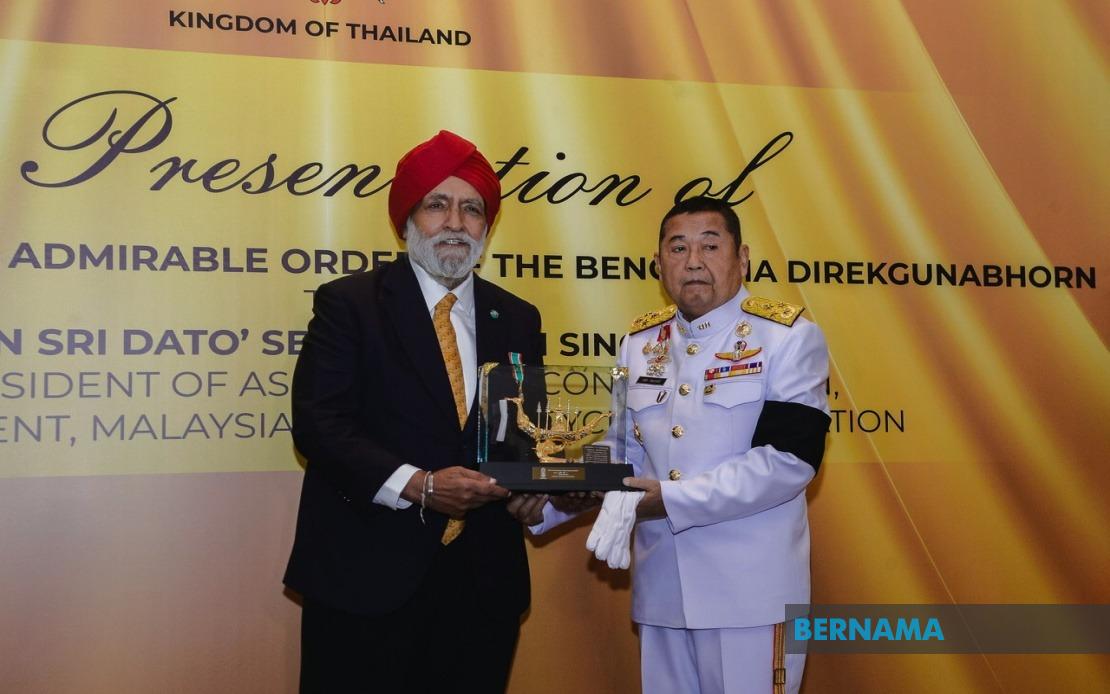
Tan Sri Darshan Singh Gill, a towering figure in Malaysian and Asian cycling administration, has been bestowed with Thailand's prestigious "The Most Admirable Order of the Direkgunabhorn (Fifth Class - Benjama Direkgunabhorn)," marking a capstone to his decades of service in the sport. The honour, originally conferred by the late King Bhumibol Adulyadej The Great of Thailand, was formally presented to him in Kuala Lumpur by ACC senior vice-president General Decha Hemkasri, underscoring Thailand's recognition of Darshan's transformative role in elevating cycling standards across the region.
Darshan's career in cycling administration spans multiple decades and leadership roles of increasing prominence. He helmed the Malaysian National Cycling Federation as president from 1988 to 1990, a formative period when Malaysian cycling was still establishing its competitive footing on the world stage. His influence extended far beyond domestic affairs when he subsequently assumed the presidency of the Asian Cycling Confederation from 1996 to 2005, a tenure during which he guided the continental body through crucial developmental phases and helped establish protocols that would benefit cycling nations throughout Asia.
Reflecting on the honour, Darshan characterised the award not merely as personal recognition but as validation of Malaysia's broader ascendancy within international cycling circles. He drew deliberate connections between his generation of administrators and the contemporary achievements now defining the nation's cycling profile. The award, in his assessment, stands as testament to the institutional capacity Malaysia has developed to compete and lead at the highest tiers of global sports governance.
Darshan specifically referenced the evolution of Malaysian cycling talent across generations, contrasting the achievements of earlier athletes such as M. Kumaresan and Rosman Alwi with the contemporary dominance of Datuk Mohd Azizulhasni Awang. This comparative framing underscores a crucial narrative: that Malaysia's cycling infrastructure has matured substantially, producing world-class track cyclists capable of claiming medals at major international competitions. Azizulhasni's recent gold medal in the men's keirin event at the Commonwealth Games in Glasgow represented a breakthrough moment, ending a 16-year drought in track cycling medals for Malaysia at the Games and demonstrating the depth of contemporary Malaysian talent.
Beyond athlete development, Darshan emphasized that Malaysia's administrative structures have equally strengthened. The election of Datuk Amarjit Singh Gill as International Cycling Union vice-president for the 2025-2029 term represents a watershed moment for Malaysian representation within world cycling governance. Amarjit's achievement makes him the first Malaysian ever to attain such a position within the UCI, the sport's ultimate regulatory body, achieved during the 194th UCI Congress held in Kigali, Rwanda. This ascension validates Darshan's longstanding thesis that Malaysian administrators possess the competence and vision to operate effectively at the global level.
The presentation ceremony highlighted the interconnected nature of cycling development within Asia. The Asian Cycling Confederation, through which Darshan exercised considerable influence during his tenure as president, functions as the institutional bridge connecting national federations with international cycling structures. His work during the 1996-2005 period helped establish or strengthen pathways for knowledge transfer, technical standardization, and competitive opportunities across Asia, benefits that continue resonating through contemporary Malaysian cycling programmes.
Thailand's decision to honour Darshan carries significance beyond bilateral sports relations. The kingdom, which has its own distinguished cycling tradition and infrastructure, implicitly acknowledged through this award that Darshan's contributions to Asian cycling transcended national boundaries and benefited the entire continental cycling ecosystem. His work creating competitive frameworks, fostering technical development, and building administrative capacity within Asian cycling generated positive spillover effects extending well beyond Malaysia's borders.
The timing of the award, formally presented in August following Azizulhasni's Commonwealth Games triumph and subsequent to Amarjit's elevation within the UCI hierarchy, creates a narrative arc illustrating continuity and progress. Darshan's pioneering administrative work during the 1990s and 2000s laid institutional groundwork upon which current Malaysian cyclists and administrators operate. The award implicitly celebrates not only his personal contributions but also the lasting legacy embedded within Malaysian cycling's organizational structures.
For Malaysian readers, the honour carries broader implications regarding the nation's sporting governance and international standing. It demonstrates that sustained, strategic investment in sports administration and athlete development yields recognition from peer nations and international bodies. Malaysia's emergence as a credible voice within Asian cycling governance, culminating in Amarjit's UCI position, traces a direct line back to foundational work by figures such as Darshan who built the institutions and established the protocols enabling such advancement.
The award also reinforces an important principle within Asian sports diplomacy: that excellence in sports administration receives recognition comparable to athletic achievement. While media coverage traditionally emphasizes medal-winning athletes, Darshan's honour spotlights the administrative infrastructure and leadership vision that enable athletes to compete successfully. Thailand's honouring of a Malaysian administrator demonstrates mutual respect among Asian sporting nations and the recognition that collaborative governance strengthens continental sports ecosystems.
Looking forward, Darshan's award serves as validation for current Malaysian cycling leadership to continue pursuing excellence within both competitive and administrative spheres. The confluence of Azizulhasni's recent medal success, Amarjit's elevation within the UCI, and the belated recognition of Darshan's historical contributions creates a momentum narrative suggesting Malaysian cycling has achieved maturity and institutional stability capable of sustaining international competitiveness across generations.

