The Rahang constituency will see an intense battle as Negeri Sembilan DAP treasurer Siaw Meow Keong seeks to retain the seat he has held since 2023 in the upcoming 16th Negeri Sembilan state election. Fielded by Pakatan Harapan, Siaw faces a challenging four-cornered contest that reflects the fractionalised opposition landscape in one of Malaysia's key swing states. His contenders include Yap Siok Moy, the Rasah MCA Wanita chief representing Barisan Nasional; S. Thinagaran from Parti Sosialis Malaysia; and Tang Jay San fielding for Bersatu. The nomination process, overseen by returning officer Mohamad Najib Mustafa at the Seremban City Council Hall, saw all four candidates file their papers within a tight timeframe, underscoring the competitive nature of this contest.
The emergence of multiple opposition challengers in Rahang reflects deeper fractures within Malaysia's political landscape. Bersatu's entry into the fray signals the party's ambitions to make inroads in Negeri Sembilan despite its controversial position oscillating between cooperating with and opposing Pakatan Harapan at various junctures. For Siaw, a relatively newer political face compared to veteran legislators in the state, holding his ground against an MCA candidate represents a test of DAP's ability to consolidate support in constituencies it has recently captured. The presence of PSM, though typically polling modestly, suggests that ideological debates around development and governance will feature prominently in campaign rhetoric.
Negeri Sembilan remains strategically significant within Malaysian politics as a bellwether state that has swung between coalitions in recent election cycles. The state's relatively balanced demographics and strong representation across ethnic communities make contests like Rahang microcosms of national political tensions. DAP's presence in the state assembly has grown incrementally, but its gains remain concentrated in specific urban and semi-urban constituencies. Siaw's defence of Rahang will therefore carry implications beyond the constituency, potentially signalling whether DAP can consolidate its foothold or whether splinter opposition votes will enable Barisan Nasional to recapture ground it lost in 2023.
Elsewhere on the Negeri Sembilan ballot, DAP Wanita chief Nicole Tan Lee Koon faces a notably different electoral scenario in Bukit Kepayang, where she confronts a straight two-way contest against Perikatan Nasional candidate Lee Boon Shian. This binary race provides clearer terrain than Rahang's four-way tussle, though PN's growing organisational capacity in Negeri Sembilan presents a formidable challenge to the incumbent. The disparity between Rahang's fragmented contest and Bukit Kepayang's direct matchup highlights how Malaysia's electoral mathematics can favour or disadvantage parties depending on vote distribution and opposition coordination.
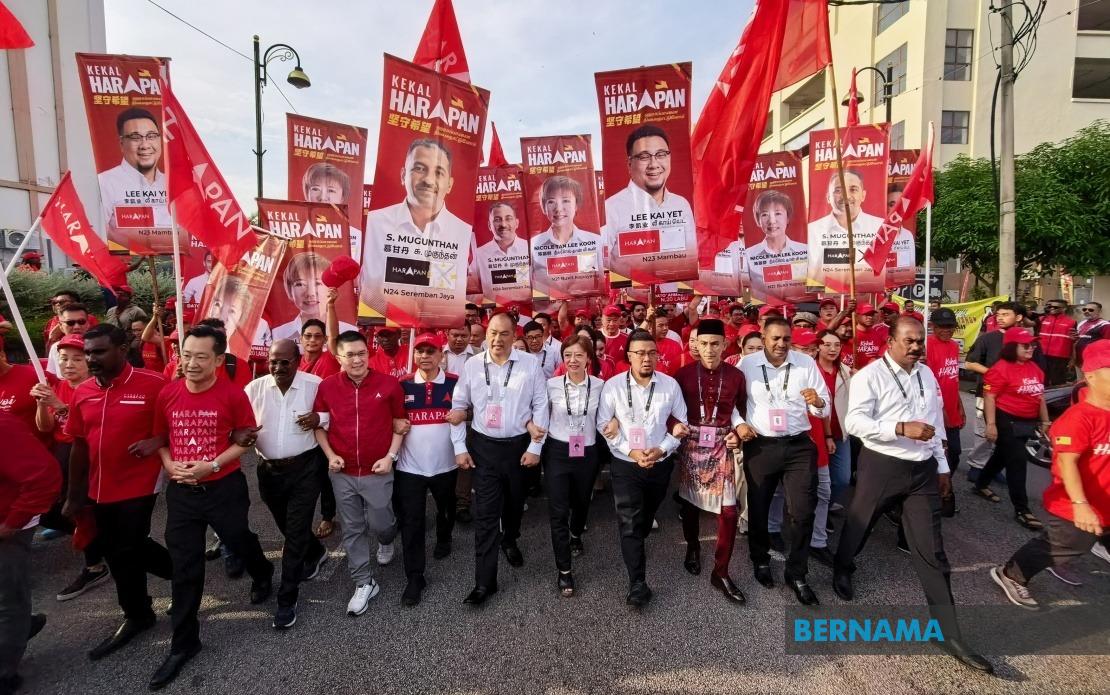
Three-cornered contests materialising in Labu, Mambau, and Seremban Jaya further demonstrate the crowded political arena characterising this election cycle. In Labu, Pakatan Harapan's Datuk Ahmad Faez Abdul Razak must navigate challenges from both Bersatu's Mohamad Hanifah Abu Baker and Barisan Nasional's Siti Nur Umaira Hasim, suggesting neither coalition has achieved decisive dominance in these constituencies. Similarly, Lee Kai Yet representing Pakatan Harapan in Mambau will contend against Bersatu's N. Sarawanan and Perikatan Nasional's Eric Michael, indicating that the opposition fragmentation extends across multiple seats rather than representing isolated anomalies.
The Seremban Jaya three-way contest between Pakatan Harapan's S. Mugunthan, Barisan Nasional's Datuk T. R. Thinalan, and Bersatu's R. Mahendran encapsulates the broader political flux reshaping Negeri Sembilan's electoral landscape. Bersatu's repeated appearances across multiple constituencies demonstrates strategic ambitions in the state that transcend opportunistic candidacy. For Pakatan Harapan, defending multiple seats simultaneously while facing challenges not only from the established Barisan Nasional but also from the reformed Perikatan Nasional bloc requires sophisticated ground mobilisation and messaging discipline.
The Election Commission's scheduling of early voting on July 28 followed by polling day on August 1 compresses the campaign period into a demanding fortnight for all participants. In Negeri Sembilan's competitive environment, this condensed timeline may advantage established political machinery over newer or less-resourced contenders. Campaign messaging in constituencies like Rahang will inevitably focus on local development priorities, but broader questions concerning coalition politics and the sustainability of Pakatan Harapan's governing agenda at state level will permeate campaign discourse.
For Malaysian political observers, the Negeri Sembilan state election provides valuable indicators concerning voter sentiment regarding the performance of Pakatan Harapan-led governance both at federal and state levels. The party's electoral position in Rahang and other constituencies will partly reflect assessments of the federal coalition's management of economic challenges, inflation pressures, and development initiatives that resonate with ordinary voters. Conversely, the showing of Barisan Nasional and Perikatan Nasional will reveal whether opposition consolidation efforts have strengthened or whether voter fragmentation persists.
The broader implications for Negeri Sembilan's political trajectory cannot be understated. Should Pakatan Harapan successfully defend multiple seats despite fragmented opposition votes, it may signal resilience in the state and potentially broader national momentum. Conversely, if Barisan Nasional or Perikatan Nasional capitalize on split opposition votes to recapture constituencies, it would underscore the electoral mathematics paradox where minority vote shares can determine outcomes when opposition strength fragments across multiple candidates. The August 1 results will thus provide crucial data points for assessing Malaysia's evolving political configuration ahead of potential federal electoral contests.
As candidates prepare their campaigns over the coming weeks, the competitive dynamics across Rahang, Bukit Kepayang, and the three-cornered contests will attract national political attention. For ordinary Negeri Sembilan voters, navigating choices between multiple opposition candidates presents both opportunities and challenges—opportunities to punish underperformance but challenges in achieving coordinated electoral decisions. The election ultimately tests not only individual candidates' viability but also the broader architecture of Malaysian coalitional politics and whether voters perceive meaningful differences between competing visions for state governance.

