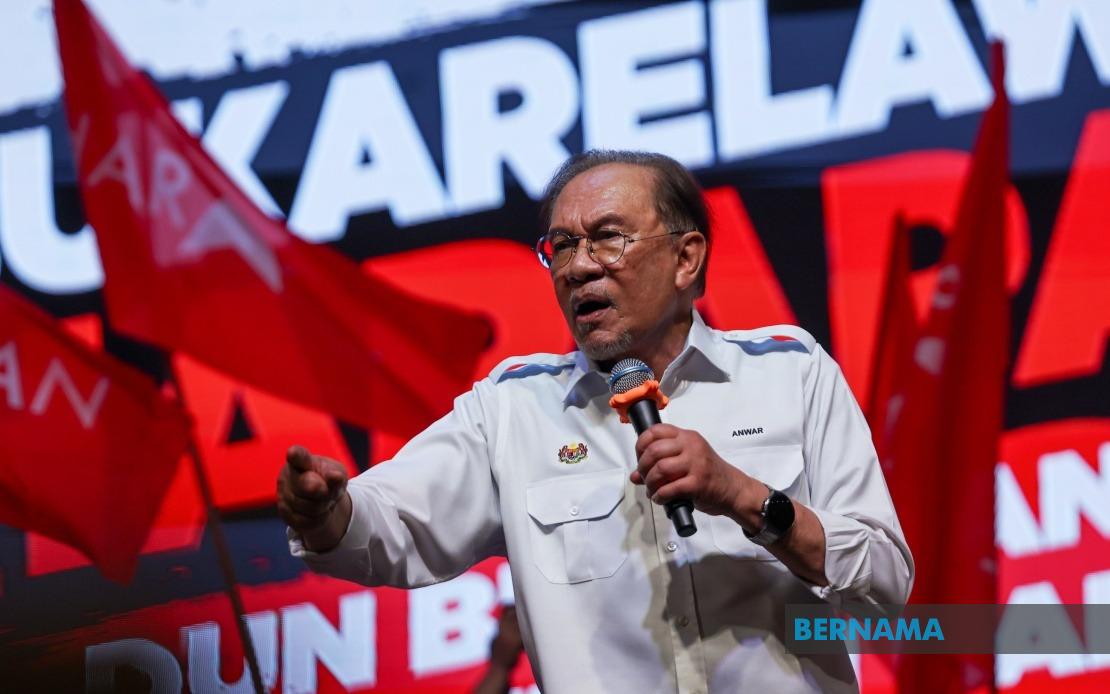
Prime Minister Datuk Seri Anwar Ibrahim moved to counter perceptions of the Democratic Action Party during a campaign stop in Muar on July 5, using the platform to underscore what he characterised as fundamental misunderstandings about the party's stance on constitutional protections for Malays and Bumiputeras. Speaking at a grassroots engagement event, Anwar dismissed suggestions from unnamed quarters that DAP harbours anti-Malay sentiment, framing such claims as deliberate mischaracterisations designed to inflame communal divisions.
The Prime Minister pointed to a concrete recent example to substantiate his assertion. When the government proposed designating 20.23 hectares in Bandar Malaysia as Malay Reserve Land, DAP offered no objection to the move, Anwar explained. This acquiescence, he suggested, demonstrated the party's acceptance of established constitutional frameworks governing Malay-Muslim interests—frameworks that remain largely beyond the boundaries of inter-communal political contestation in Malaysia's delicate constitutional architecture.
Yet Anwar's remarks extended beyond merely defending his coalition partner. He articulated a broader vision of governance that transcends what he termed the narrow sectarian thinking that has historically dominated Malaysian politics. As chairman of Pakatan Harapan and head of the Unity Government, Anwar positioned himself as arbiter of equitable treatment, insisting that his administration must balance community-specific initiatives with universalist principles of need-based assistance. This dual commitment reflects ongoing tensions within Malaysian politics between accommodation of communal interests and aspirations toward meritocratic, universalist policymaking.
Anwar listed specific examples of government support for Malay and Bumiputera communities, including expanded budgets for Perbadanan Usahawan Nasional Berhad (PUNB), the national entrepreneurship corporation, and targeted economic programmes. These allocations face no resistance from DAP, he stated, suggesting that the party's commitment to inclusive development does not translate into obstruction of community-specific initiatives. Yet he simultaneously stressed that this posture must not result in the marginalisation or deprioritisation of assistance to non-Malay communities, particularly those facing poverty.
The Prime Minister's framing of poverty assistance reveals an important shift in how the Unity Government conceptualises social support. Rather than distributing aid along strictly communal lines, Anwar emphasised need as the primary criterion. Poor Malays, poor Chinese, and poor Indians should all receive government backing, he insisted. This universalist approach potentially reshapers expectations around social safety nets, though it remains unclear whether such rhetoric translates into structural changes in how aid is disbursed or whether communal frameworks continue to dominate disbursement mechanisms in practice.
Broader economic concerns animated Anwar's remarks as well. Malaysia's current economic expansion, while welcome, risks benefiting only narrow segments of the population if not coupled with deliberate redistributive mechanisms, he warned. Anwar positioned the Unity Government as committed to channelling economic growth into tangible improvements in living standards across all communities. Housing, small business infrastructure, basic public amenities, and educational quality emerged as his priorities—areas where deficiencies disproportionately affect lower-income households regardless of ethnicity.
Educational advancement featured prominently in Anwar's vision for translating economic gains into shared prosperity. He called for enhanced educational quality that would expand opportunities for disadvantaged youth, suggesting that political elites bear responsibility for ensuring that younger generations benefit from the country's trajectory. This emphasis reflects concerns about educational disparities and their role in perpetuating economic inequality—dynamics that intersect with but are not entirely reducible to communal divisions.
Central to Anwar's remarks was a philosophical assertion about the nature of political power and public service. He cautioned against conceiving politics as an avenue for personal enrichment, instead articulating an aspirational vision of leadership as custodianship exercised for collective benefit. This framing implicitly critiques both previous administrations and political actors across the spectrum who have instrumentalised public office for personal aggrandisement—a phenomenon that has generated public cynicism across Malaysian society.
The timing of these remarks matters significantly. Anwar delivered them during the campaign period preceding the Johor state election, scheduled for July 11, in which 172 candidates contested 56 state assembly seats. Early voting occurred on July 7. The Johor contest represented an important test of the Unity Government's popularity, particularly given that state's political significance within Malaysian federalism. Anwar's defence of DAP and articulation of inclusive governance principles thus constituted not merely rhetorical positioning but active electioneering aimed at consolidating support among diverse constituencies.
For Malaysian readers monitoring coalition dynamics and governance priorities, Anwar's intervention signals several developments. First, tensions between DAP and its coalition partners regarding communal politics persist, requiring periodic public reassurance. Second, the Unity Government continues emphasising inclusive development as its signature approach, distinguishing itself from predecessors. Third, challenges remain in translating egalitarian rhetoric into institutional practices that genuinely prioritise need over communal affiliation. Whether such ambitions survive electoral competition and bureaucratic inertia remains a crucial question for Malaysia's political future.

