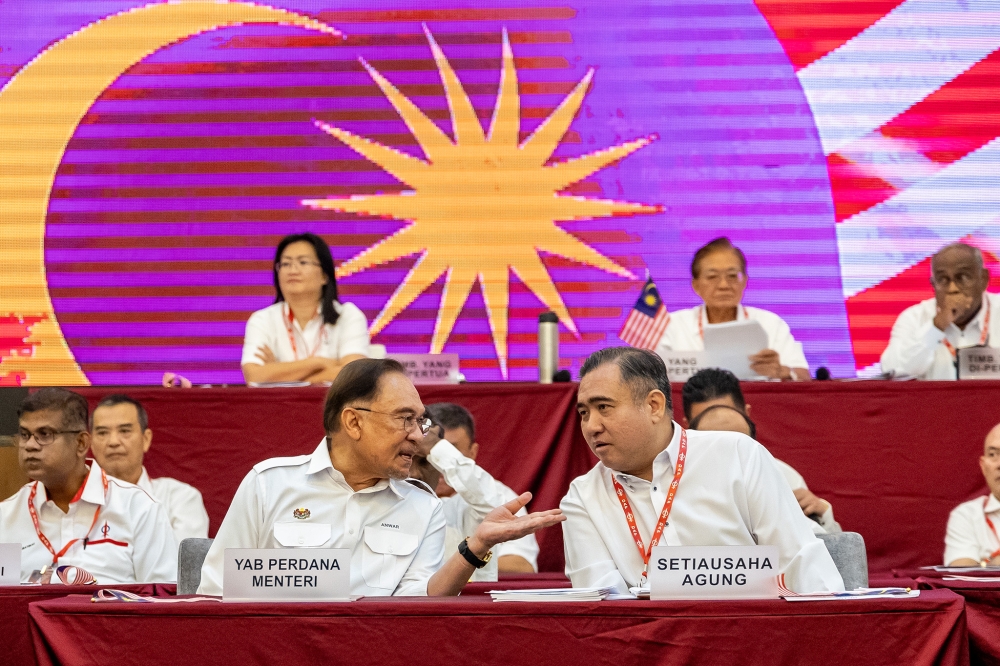
Transport Minister Anthony Loke has moved to extinguish rumours of potential fractures within Malaysia's ruling coalition, explicitly ruling out any scenario in which the Democratic Action Party abandons Pakatan Harapan under Prime Minister Datuk Seri Anwar Ibrahim's leadership. His statement represents an important clarification of DAP's commitment to the governing alliance at a moment when observers have questioned whether policy disagreements might create pressure for the party to reassess its position within the broader coalition structure.
Loke's comments address an undercurrent of frustration that has become increasingly evident within DAP circles regarding the pace at which the administration is implementing reforms that the party considers essential. This tension reflects a broader dynamic in Malaysian coalition politics, where parties with distinct ideological commitments must negotiate priorities and timelines with multiple partners holding different constituencies and political calculations. The gap between campaign promises and governing reality has historically been a flashpoint in Malaysian coalitions, and DAP's experience illustrates how this challenge plays out in the context of contemporary politics.
The minister's acknowledgment that slower reform represents an inherent cost of governing within a coalition structure signals a pragmatic reassessment by DAP leadership. Rather than framing delayed reforms as a temporary obstacle to be overcome, Loke's statement reframes sluggish implementation as a permanent feature of multiparty governance. This distinction matters because it suggests DAP has internalized lessons from previous coalition experiences and adjusted its expectations accordingly—a political maturation that prevents unrealistic timelines from becoming sources of destabilizing conflict.
DAP's calculus reflects several strategic considerations beyond immediate frustration with reform velocity. The party benefits substantially from its role within Pakatan Harapan, particularly given Malaysia's fragmented political landscape where no single party commands overwhelming electoral support. Remaining within the coalition provides DAP with ministerial positions, access to government resources, and the ability to shape policy from within—advantages that would be sacrificed if the party pursued an oppositional stance. Coalition discipline, therefore, represents a trade-off that DAP leadership appears willing to accept as the price of wielding governmental power.
The broader Pakatan Harapan arrangement itself faces inherent coordination challenges stemming from the coalition's internal diversity. Prime Minister Anwar Ibrahim must balance competing demands from PKR, the Malaysian Chinese Association component, and other partners while simultaneously managing criticism from both the government's right and left flanks. In this environment, DAP's continued participation provides a stabilizing anchor, particularly on matters where the party's urban, multiethnic base expects progressive stances on governance reform, civil rights, and institutional accountability.
For Malaysian voters invested in substantive political change, Loke's remarks carry mixed implications. On one hand, his unequivocal reaffirmation of coalition commitment suggests that governance will continue on its present trajectory, with reforms proceeding through established institutional channels rather than encountering revolutionary disruption. This predictability carries both advantages and disadvantages—it minimizes uncertainty but also constrains the pace of transformation that advocates for rapid change might otherwise demand. On the other hand, DAP's willingness to remain engaged within Pakatan Harapan, despite acknowledged frustrations, indicates that the party believes incremental progress remains superior to the alternative of withdrawal and renewed opposition status.
Regional observers monitoring Malaysian politics often identify coalition stability as essential for Southeast Asian regional dynamics. A fractured Pakatan Harapan could trigger broader political instability that might reverberate across the region's investment climate and diplomatic relationships. Loke's categorical rejection of exit scenarios therefore carries implications extending beyond domestic Malaysian considerations, as it reduces uncertainty regarding governmental continuity at a time when international partners value predictable leadership in the region.
The specific articulation of Loke's position—emphasizing that slower reforms represent governing reality rather than temporary inefficiency—reflects a maturation in DAP's political discourse. Rather than maintaining the implicit narrative that delays stem from obstruction by other coalition members, this framing acknowledges structural constraints inherent in democratic governance involving multiple stakeholders. Such intellectual honesty, while potentially disappointing to party activists accustomed to more combative rhetoric, actually strengthens DAP's negotiating position by demonstrating that the party understands coalition dynamics and maintains realistic expectations.
Looking forward, Loke's statements effectively close one chapter of speculation while opening another regarding the actual substance of negotiated reforms within Pakatan Harapan. If DAP has genuinely internalized the reality of slower change, the relevant political question shifts from whether the coalition will hold to what specific reforms will progress despite acknowledged constraints. This recalibration positions DAP to extract maximum value from its continued participation by establishing clearer benchmarks for achievements and maintaining pressure for incremental advancement on identified priorities.
The minister's remarks also implicitly communicate something important to DAP's voter base: the party leadership believes that remaining in government and implementing partial reforms through incremental processes serves the party's broader political objectives more effectively than opposition politics would. This message may disappoint activists frustrated by constrained progress, but it reflects calculations about durable political advantage that extend beyond individual parliamentary cycles. For Malaysia's political system, such commitments to stability and coalition discipline, even when expensive in reform terms, may represent precisely the kind of constraint that allows complex multiparty democracies to function effectively.

