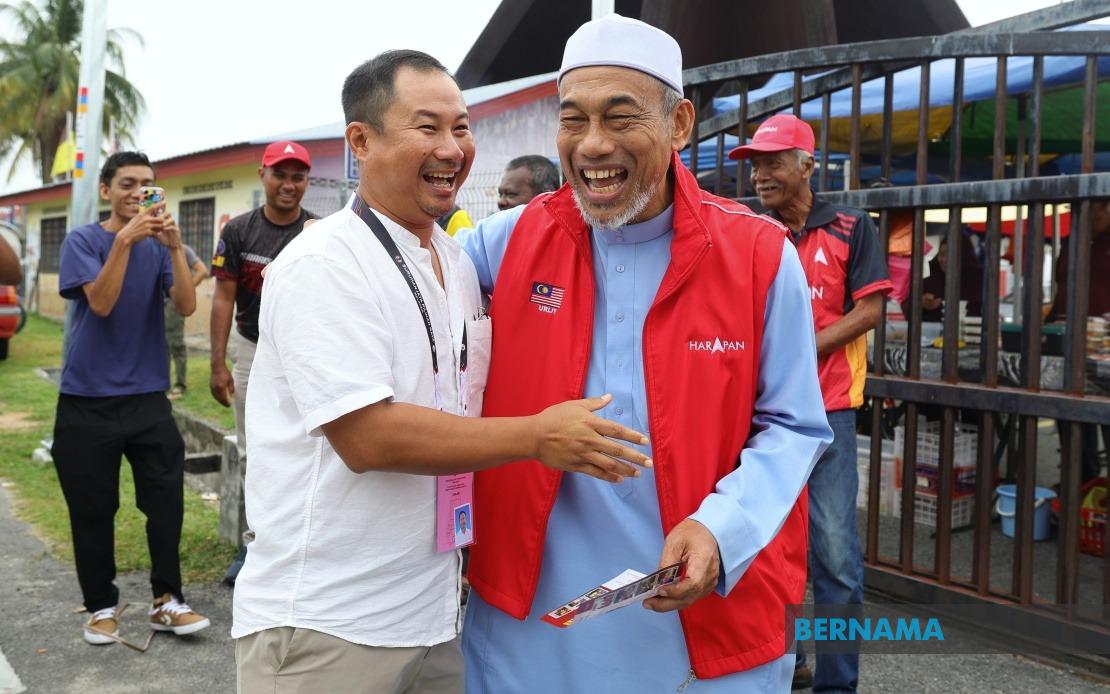
The Negeri Sembilan State Election has produced an unusual scenario at Kuala Klawang, where two family members representing opposing coalitions are battling for the same constituency seat. Incumbent Datuk Bakri Sawir, backed by Pakatan Harapan, and his cousin Danni Rais, campaigning under the Perikatan Nasional banner, crossed paths at Jelebu's weekend market during the second day of campaigning, drawing considerable public attention as voters and traders witnessed both candidates working the crowd in proximity to one another.
The encounter between the two cousins at the Kuala Klawang market demonstrated a refreshing departure from the sometimes acrimonious nature of Malaysian political contests. Rather than engaging in confrontation or stoking tension, both candidates maintained a respectful demeanor throughout the day, with observers noting that they managed to exchange pleasantries and even share jokes whilst pursuing their separate campaign agendas. The cordial atmosphere allowed onlookers to move freely between both camps, with many seizing the opportunity to engage with each candidate, capture photographs, and document the unusual spectacle for social media sharing.
The three-way contest for Klawang represents a complex political landscape within Negeri Sembilan's electoral dynamics. Beyond the Pakatan Harapan and Perikatan Nasional representatives, Bersatu's Muhammad Adib Musa enters the fray as a third candidate, dividing the coalition vote further. The constituency encompasses 13,355 registered voters, making this a moderately-sized seat within the state legislature. The presence of three significant contenders from different political formations suggests that no single bloc has overwhelming dominance in this particular area, potentially making ground-level campaign efforts and voter engagement particularly consequential.
Datuk Bakri's philosophical approach to the electoral contest reflects a perspective increasingly articulated by Malaysian political figures seeking to transcend partisan divisions. When discussing his competition with his cousin, the incumbent rejected framing the race as an extraordinary or contentious family struggle, instead characterising the election as an opportunity for both candidates to demonstrate their capacity to serve constituents. This reframing emphasises that political competition, even within families, need not devolve into personal animosity or breach family bonds.
The incumbent candidate's emphasis on regulatory compliance and institutional respect offers insight into his campaigning philosophy. Bakri highlighted that when local authorities identified irregularities with campaign flag placements on stadium fencing, his team immediately complied with removal directives without resistance or complaint. He articulated the principle that political actors must themselves exemplify the rule of law they expect from citizens, suggesting that violations or circumventing regulations—even minor ones—undermine the legitimacy of democratic processes.
Bakri's public appeal for campaign discipline extends beyond his personal conduct to encompass the broader party machinery operating within the state. His call for all political actors to ensure orderly and respectful campaign procedures reflects concern that emotionally-charged grassroots activism might escalate tensions, compromise public safety, or create divisions extending beyond the electoral period. This concern appears particularly salient in Malaysian constituencies where intense communal identities or historical grievances could be weaponised during high-stakes campaigns.
The Negeri Sembilan state election occurs within a broader context of Malaysian political transformation. Recent years have witnessed significant shifts in coalition alignments, with Perikatan Nasional emerging as a substantial counterweight to the long-dominant Barisan Nasional and Pakatan Harapan blocs. State-level contests therefore carry particular significance in testing evolving voter preferences and evaluating shifting political coalitions' respective resonance across different demographic and geographic segments.
The Election Commission's scheduling places early voting on July 28 and the main polling day on August 1, providing voters with a compressed campaign window. This abbreviated timeframe intensifies the importance of direct engagement and market-level campaigning, where candidates interact with voters in informal settings. The Kuala Klawang weekend market thus becomes a critical venue for candidate visibility and voter assessment, particularly for undecided voters observing how contenders conduct themselves under real-world conditions.
For Southeast Asian observers monitoring Malaysia's democratic trajectory, the Klawang contest illuminates evolving norms around political civility. Family-based political rivalries have occasionally generated significant acrimony in regional electoral contests, with personal animosities complicating governance and policy formulation post-election. The apparent mutual respect demonstrated by Bakri and Danni suggests that Malaysian political culture, despite heightened recent polarisation, retains capacity for dignified competition that preserves relationships and institutional functionality.
The broader implications for Negeri Sembilan's political future remain uncertain pending August 1 results. However, regardless of electoral outcomes, the Klawang contest will likely be referenced in discussions of Malaysian political maturity and the possibilities for competition conducted without descending into personal or communal conflict. For voters navigating increasingly fragmented political landscapes offering multiple credible options, demonstrations that family members and political opponents can maintain civility may influence electoral calculations, rewarding candidates perceived as principled and self-controlled over those perceived as opportunistic or inflammatory.

