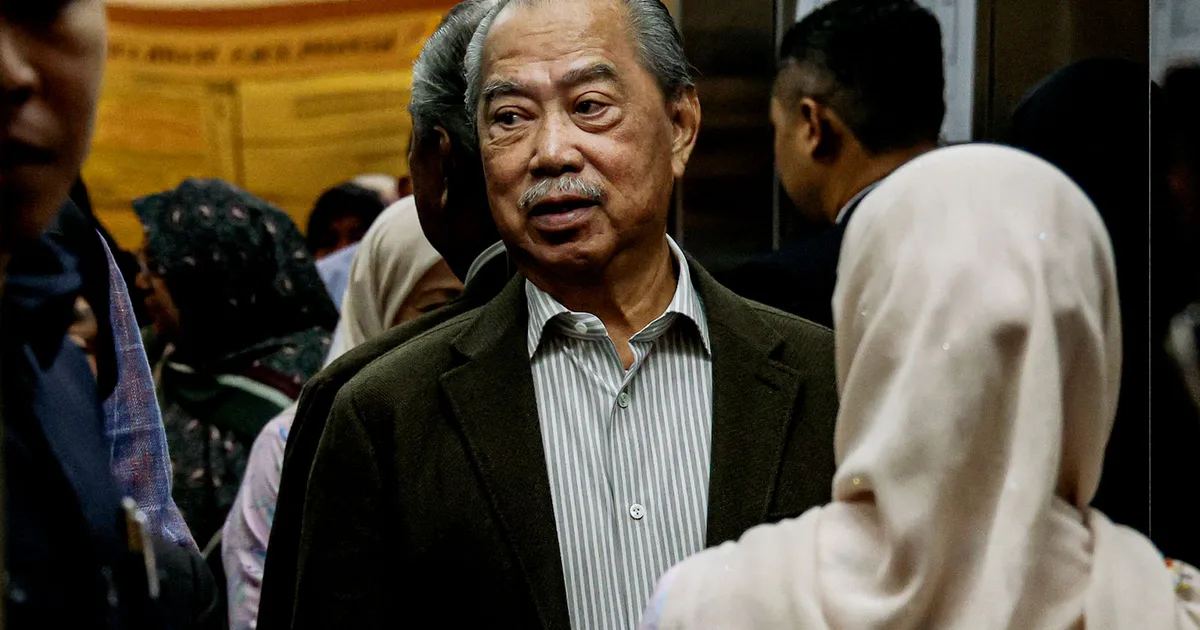
Evidence presented in court suggests that contractors vying for lucrative Jana Wibawa infrastructure contracts during the pandemic era encountered expectations to make monetary donations to Bersatu, Malaysia's ruling coalition partner. The testimony, delivered by businessman Azman Yusoff, provides a glimpse into the interconnected relationship between government procurement decisions and political fundraising that has drawn judicial scrutiny.
Azman Yusoff, a prominent figure in the contracting sector, expressed a sense of personal obligation to Muhyiddin Yassin, who served as Prime Minister during the acute phase of the Covid-19 crisis. His court testimony revealed that this perceived debt stemmed from measures the government implemented to support Bumiputera contractors during an economically turbulent period when construction activity had largely halted and many businesses faced existential threats. The Jana Wibawa programme, a major infrastructure stimulus initiative, emerged as a lifeline for the construction sector during this challenging timeframe.
The Jana Wibawa economic stimulus programme represented one of Malaysia's most substantial post-pandemic recovery investments, channelling billions of ringgit into infrastructure development across multiple sectors. The scheme prioritized Bumiputera participation in project allocation, making it particularly significant for indigenous Malaysian contractors who had endured months of project cancellations and payment delays. Given the programme's scale and the desperation of many contractors facing cash flow crises, securing Jana Wibawa contracts became extraordinarily valuable for business survival and growth.
The legal proceedings underscore broader concerns about potential blurred boundaries between government resource allocation and political party financing in Malaysia. When access to substantial government contracts becomes contingent on party donations or political affiliation, it raises fundamental questions about procurement fairness and democratic governance. Such arrangements, if substantiated, would represent a corruption risk that independent anti-corruption bodies are designed to prevent through transparent tendering processes and regulatory oversight.
For Malaysian contractors and the business community more broadly, the testimony highlights an uncomfortable reality that project opportunities sometimes intertwine with political considerations. Smaller Bumiputera firms, which typically have less financial flexibility than established corporations, may feel particularly vulnerable to implicit or explicit expectations regarding party contributions. This dynamic potentially distorts market competition and places ethical pressure on business owners to navigate the intersection of commerce and politics.
The testimony reflects patterns that have occasionally surfaced in Malaysian political discourse concerning the relationship between government spending and party funding. While political parties require financial resources for operations, campaign activities, and organizational development, these revenues should ideally derive from voluntary contributions rather than arise as perceived conditions for government benefits. The distinction matters profoundly for democratic accountability and institutional integrity.
Muhyiddin Yassin's tenure as Prime Minister coincided with Malaysia's initial Covid-19 response period, during which the government deployed various support mechanisms for affected industries. His administration's focus on supporting Bumiputera enterprises resonated with a significant constituency within Malaysia's business community, though these policies also generated debate about economic prioritization and resource allocation efficiency. The Jana Wibawa programme emerged as flagship infrastructure recovery strategy during this politically sensitive period.
For policymakers and governance observers, the court evidence raises practical questions about ensuring separation between legitimate political fundraising and government procurement decisions. Transparent, merit-based tender processes represent essential safeguards against arrangements where political donations become prerequisites for contract awards. Malaysia's anti-corruption framework, including the Malaysian Anti-Corruption Commission and the Courts, functions partly to identify and deter such arrangements through investigation and prosecution.
The implications extend beyond individual political parties or personalities to encompass broader institutional frameworks governing government spending. As Malaysia continues developing its governance structures and anti-corruption capacity, cases that examine connections between political financing and procurement decisions contribute to evolving jurisprudence and administrative practice. These proceedings generate precedent and public awareness that strengthens accountability mechanisms over time.
For Southeast Asian observers, Malaysia's handling of such matters carries regional significance. As other countries in the region grapple with similar governance challenges, how Malaysian institutions investigate and adjudicate allegations of corruption within political-procurement relationships influences broader regional conversations about democratic standards and anti-corruption practice. The transparency of legal proceedings and institutional responses matters considerably for regional governance benchmarking.
The courtroom testimony ultimately highlights tension between political necessity and governance principles that democratic societies continuously navigate. While recognizing that political parties require funding for legitimate operations, the legal system must simultaneously guard against corruption and ensure government resources serve public interest equitably. How Malaysian courts ultimately adjudicate these specific allegations will inform understanding of where institutional boundaries stand and how procurement integrity is protected against political influence.

