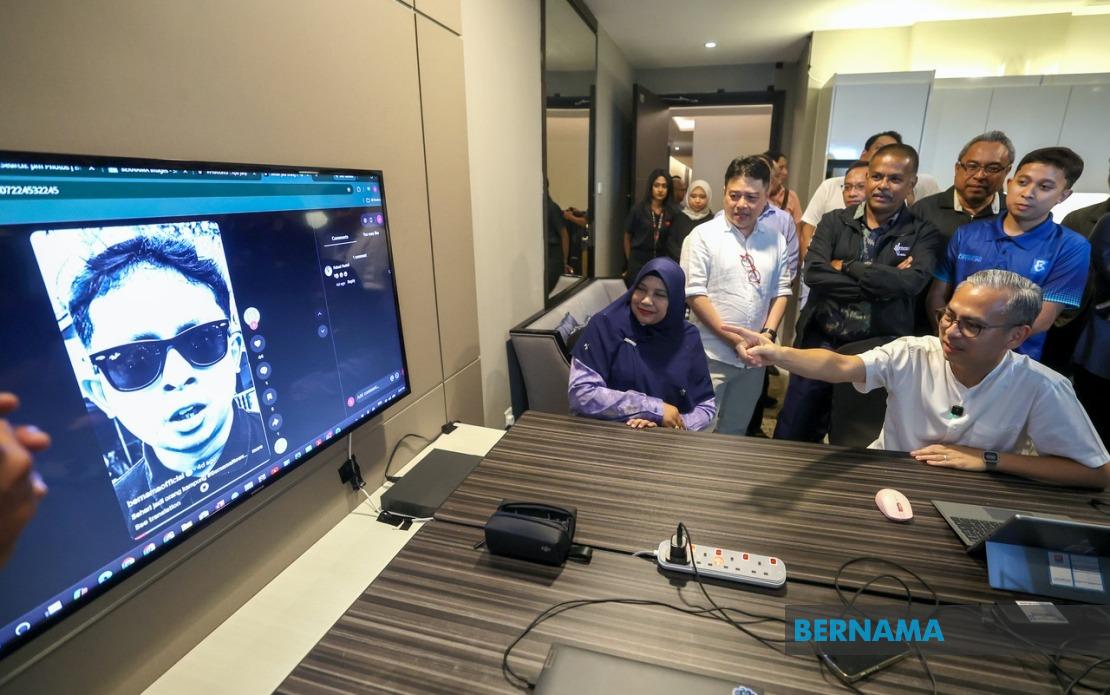
Malaysia's Communications Minister Datuk Fahmi Fadzil has publicly acknowledged the professional standards maintained by the Malaysian National News Agency (Bernama) in its coverage of the Johor state election, following an inspection of the agency's dedicated operations centre in Johor Bahru. The minister's visit on July 7 underscored the government's recognition of the role played by national news infrastructure in disseminating reliable electoral information to Malaysian voters during the contest for 56 state seats.
During his tour of the operations facility, Fahmi observed firsthand the working conditions and resources allocated to Bernama's election coverage team. The minister expressed satisfaction with the logistical arrangements in place, noting that the infrastructure and support systems enabled journalists and technical staff to perform their roles effectively. His remarks reflected broader government expectations regarding media responsibility during electoral contests, particularly in ensuring information flows accurately to the public during critical democratic exercises.
The Bernama operations centre mobilised a workforce of 44 personnel specifically for the Johor assignment, encompassing journalists, cameramen, and photographers deployed across the entire state. This team was tasked with tracking developments spanning the geographic breadth of Johor, from the southern constituencies around Endau through to Tanjung Surat and extending northwards into upper Johor. The scale of this deployment illustrated the resource commitment required to maintain comprehensive electoral coverage across a large state with multiple competing campaigns and parallel electoral developments.
Fahmi's commendation extended to Bernama's senior leadership, specifically chief executive officer Datin Paduka Nur-ul Afida Kamaludin and editor-in-chief Arul Rajoo Durar Raj, for orchestrating the preparations and coordination that underpinned the coverage strategy. The minister highlighted that the arrangements extended beyond basic infrastructure to encompass substantive support mechanisms designed to facilitate journalists' work under the demanding conditions inherent in covering a statewide election. This recognition acknowledged the institutional coordination required to execute large-scale news operations during time-sensitive political events.
The Johor state election itself represented a significant democratic exercise, with 172 candidates contesting the 56 available seats. The polling date of July 11 marked the culmination of the campaign period, while early voting had occurred on the day of Fahmi's visit. This compressed electoral timeline, characteristic of state elections in Malaysia, demanded rapid-response news operations capable of tracking multiple simultaneous developments across diverse geographical zones and reporting them to audiences seeking timely updates.
Bernama's role as Malaysia's official national news agency carries particular significance during electoral periods, as the organisation functions as a foundational information source for both mainstream media outlets and digital platforms. Fahmi's public appreciation of the agency's work reflected an implicit acknowledgment that quality electoral coverage depends on robust institutional media infrastructure. For Malaysian readers and regional observers, this visibility underscores how state apparatus and professional journalism interact during democratic processes, particularly in larger federal states like Johor where coordination challenges multiply.
The minister's extended visit to the operations centre—spending more than an hour inspecting facilities and engaging with working journalists and production staff—conveyed a symbolic message regarding government oversight of media performance during elections. By personalising his recognition through direct facility inspection and staff interaction, Fahmi reinforced the principle that electoral coverage constitutes a public service requiring institutional support and ministerial attention. Such gestures, while apparently routine, carry institutional weight in signalling expectations for professionalism and comprehensive reporting.
For Southeast Asian media observers, the Johor election coverage presented a case study in how national news agencies maintain editorial operations under electoral constraints. Bernama's distributed deployment across the state, with teams working from a centralised operations hub, reflected operational models increasingly adopted across the region as news organisations balance cost efficiency with the need for geographically dispersed reporting capability. The Malaysian experience provides a reference point for understanding how state media institutions adapt to electoral demands.
The timing of Fahmi's visit during the election process itself demonstrated the government's active engagement with media operations beyond rhetorical commitments to press freedom. By appearing at the operations centre while coverage was actively unfolding, the minister signalled that electoral journalism warranted sustained institutional attention. This contrasts with scenarios where ministerial engagement occurs only after electoral processes conclude, providing a snapshot of ongoing rather than retrospective government-media relations during pivotal democratic moments.
The coordination between Bernama's leadership and government officials reflected a broader institutional ecosystem within which Malaysian electoral journalism operates. The agency's positioning as both a state institution and a primary information source for competing political narratives requires careful navigation of professional standards and institutional relationships. Fahmi's remarks about satisfactory facilities and preparations implicitly endorsed Bernama's capacity to maintain this balance, suggesting confidence in the agency's ability to serve multiple constituencies—government, media clients, and the voting public—simultaneously.
Looking forward, the Johor election coverage will be evaluated not merely on Fahmi's impressions but on the actual information accessibility experienced by voters and media organisations throughout the campaign. The minister's public endorsement of operational standards establishes a benchmark against which coverage quality can subsequently be assessed. For Malaysian media professionals, such ministerial recognition carries both professional validation and implicit expectations regarding the standards to be maintained in future electoral coverage cycles.

