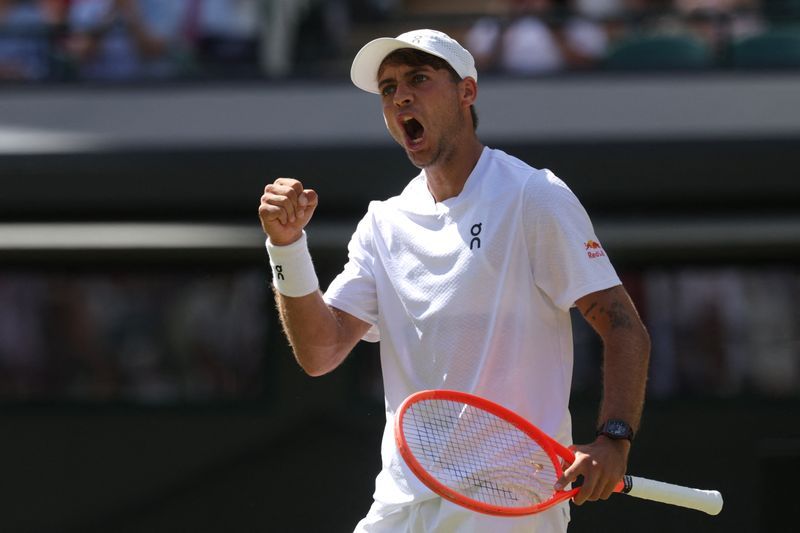
Flavio Cobolli's remarkable Grand Slam ascent continued at the All England Club on Monday as the Italian ninth seed dispatched Australian fifth seed Alex de Minaur in straight sets, advancing 7-5 7-6(4) 6-3 to secure his place in the Wimbledon quarter-finals. The 24-year-old's second-round victory marked another significant milestone in what has become an exceptional year on the sport's biggest stages, coming merely weeks after he reached the final of the French Open where he fell short of claiming his first major title.
Cobolli's performance on Court One demonstrated the composure and tactical acumen that has characterised his breakthrough campaign. He engineered the critical opening set through a decisive break of serve in the 11th game, securing the set in just 50 minutes. The Italian's ability to seize control at crucial junctures would prove essential throughout the match, as he navigated not only a determined opponent but also the oppressive heat that plagued the grounds this week. His victory places him among the tournament's survivors heading into the latter stages, with momentum distinctly in his favour.
The journey to the quarter-finals carries particular significance for Cobolli, as it represents his second consecutive appearance at this stage of Wimbledon. That consistency at a prestigious grass-court championship underscores the depth of his development as a competitor at elite level. The draw presents him with an opportune path forward, as his next opponent will emerge from the fourth-round contest between British prospect Arthur Fery and Bulgarian veteran Grigor Dimitrov—a matchup that could favour Cobolli depending on how the encounter unfolds and what condition the victor emerges in.
The second set revealed both the quality of De Minaur's resistance and Cobolli's capacity to respond to adversity. Trailing at 2-5, Cobolli engineered an improbable recovery by reeling off three consecutive games to force a tiebreak, which he claimed 7-4. The sequence illustrated his improved serve-and-volley capabilities and his willingness to take calculated risks when cornered. De Minaur, despite his seeding and ranking, could not sustain the pressure required to close out the set, a failure that ultimately proved costly in the context of the match.
The third set began with De Minaur seizing an initial advantage, breaking Cobolli's serve to assume a 2-0 lead. However, the Australian could not consolidate his position. Cobolli reversed the momentum immediately, claiming back the break in the sixth game and using his burgeoning confidence to take control of the closing exchanges. His explosive shot-making during these pivotal moments—the same aggression that has defined his breakthrough year—overwhelmed De Minaur's typically solid defensive game.
Extraordinary heat conditions disrupted the match at critical moments, forcing two stoppages in play as spectators struggled with the intense temperature. The first halt came in the second set when a fan fell ill, prompting medical intervention and a break in competition. A second stoppage followed shortly thereafter, with both players pausing to allow officials to manage the crowd situation. Rather than viewing these interruptions negatively, Cobolli reflected on his fortune that the matches could proceed with only two such breaks, acknowledging the unusual conditions both competitors faced.
The respective players' mutual respect became evident during the match breaks, with Cobolli and De Minaur exchanging words courtside. The Italian revealed that De Minaur warned him to anticipate further heat-related disruptions, demonstrating the camaraderie that often characterises professional tennis despite the competitive intensity of the moment. Cobolli spoke warmly of his Australian opponent, expressing genuine appreciation for De Minaur's playing style and competitive approach, even as he worked methodically to dispatch him from the tournament.
Cobolli attributed his successful passage through three rounds to his ability to preserve energy amid a gruelling calendar. The Italian has expressed concern about fatigue accumulating through the tour season, making his efficient straight-sets victory particularly satisfying. By avoiding a protracted four or five-set struggle in such oppressive heat, Cobolli has positioned himself to recover adequately before his quarter-final clash. The mental and physical toll of major championships demands such efficiency, especially for players targeting extended runs through later rounds.
When asked about his plans during the interval before his next match, Cobolli provided characteristically candid and lighthearted responses that revealed his approach to balancing the demands of elite sport with personal wellbeing. Rather than studying his potential opponents, the Italian indicated his intention to seek respite from the heat through ice cream consumption—a refreshingly human perspective from an athlete operating at the highest level. He also disclosed that his father would prepare his evening meal, featuring pasta with tomato and onion, suggesting the comfort of family presence during this important tournament.
Beyond Wimbledon, Cobolli mentioned intentions to maintain some recreational activities, including the possibility of practising on grass courts and watching football, specifically the World Cup encounters between Spain and Portugal. This mental diversification reflects a maturity in his approach to the sport, recognising that consistent championship performance requires not only focused preparation but also meaningful recovery and engagement with interests beyond tennis.
Cobolli's trajectory through 2024 has redrawn expectations for the Italian contingent in men's professional tennis. His run to the French Open final surprised many observers, yet his sustained excellence at Wimbledon suggests this represents a genuine elevation in his capabilities rather than a fleeting hot streak. For Malaysian and Southeast Asian followers of professional tennis, Cobolli's emergence as a top-10 player offers a compelling reminder that the sport remains open to breakthrough campaigns, with younger players capable of challenging the established elite through improved fitness, tactical innovation, and mental resilience. His continued advancement at Wimbledon will provide further evidence of whether this year's surge represents a new baseline for his career or a singular breakthrough season.

