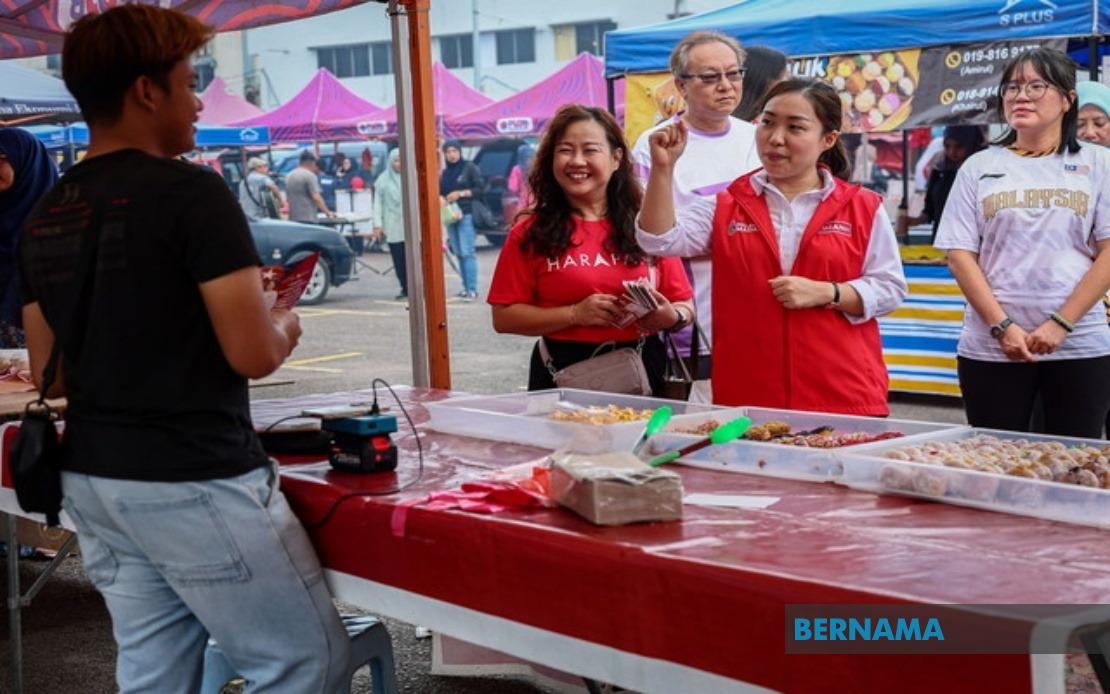
Chu Poh Yee, a young lawyer representing Pakatan Harapan in the Mengkibol state constituency, is mounting a campaign centred on three interconnected policy pillars: revitalising basic infrastructure, unlocking economic potential, and strengthening community welfare provisions. Speaking ahead of Johor's state election on July 11, she articulated a vision that seeks to address immediate service deficits while positioning Kluang for sustainable development that benefits residents across income levels and demographics.
The infrastructure component of Chu's platform reflects widespread resident concerns about service quality in the district. Beyond conventional road rehabilitation, her proposals encompass expanding urban agriculture initiatives and community farming projects designed to improve food security and generate supplementary income for household-dependent families. This approach acknowledges the practical reality that infrastructure investment in smaller urban centres must deliver tangible quality-of-life improvements rather than purely symbolic development.
Economically, Chu identifies Kluang's existing business foundation as a springboard for accelerated growth rather than starting from weakness. She argues that the district possesses untapped capacity that can be mobilised through expanded entrepreneurship platforms and targeted employment creation, particularly initiatives capable of retaining younger professionals and families who might otherwise migrate to larger economic centres such as Johor Bahru or the Klang Valley. This concern reflects a broader Malaysian challenge: smaller district economies often struggle to retain educated talent, eroding their long-term competitiveness and social cohesion.
The Kluang Rail Festival serves as Chu's concrete example of how creative, locally-anchored tourism can generate economic spillovers. She contends that such events demonstrate the district's capacity to attract visitors and create business opportunities across hospitality, retail, and service sectors when managed strategically. This reflects emerging recognition within Malaysian politics that authentic, heritage-linked tourism often delivers more sustainable returns than generic development projects.
Chu's advocacy for strengthened female workforce participation addresses a demographic reality: Malaysia's female labour force participation, though improving, remains below regional peers and below the nation's own economic requirements. She specifically targets the childcare infrastructure gap, identifying well-equipped community childcare centres as essential enabling infrastructure for working parents. This positions childcare not as a family matter but as legitimate public policy infrastructure, comparable to roads and utilities.
The practical barrier she highlights—enabling women to manage career advancement without impossible trade-offs between professional and family responsibility—represents a structural constraint that affects household incomes, consumer demand, and economic productivity. Malaysia's persistent gender wage gap and workforce participation disparities partly reflect precisely these infrastructure and support gaps that Chu identifies.
The campaign itself has encountered deliberate friction, including vandalism of Pakatan Harapan materials, which Chu characterises as provocation. Her response—renewed determination rather than escalation—follows a familiar Malaysian political pattern whereby both coalition candidates must demonstrate resilience while remaining non-inflammatory, particularly in constituencies with mixed demographic compositions like Kluang.
Mengkibol represents one of 14 straight contests in this Johor election, pitting Chu against Barisan Nasional candidate Yap Zhi Peng. This binary configuration emerged from Malaysia's complex electoral geometry, where seat distributions between dominant coalitions sometimes produce direct two-candidate races, intensifying resource concentration and voter attention on individual candidate competence and programmes.
The broader 2024 Johor state election context encompasses 172 candidates competing across 56 state constituencies. Polling occurs on July 11, with advance voting on July 7, following Malaysia's standardised electoral procedures. State elections in Johor carry significance beyond local governance: the state represents Malaysia's second-largest economy by nominal gross domestic product and historically functions as a bellwether for nationwide political sentiment, particularly regarding urban-rural coalition preferences and Malay-majority voter behaviour.
Chu's campaign articulation—emphasising practical service delivery, economic inclusion, and targeted social infrastructure—mirrors broader Pakatan Harapan strategy in 2024 state elections of focusing on governance competence and tangible improvements rather than ideological positioning. This reflects political evolution following the 2018-2023 federal government experience, where PH faced public criticism regarding implementation capacity despite rhetorical commitments.
For Kluang residents evaluating their choice, the contest ultimately frames competing visions of district development: whether incremental improvement through existing governance frameworks suffices, or whether new political representation might accelerate infrastructure modernisation and economic repositioning. Chu's specific prioritisation of infrastructure, entrepreneurship enablement, and family support services provides voters with measurable benchmarks against which to evaluate incumbent performance and opposition promises.

