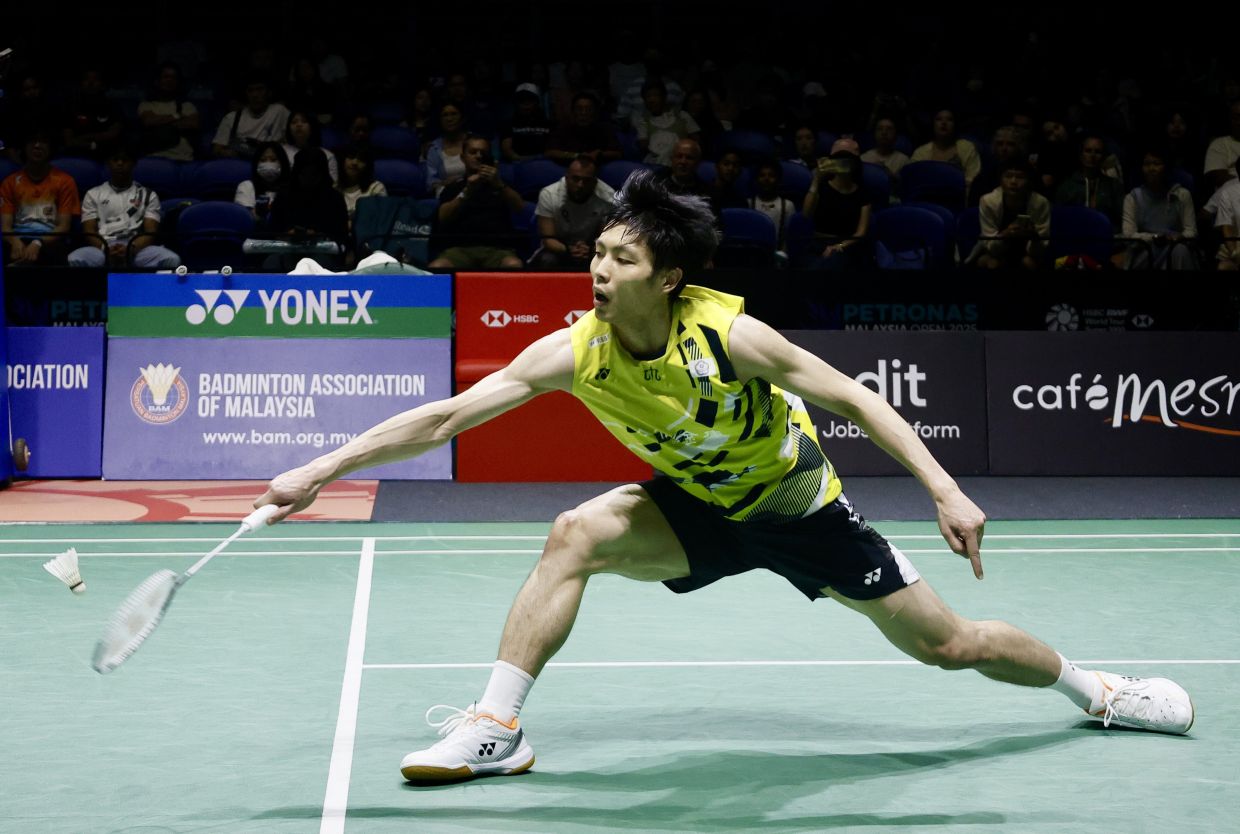
Taiwan's Chou Tien-chen has defied the conventional wisdom that athletic peak years inevitably slip away with age, clinching the prestigious China Open title at 36 to etch himself into badminton history. The veteran shuttler's triumph at the Changzhou Olympic Sports Centre represents not merely a personal milestone but a watershed moment for Taiwanese men's singles badminton, snapping a three-decade championship drought stretching back to Fung Permadi's 1996 victory on the same circuit.
Chou's path to the title was neither straightforward nor inevitable. Facing France's Toma Junior Popov, a player a decade his junior, the Taiwanese demonstrated the kind of championship mettle that separates champions from contenders across a gruelling 64-minute encounter. Though he surrendered the second set 7-21, Chou recovered with the composure befitting a seasoned professional, claiming the opening frame 21-15 and sealing the match with a decisive 21-13 performance in the decider. The scoreline itself underscores a critical narrative—that youth and physical conditioning alone provide insufficient advantage against experience, tactical acumen, and unwavering mental fortitude.
The magnitude of Chou's achievement becomes starkly apparent when contextualised against the broader landscape of professional badminton. By capturing a Super 1000 crown at his age, he has become the oldest player to claim such a prestigious BWF World Tour title, a record that fundamentally challenges assumptions about athletic longevity and performance trajectories in the modern era. For a region watching closely as athletes from China, Japan, and Indonesia dominate international badminton, Taiwan's breakthrough represents a rare assertion of relevance at the sport's highest competitive tier.
What makes this victory particularly noteworthy is its improbability from Chou's own perspective. Just seven days earlier, he had suffered an embarrassing first-round exit at the Japan Open to Ireland's Nhat Nguyen, a result that might have prompted many veteran players to contemplate retirement rather than redemption. Instead, Chou's response demonstrates a professional infrastructure and mindset capable of rapid tactical and physical recalibration. The player himself attributed this turnaround to meticulous attention to conditioning, nutrition, and recovery protocols overseen by his physiotherapist Victoria Kao and her supporting team.
For Malaysian badminton observers and Southeast Asian enthusiasts more broadly, Chou's journey offers instructive lessons about the relationship between investment in player support systems and competitive outcomes. The willingness to invest substantially in physiotherapy, nutritional science, and dedicated coaching—elements sometimes treated as luxuries rather than necessities by developing badminton programmes—appears integral to sustaining elite-level competitiveness into the fourth decade of life. As Malaysia's own badminton hierarchy contemplates strategies to maintain relevance against increasingly formidable Chinese and Japanese opposition, the infrastructure supporting Chou merits serious examination.
Chou's quoted reflections following his triumph reveal a philosophical sophistication that transcends mere technical skill. His emphasis on maintaining positivity after defeat, treating training as a non-negotiable daily discipline even following disappointment, and remaining grateful for support networks speaks to a psychological maturity that younger competitors may still be developing. In an era when social media amplifies every loss and commentators dissect setbacks with surgical precision, Chou's capacity to compartmentalise disappointment and channel it constructively within days separates champions from merely talented athletes.
The broader implications of Chou's China Open victory extend beyond individual accomplishment to questions about competitive depth across Asian badminton. That a 36-year-old could claim a Super 1000 title by defeating a talented French player suggests potential soft spots in certain competitive cohorts. Conversely, the quality of opposition Chou encountered throughout the tournament—culminating in victory over a formidable young challenger—indicates that elite-level badminton remains intensely competitive at this tier. For Malaysia, where men's singles has increasingly receded from the championship conversation dominated by doubles specialists, observing Chou's pathway and tactical execution offers valuable strategic insights.
Fung Permadi's previous China Open triumph in 1996 now belongs to the historical record rather than contemporary conversation, having occurred three decades before Chou's success. This gap reflects the tournament's prestige—few players win it, fewer still defend or repeat victories, and even fewer sustain careers long enough to claim their first Super 1000 title in their fourth decade. Chou has joined an exceptionally exclusive cohort, one that includes perhaps a handful of athletes across badminton history who have performed at the highest level past age 35.
The tournament results surrounding Chou's victory reveal a badminton landscape where established powerhouses—particularly Indonesia, China, and Japan—continue to dominate multiple disciplines. Fajar Alfian and Shohibul Fikri's men's doubles triumph, Akane Yamaguchi's women's singles success, and the Chinese victories across other categories underscore how concentrated competitive advantage remains geographically. Against this backdrop, Chou's singular achievement gains additional significance, serving as a reminder that individual excellence, strategic preparation, and psychological resilience can occasionally transcend collective advantages.
Looking forward, Chou's example may inspire both younger Taiwanese players and regional competitors to reconsider assumptions about athletic retirement ages and the relationship between investment in player welfare and competitive success. His testimony that success requires constant attention to physical maintenance, technical development, and psychological discipline applies universally across badminton, yet few achieve what Chou has demonstrated. For Malaysian badminton administrators, coaches, and players, the question now centres on whether similar infrastructure investments might produce comparable longevity and late-career excellence among their own athlete rosters.

