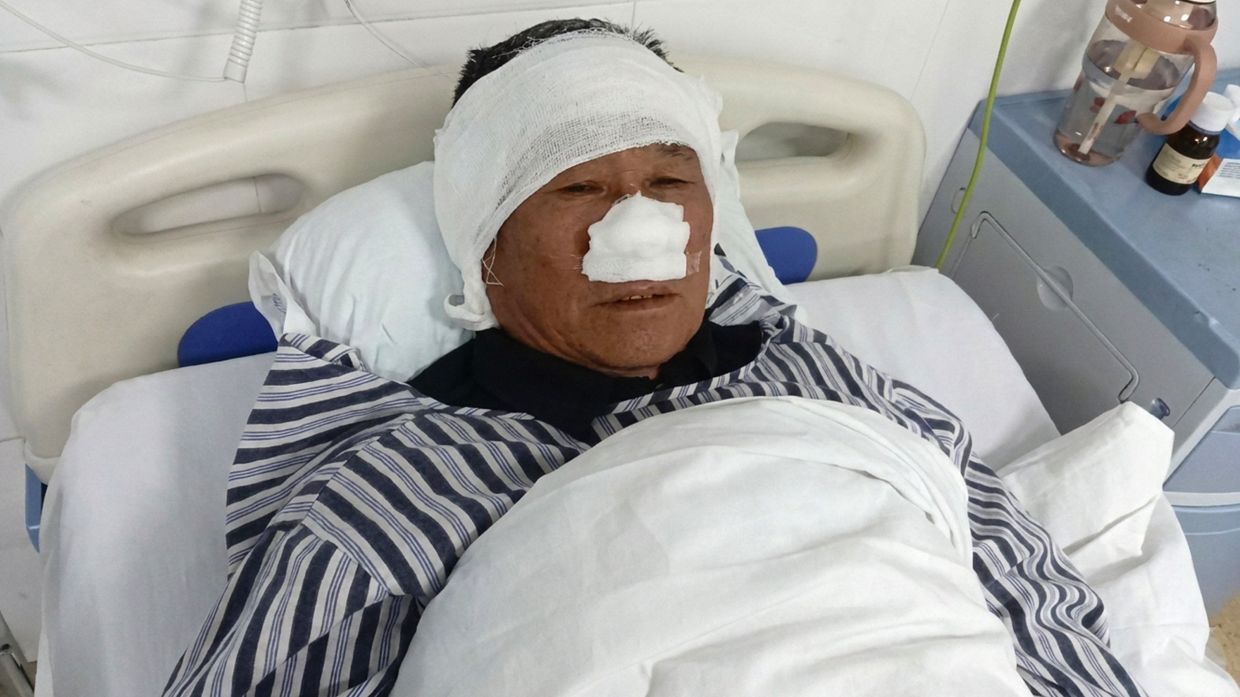
Zeng Fanlin, a 69-year-old from Chenzhou in Hunan province, has been formally recognised by the Chinese government as a national hero following an extraordinary act of courage in April that left him permanently disfigured. The former village official and volunteer mediator rushed to help a woman being attacked by a stranger, an intervention that cost him most of his nose but likely saved her life. His story has sparked widespread admiration across China and raises important questions about civic responsibility and the price of heroism in contemporary society.
The incident unfolded when a man in his twenties entered Zeng's village in a violent state, attacking random pedestrians and kicking at doors in what witnesses described as an uncontrolled rampage. The situation escalated when the attacker targeted a woman riding an e-bike, seizing her by the neck and creating an immediate threat to her life. Bystanders at the scene, understandably fearful of the aggressor's unpredictable behaviour, chose to contact police rather than intervene directly, leaving the woman in immediate danger of strangulation.
Zeng's response was instinctive and selfless. Despite the clear physical threat posed by the assailant, he moved toward the commotion and tackled the attacker, initiating a struggle that would have permanent consequences for his own body. Two other villagers eventually joined him in subduing the man, and together they managed to restrain him until police arrived at the scene. Throughout this violent confrontation, the attacker bit away a significant portion of Zeng's nose—a brutal injury that would require months of medical intervention and reconstruction.
What distinguishes Zeng's actions is not merely the spontaneous decision to intervene, but his commitment to maintaining control of the situation despite experiencing severe pain and trauma. He held fast to the attacker until law enforcement arrived, ensuring that the suspect could be taken into custody and preventing any possibility that the woman might suffer further harm. The suspect remains under investigation, with police attributing his violent outburst to a loss of emotional control. Under Chinese law, intentional serious injury carries sentences ranging from three to ten years imprisonment, suggesting significant legal consequences ahead for the attacker.
The medical consequences of Zeng's heroism proved extensive and complex. Doctors at the hospital confirmed that most of his nose had been lost, creating substantial reconstruction challenges with risks of long-term complications and scarring. The medical team designed an ambitious restoration plan requiring at least six months of recovery, with total costs exceeding 70,000 yuan, approximately US$10,000. Government support covered these substantial medical expenses, acknowledging both the public nature of the incident and the heroic context in which the injury occurred.
Zeng has undergone two surgical procedures to date. Medical specialists rebuilt his nose using a skin graft harvested from his own scalp and restored the nasal wings to restore normal breathing function. Despite these interventions and their technical success, Zeng continues to experience daily pain from the injury. Yet his perspective on what he has endured remains remarkably philosophical. In comments to local media, he reflected that compared to the life he saved, the physical sacrifices he made were entirely worthwhile, a statement that resonates with his lifelong commitment to community service.
Zeng's background illuminates the values that drove his actions during the April incident. Orphaned early in life, he grew up supported by his villagers and later received government assistance to attend school without cost. This foundation of communal care and educational opportunity shaped his adult conviction that he had an obligation to repay society's generosity through his own service. He became a volunteer mediator, dedicating himself to resolving local disputes and maintaining social harmony within his community. This pattern of civic engagement extends back several years—in 2016, he reportedly helped local police capture a thief, demonstrating a consistent willingness to assist law enforcement and protect village safety.
His daughter has provided insight into his character, describing him as someone with an acute sense of justice who simply cannot remain passive when witnessing wrongdoing. This moral framework, instilled by his own experiences of receiving help when most vulnerable, appears to have guided his decision to act during the April attack despite the obvious physical danger. For Zeng, intervening was not a choice requiring deliberation but rather a reflexive response aligned with his core values and years of community service.
Recognition of Zeng's sacrifice came through multiple channels. The Alibaba Foundation and local media outlets jointly awarded him 20,000 yuan in recognition of his bravery, providing some financial acknowledgment of his sacrifice. More significantly, on July 9, the Chinese government included Zeng among 86 individuals named in its latest list of "national heroes for a just cause," elevating his story from a local incident to a matter of national symbolic importance. This formal recognition reflects how Chinese authorities view exceptional acts of civilian courage that embody wider societal values.
The public response to Zeng's story has been overwhelmingly supportive, with online commentators expressing admiration for his selflessness while calling for severe punishment of the attacker. One observer captured the sentiment succinctly, stating that Zeng represents "a true everyday hero" and emphasising that good people should not have to sacrifice their health and wellbeing without the criminal justice system responding appropriately. This sentiment underscores a broader social contract—that communities should honour and protect those who sacrifice for others' safety.
For Malaysian and Southeast Asian readers, Zeng's story raises important questions about community responsibility and the relationship between individual action and state support. His case illustrates how traditional village-based systems of dispute resolution and mutual aid, still prevalent across much of Asia, can complement formal law enforcement. It also demonstrates the importance of financial and medical support systems for those injured in service to their communities. As societies in the region continue developing, there is value in both preserving community-oriented values that motivate heroic intervention and ensuring that heroes receive appropriate medical care and recognition when their sacrifice exacts physical costs.

