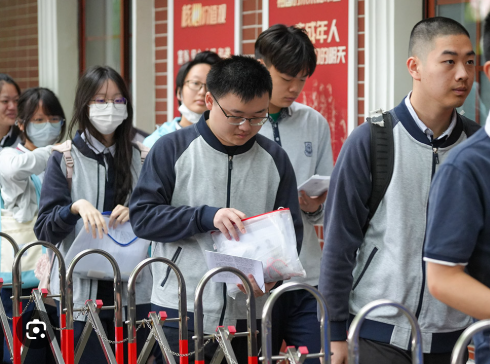
Chinese universities are taking aggressive steps to combat examination fraud, with multiple institutions now strictly prohibiting students from bringing any smart devices—including smartwatches, fitness trackers, wireless earbuds and intelligent eyewear—into testing venues. The coordinated enforcement drive reflects growing alarm over how rapidly advancing wearable technology is being weaponised by students seeking academic shortcuts, forcing education authorities to implement increasingly sophisticated counter-measures that extend far beyond traditional examination security protocols.
The scale of the problem became evident in late June when several prestigious institutions publicly disclosed cheating incidents involving high-tech devices. South China Agricultural University in Guangdong province issued a stern warning on July 1 after uncovering multiple cases of students attempting to breach examination integrity using electronic gadgets. The university's notice explicitly blacklisted any device capable of communication, photography, information storage or transmission—a deliberately broad category designed to close loopholes as technology evolves. The consequences are severe: bringing prohibited items into examination halls results in automatic zero marks for the subject, a demerit that bars students from awards, scholarships and Communist Party membership, plus potential additional disciplinary action.
Other major institutions reported similar violations during the examination season. Xuchang University in Henan province documented cases where students had smuggled devices containing exam materials into testing rooms, while others used communication-capable gadgets to receive answers remotely. Hubei University of Technology imposed a ten-month demerit on a student caught bringing an electronic device with exam content into a final English examination. Zhongnan University of Economics and Law specifically warned against smart glasses capable of wirelessly transmitting answers and photographing examination papers, highlighting how these ostensibly innocent accessories have become tools for systematic cheating.
To combat these sophisticated methods, universities are deploying artificial intelligence-powered proctoring systems that monitor examination halls in real time. These systems can identify suspicious behaviour patterns—students carrying unidentified objects, passing items between desks, frequent head movements, or hands disappearing beneath desk level—flagging potential cheating attempts for human review. The technology represents a significant escalation in examination security, moving beyond traditional invigilator oversight to algorithmic surveillance that never tires and operates with perfect consistency across large examination cohorts.
The Ministry of Education in Beijing has reinforced these local crackdowns with national policy directives. Under official regulations governing misconduct in national education examinations, bringing devices capable of sending or receiving information constitutes cheating regardless of whether they are actually used, a strict liability approach that eliminates any ambiguity or claims of innocence. In June, the ministry issued explicit warnings ahead of the 2026 gaokao (national college entrance examination), reminding candidates that merely possessing such devices in examination venues constitutes violation, not just their activation or use. This preemptive messaging aims to establish zero-tolerance expectations before the high-stakes examination that determines university placement for hundreds of thousands of Chinese students annually.
The technological sophistication now available to potential cheaters has accelerated dramatically. A December 2025 study by researchers at Hong Kong University of Science and Technology demonstrated how commercially available smart glasses, when connected to the GPT-5.2 AI model, could enable a wearer to read answers displayed on the lens and complete a Computer Network Principles examination in just 30 minutes with a 92.5 per cent score. This proof-of-concept, published in China Newsweek, shocked educators by illustrating how accessible the technology had become—these were not bespoke devices constructed by engineering teams, but modified off-the-shelf products that could theoretically be obtained by any student with technical knowledge and financial means.
Industry insiders warn that detection will become progressively harder as devices miniaturise. Lin Che, a product manager with extensive experience in smart eyewear development, noted that universities have not kept pace with technological advancement, creating regulatory gaps that enterprising students exploit. As smart glasses increasingly resemble ordinary spectacles, distinguishing them from legitimate eyewear becomes nearly impossible for human proctors. Lin proposed that manufacturers adopt design features making devices more conspicuous—such as visible camera indicators—to assist proctoring staff in identifying suspicious items. This suggestion reflects an uncomfortable reality: technological solutions alone cannot solve the problem; manufacturers must be persuaded to prioritise examination integrity over sleek, inconspicuous design.
For Southeast Asian readers and policymakers, the Chinese experience offers cautionary lessons. As wearable AI technology proliferates globally, similar cheating methods will inevitably migrate to educational institutions across the region. Malaysian, Singaporean and Thai universities may need to reassess their own examination security protocols before widespread smart device cheating becomes endemic. The challenge extends beyond mere policy—it requires coordination between universities, technology companies, education ministries and examination bodies to establish clear standards, detection capabilities and enforcement mechanisms.
The fundamental tension underlying this arms race between cheaters and institutions reflects how artificial intelligence has fundamentally altered the cheating landscape. Previous generations of academic misconduct involved memorisation, hidden notes or collusion between test-takers. Contemporary cheating outsources cognition itself to AI systems, transforming examination halls from tests of individual knowledge into tests of device access and technical sophistication. Universities must now defend not just against dishonest individuals but against automated intelligence systems designed to replicate human understanding at superhuman speed and accuracy.
China's aggressive response—combining hardware bans, AI-powered surveillance and draconian penalties—represents one possible future for examination governance. Whether this approach proves sustainable, legally defensible or effective remains uncertain. The alternative risks allowing AI-powered cheating to proliferate until examination credentials become meaningless. For now, Chinese universities have chosen maximalist enforcement, betting that sufficiently severe consequences combined with technological detection will deter students from attempting high-tech shortcuts. Whether this strategy succeeds will significantly influence how education systems worldwide respond to similar technological disruption in coming years.

