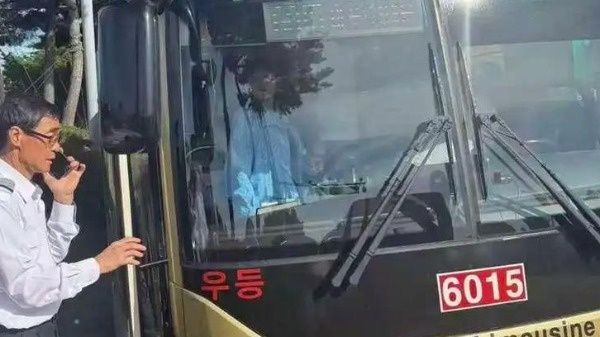
A harrowing incident on a Seoul airport highway last Saturday afternoon ended with swift intervention from an unlikely group of heroes — Chinese tourist women who prevented what could have been a catastrophic accident when the bus driver suddenly lost consciousness. The No 6015 airport bus, travelling from central Seoul towards Incheon International Airport, carried more than a dozen passengers, predominantly Chinese visitors, when the driver collapsed without warning. In the critical seconds that followed, a combination of clear thinking and coordinated action from multiple passengers kept the out-of-control vehicle from causing further harm to those aboard.
Sun Qian, a healthcare professional in her mid-thirties from Nanjing, Jiangsu province, was seated in the second row directly behind the driver when the emergency unfolded. Her account of those initial moments captures the urgency and confusion of the situation. Observing the bus beginning to veer dangerously and scrape against a roadside guardrail, Sun reacted instinctively by moving forward to grasp the steering wheel, attempting to stabilise the vehicle's trajectory. The scale of her task was immediately apparent — the large coach steering wheel proved unwieldy even for someone with driving experience, a factor that heightened her nervousness throughout the crisis. Yet despite her anxiety, Sun maintained her grip and focus, recognising that her actions in those opening seconds were critical to preventing a worse outcome.
Her efforts were matched by another passenger who simultaneously scrambled to locate the brake mechanism. Working in concert with Sun's steering efforts, this passenger managed to activate the emergency brake button whilst also pulling the handbrake, creating a multi-pronged approach to bringing the vehicle under control. The coordination between these individuals, though entirely spontaneous and unplanned, demonstrated the kind of instinctive cooperation that often emerges in moments of genuine crisis. Sun, who possesses fluency in Korean, would later leverage this linguistic skill when the situation demanded professional emergency response.
Sitting adjacent to Sun was her friend Du He, 33, also from Nanjing, who responded with equal decisiveness. Du's initial instinct was to attempt a traditional first-aid technique, pinching the driver's philtrum — a pressure point in classical Chinese medicine believed to revive unconscious individuals. However, as she performed this intervention, Du quickly recognised more ominous signs. The driver's face was turning purple, and Du realised he had stopped breathing entirely. This observation signalled the onset of a far more serious medical emergency than an episode of fainting.
Recognising the gravity of the situation, the passengers transitioned from crisis management to emergency medical response. Multiple passengers began performing cardiopulmonary resuscitation on the driver in coordinated shifts, with individuals taking turns applying chest compressions. This collective effort represented a striking demonstration of how ordinary people can draw upon basic medical knowledge in extraordinary circumstances. Sun utilised the driver's mobile phone to contact emergency services, communicating their location and situation entirely in Korean — a crucial detail given that language barriers could easily have delayed or complicated the response of first responders.
Despite their efforts, the passengers were unable to reverse the medical catastrophe unfolding before them. According to South Korea's Yonhap News Agency, the driver was found in cardiac arrest and transported to hospital, where he succumbed after approximately two hours of intensive emergency treatment. Police investigations into the precise cause of his collapse were subsequently initiated, though the symptoms — sudden loss of consciousness, respiratory failure, and the purple discolouration Du observed — suggest a cardiac event. The tragedy underscores the random nature of such medical emergencies and the limits of even the most well-intentioned intervention.
What transformed this incident from a simple medical emergency into a broader human interest narrative was the passengers' composure in recognising and preventing secondary disaster. Du highlighted a crucial factor that day: the relative absence of other traffic on the highway at that moment. Had rush hour traffic been present, the uncontrolled bus could have triggered a catastrophic multi-vehicle collision. The passengers' success in bringing the vehicle to a halt meant that whilst the driver's life could not be saved, the safety of everyone aboard was preserved. After the emergency response concluded, the surviving passengers managed to board another bus and continue to their airport destination, though understandably shaken by their experience.
The psychological impact of the ordeal became apparent to the women only after the immediate crisis had passed. Du described a phenomenon common to people involved in traumatic incidents — the adrenaline-fuelled calm of the moment giving way to fear and trembling once safety was restored. At the airport, the reality of what might have occurred struck her forcefully. She acknowledged that whilst her actions seemed natural and instinctive during the emergency, reflection afterwards triggered a more visceral understanding of the danger they had navigated. Sun echoed this sentiment, comparing the experience to a dramatic television scene, noting that the speed of events had left her little time for conscious thought or deliberation.
When confronted with the praise cascading across both Chinese and South Korean social media platforms, both women demonstrated characteristic humility about their actions. Du's response — that she had simply done what anyone capable of doing so would have done — reflects a philosophical approach common in collective cultures that prioritises community welfare over individual heroism. She framed the intervention not as exceptional but as a natural expression of human solidarity, suggesting that had circumstances been different, another passenger would have stepped forward with equal determination. This perspective stands in contrast to more individualised Western narratives of heroism, offering instead an interpretation rooted in communal responsibility and mutual aid.
Sun similarly emphasised the collaborative nature of the rescue, noting that multiple elements contributed to the positive outcome. The passenger who found the brake, the several individuals performing CPR, and all those who maintained calm and provided support during the emergency shared responsibility for preventing catastrophe. She highlighted the emotional resonance of receiving help from compatriots during a foreign crisis, suggesting that shared cultural identity fostered a particular quality of mutual concern and commitment to collective safety. This observation touches upon a broader phenomenon in international travel — the way shared nationality or cultural background can create spontaneous bonds of mutual obligation during emergencies.
The incident has generated significant admiration across digital platforms in both nations, offering a rare moment of positive cross-cultural recognition. South Korean social media users expressed particular appreciation for the composure displayed by individuals operating across a language barrier in a high-stress situation, understanding the additional cognitive load such circumstances create. Chinese social media platforms, particularly Xiaohongshu, became forums for celebrating the women's actions, with commenters appreciating both their individual courage and their demonstration of collective responsibility. The positive reception on both sides suggests how such incidents can momentarily transcend the usual frictions between neighbouring nations, creating shared appreciation for human virtue.
For Malaysian and Southeast Asian readers, this incident carries particular relevance as the region experiences increasing numbers of Chinese tourists and as cross-cultural travel becomes ever more commonplace. The crisis illustrated both the universal human capacity for courage and mutual aid, whilst also demonstrating the importance of basic emergency response knowledge across linguistic and cultural boundaries. It serves as a reminder that in moments of genuine peril, the instinct to protect others can overcome fear, hesitation, and language barriers. The aftermath — marked by humility and an emphasis on collective rather than individual achievement — offers a model for how cross-cultural crises might be navigated with grace and mutual respect.

