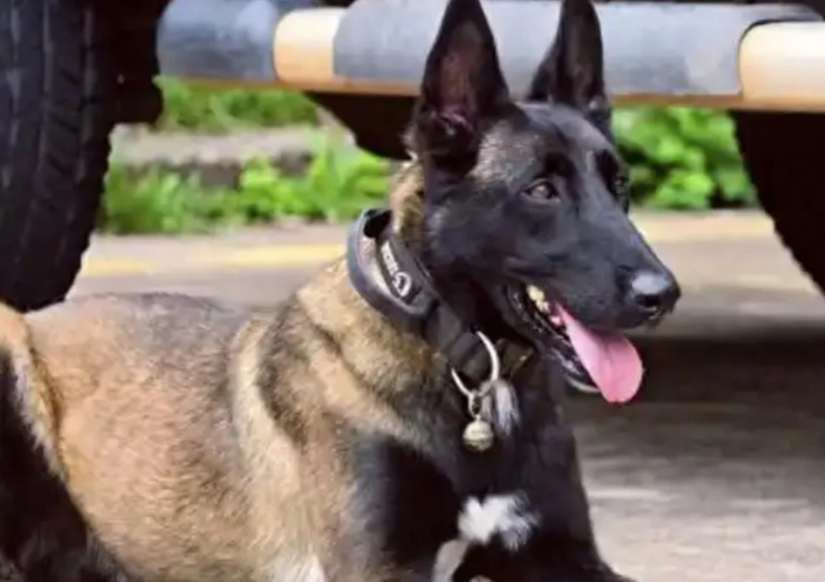
A touching story emerging from southwestern China has resonated with millions of social media users, illustrating the profound bond that develops between working dogs and their handlers. When police officer Awei from Chuxiong in Yunnan province fell from a second-storey height during a drug enforcement operation, his partner Bulu, a four-year-old German shepherd trained in narcotics detection, demonstrated an unwavering loyalty that would eventually move the nation.
The incident unfolded in November when both officer and dog were deployed to an abandoned building as part of a targeted operation against suspected drug traffickers. Bulu's acute senses detected fleeing suspects, and the trained canine surged ahead with Awei in pursuit. Yet in the darkness and cluttered environment of the corridor, Awei lost his footing and plummeted to the ground below. Surveillance footage from the scene captured the officer convulsing and vomiting blood, slipping between consciousness and unconsciousness, while anxious colleagues urged him to hold on, reassuring him that they still had battles ahead to fight together.
During those critical moments, Bulu remained by his handler's side, circling frantically and nuzzling the injured officer in desperate attempts to rouse him. The scene captured on camera revealed not merely a working animal following training protocols, but a creature experiencing what appeared to be genuine distress at his partner's condition. Awei was immediately transported to hospital, where doctors diagnosed him with multiple fractures to his head and chest. His condition was severe enough that he fell into a coma, remaining unconscious for five days before finally regaining awareness.
While Awei began his slow recovery in the medical facility, Bulu was transferred to a training base to await his handler's return. What followed was a six-month period of separation that visibly affected the dog's wellbeing and behaviour. The German shepherd stopped working, grew increasingly restless, and dramatically reduced his food and water intake, eating and drinking only small amounts despite the care of handlers at the facility. Rather than settling into the routine of the training base, Bulu became obsessed with searching for his missing partner, repeatedly returning to locations where Awei might plausibly appear.
Surveillance footage documented Bulu's persistent vigil across the base. The dog visited the dormitory where Awei had lived, stationed himself at the gate where his handler might enter, and retraced their familiar training routes. On multiple occasions, when police vehicles returned to the base, Bulu would rush toward them with apparent hope, only to experience repeated disappointment when informed that Awei was not among those arriving. This pattern repeated dozens of times over the months, yet the dog's determination never wavered. For anyone who has worked with animals, the behaviour speaks to a level of emotional attachment that transcends simple conditioning or training.
When Awei finally completed his rehabilitation and returned to active duty, the authorities arranged a reunion with Bulu. The moment was recorded on video and subsequently shared across mainland Chinese social media platforms. In the footage, Bulu can be seen barking and sprinting toward his returning handler with unbridled enthusiasm. Awei, overcome with emotion, dropped his luggage immediately and knelt down to embrace the German shepherd. The video resonated powerfully with viewers, accumulating more than 10 million views and exceeding 580,000 likes. Online commentators were particularly moved by the apparent emotional complexity of the reunion, with one observer noting that Bulu had been waiting not simply for its handler but for a comrade-in-arms, moved by the bond between human and animal.
During Awei's extended absence from operations, his colleagues persisted with the original case that had led to his injury. The ongoing investigation proved successful, resulting in the arrest of 11 suspects and the seizure of 4.4 kilos of drugs along with more than 500,000 yuan in illicit funds. The case ultimately reached closure, though at considerable personal cost to the primary handler involved. The success of the operation underscored the importance of police dog programmes in China's law enforcement activities, particularly in complex and dangerous environments where human senses alone prove insufficient.
The viral story has shone a spotlight on China's broader police dog operations, prompting public interest in the scale and nature of the country's canine law enforcement programmes. According to CCTV News, China maintained more than 29,000 active police dogs in service as of 2024, representing a substantial investment in animal-assisted policing. These trained canines typically serve an average career span of eight years, with their working lives concentrated during their prime physical condition. However, the intensive and often hazardous nature of police dog work takes a physical toll. Prolonged high-intensity deployment frequently results in joint and spinal injuries that can permanently impair these dedicated animals.
The retirement pathway for police dogs in China reflects the recognition of their contributions to public safety. Most dogs remain with their original units, continuing to live with their handlers even after retirement from active service, ensuring continuity of care from individuals who understand their needs and temperament. Some retired police dogs become available for adoption by members of the public, providing these working animals with family-oriented home environments. The story of Bulu and Awei has amplified awareness of these animals' sacrifices and has contributed to broader societal appreciation for the role of police dogs in Chinese law enforcement operations.
The incident also underscores the significance of human-animal partnerships in high-risk operational environments. Police dogs like Bulu undergo extensive training to function effectively in complex and unpredictable scenarios, yet their performance depends fundamentally on the trust and communication established with their handlers. The six-month separation and Bulu's emotional response upon reunion demonstrate that the relationship extends far beyond transactional working partnership into something more profound and emotionally resonant. For Southeast Asian law enforcement agencies considering or expanding their own police dog programmes, the Chinese example illustrates both the operational value and the emotional and ethical dimensions of deploying canine partners in dangerous situations.
The story has generated reflection on how animals respond to loss and separation, challenging assumptions about the depth of animal cognition and emotion. Bulu's refusal to eat, his systematic search patterns, and his explosive joy at reunion suggested behaviours consistent with grief, hope, and recognition. While animal behaviour experts might characterise these actions through the lens of conditioning and attachment theory, the public interpretation—that Bulu was mourning his missing partner and joyfully celebrating his return—speaks to a broader cultural recognition of animals as sentient beings worthy of moral consideration. This narrative has rippled across East and Southeast Asia, affecting how audiences perceive their own relationships with working animals and service dogs.

