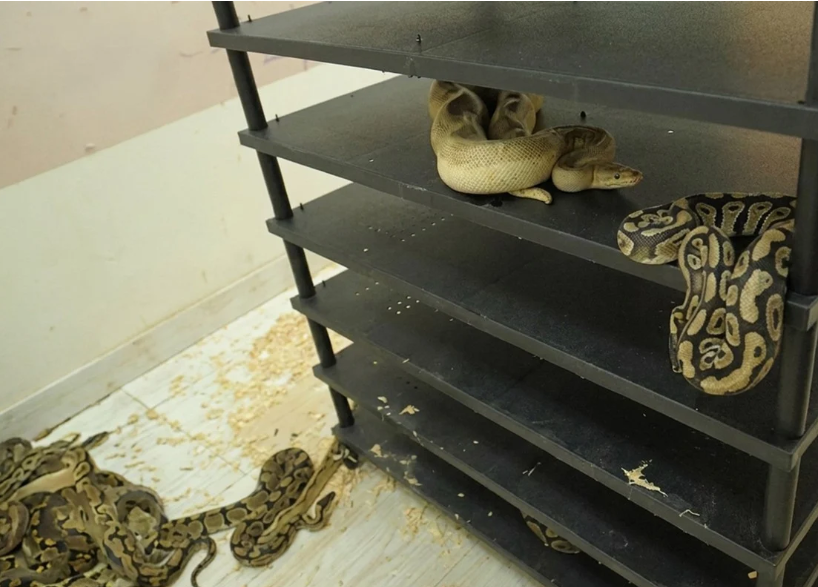
A resident of Zhejiang province in eastern China has been convicted and sentenced to prison for operating an extensive illegal breeding operation involving more than 300 pythons in his residential flat. The case, which came to light in late June through reporting by state broadcaster CCTV, is being treated as a serious violation of China's wildlife protection laws and highlights how mundane utility data can expose criminal activity.
Pythons hold Grade Two protected animal status under Chinese law, meaning they cannot be legally bred, bought, sold, transported, or otherwise handled without explicit government approval. The discovery of this large-scale operation represents a significant breach of these regulations. The entire case, involving multiple suspects, has exposed a network dealing in protected reptiles across the province, with police ultimately identifying 436 pythons across three separate locations worth more than 30 million yuan in total value.
The investigation began unexpectedly in March 2024 when an elderly resident of Taizhou discovered an unusual reptile near the base of a local mountain. The thick-bodied snake, roughly the circumference of an adult human arm, appeared entirely out of place for the region and the season. Believing the sighting warranted official attention, the senior citizen reported the finding to authorities, triggering the chain of events that would eventually unravel the operation.
Initial police analysis suggested the snake had likely escaped from a captive breeding setup. The logic was straightforward: the species is not indigenous to the area, and wild snakes typically remain dormant during March's cooler temperatures. This conclusion pointed investigators toward the possibility of commercial breeding rather than casual pet-keeping. The breakthrough came when officers consulted with professional reptile handlers, who explained that pythons require precise environmental controls, including consistent warmth and humidity maintained within a narrow band of 20 to 30 degrees Celsius. Such conditions would demand substantial ongoing electricity consumption, providing police with a new investigative angle.
Authorities executed a systematic check of residential electricity usage patterns in the vicinity where the snake was found. This unconventional approach proved highly effective in narrowing their suspects. The method ultimately focused attention on a man identified as Guo, who lived alone, was unmarried, and was currently unemployed. The suspect's profile suggested someone with both time and motivation to engage in such a specialised breeding operation. Further observation revealed frequent visits from another man, identified as Di, who made repeated trips to courier collection points to retrieve packages containing small white mice purchased online. Police cross-referenced these courier patterns with retailers, confirming that such mice were consistently sold to reptile enthusiasts for feeding purposes.
Digital evidence strengthened the case considerably. Guo had been sharing images of snakes on social media platforms and making oblique references to selling specimens. A transaction record showed Di had successfully sold two pythons to another buyer for 1,000 yuan, demonstrating active involvement in the sales side of the operation. With sufficient probable cause established, police moved to detain both Guo and Di. The moment officers entered Guo's flat, the scale of the operation became apparent. Plastic storage boxes stacked throughout the residence contained hundreds of living pythons. The suspect had consolidated his living arrangements into a single bedroom, converting the two remaining bedrooms and the living room into a reptile farm.
The final count from Guo's residence totalled 309 pythons. These animals were transferred to a local zoo following seizure. During interrogation, Guo revealed his deep personal investment in the project, explaining he had purchased his first four pythons in 2014 and had spent the subsequent decade focused on mastering reptile genetics and breeding techniques. He expressed particular pride in his ability to cultivate pythons displaying various colour morphs. In a telling remark that suggested ideological motivation beyond pure profit, Guo claimed to feel like a "creature creator" through his work.
The investigation expanded beyond Guo when police traced the origin of his initial breeding stock. The retailer who had sold Guo four pythons back in 2014, a shop owner named Deng, was also arrested. Authorities discovered 47 additional pythons in Deng's home, expanding the total seizure across all locations to 436 animals. Police documented evidence that Guo and Di had already sold approximately 80 pythons through their network, representing a sizable black market transaction volume.
The Taizhou district court has sentenced Guo, Di, and Deng to imprisonment, though the specific lengths of their sentences were not detailed in the initial reports. Under China's Criminal Law provisions governing Grade Two protected species violations, offenders face maximum prison sentences of up to five years. The nature and severity of individual sentences likely reflected the court's assessment of each defendant's role within the broader operation, with Guo's position as the primary breeder presumably resulting in harsher penalties than those assigned to Di, who functioned more in a logistics and sales capacity.
This case reveals important patterns in contemporary wildlife trafficking within China. The investigation demonstrates how regulatory agencies are increasingly leveraging unconventional data sources, such as utility consumption records, to identify hidden illegal operations. The case also underscores the persistence of demand for exotic reptiles despite legal prohibitions. For Southeast Asian observers, the implications extend beyond entertainment value. China's enforcement mechanisms for wildlife protection, while not always comprehensive, are becoming more sophisticated. Neighbouring countries with their own populations of protected reptile species should take note of these investigative techniques, as they may offer templates for strengthening enforcement capacity in their own jurisdictions.