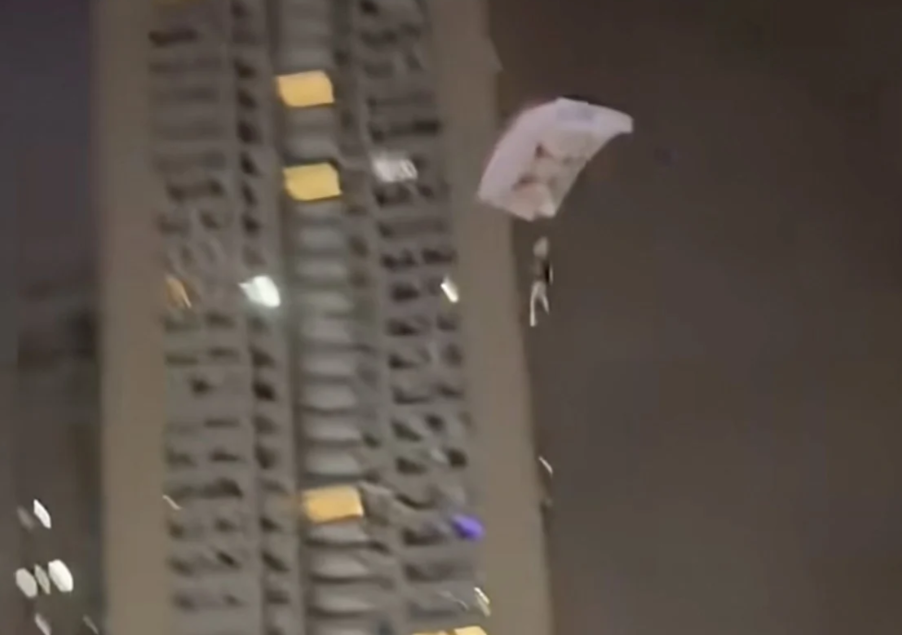
A 23-year-old man in Sichuan province has been taken into custody by authorities after executing an unauthorized parachute jump from the rooftop of a residential building in a populated area. The incident, which occurred on June 30 at 11pm in Chenghua district, represents the latest case of an online personality risking public safety in pursuit of viral content and follower growth. The man, identified as Ren, documented his dangerous stunt and shared footage across social media platforms the following day, drawing significant attention from both followers and law enforcement.
Ren's motivation for the reckless act was explicitly tied to expanding his digital presence. According to reporting by the Qilu Evening News, he specifically intended the stunt to drive traffic to his social media accounts, where he had accumulated approximately 60,000 followers under the persona "Parachute Coach Kakaxi". The recorded footage revealed the substantial hazards posed by his actions, showing him descending dangerously close to residential structures and trees during his jump. Such proximity to populated areas and obstacles transformed what might have been presented as extreme sports entertainment into a genuine public safety threat.
Chenghua district police characterized Ren's behaviour as seriously disruptive to public order while simultaneously endangering the safety of residents and passersby below. The authorities imposed administrative detention lasting up to 15 days, a standard penalty in China for conduct that violates public order regulations. Additionally, Ren has been barred from using social media platforms, effectively silencing the digital megaphone that motivated his dangerous activities. The enforcement action underscores a growing concern among Chinese authorities about the lengths some influencers will pursue to generate online engagement.
A critical discrepancy emerged during police investigation into Ren's credentials and background. Although he marketed himself as a professional parachute coach through his online presence, authorities conducting verification checks determined he had never obtained the necessary coaching licence. This gap between his claimed expertise and actual qualifications raises questions about whether he possessed adequate safety knowledge for such an inherently dangerous activity, potentially compounding the recklessness of his actions. His unverified status as a coach may have given followers false confidence in the safety of similar stunts.
Chinese law strictly prohibits parachuting activities outside officially designated zones and without explicit government authorization. Skydiving from downtown buildings, residential towers, bridges, or other densely populated areas carries severe legal consequences. The regulations exist precisely because such activities create uncontrolled risk scenarios where a malfunction or miscalculation could result in catastrophic consequences for bystanders who had no opportunity to consent to the danger. Police issued a public reminder that violators of these prohibitions face substantial penalties under Chinese law.
Ren's transgression was not an isolated incident in his online history. The police report referenced earlier footage showing him executing another unauthorized rooftop parachute jump from a residential building in May 2024, suggesting a pattern of escalating dangerous behaviour for content creation purposes. This longitudinal pattern indicates neither a momentary lapse in judgment nor a spontaneous decision but rather a calculated strategy to build audience engagement through repeated high-risk stunts. Each subsequent jump amplified the statistical likelihood of injury or fatality to himself or others.
Public reaction across Chinese social media platforms revealed widespread concern and frustration with such behaviour. Internet users expressed alarm at the genuine threat posed to ordinary people simply going about their daily lives below. One commenter highlighted the fundamental unfairness of the situation: the influencer was voluntarily assuming personal risk for profit and attention, but simultaneously imposing involuntary risk upon innocent residents who never agreed to participate. Another user criticized the motivation, emphasizing that chasing online traffic metrics should not justify endangering lives. A third observer advocated for harsher penalties, warning that without significant consequences, copycat behaviour could proliferate among other content creators seeking viral success.
This incident reflects a broader pattern across mainland China where influencers and online personalities engage in progressively dangerous stunts to capture audience attention in an increasingly saturated digital landscape. The tactics evolve as algorithms reward novelty and shock value, creating perverse incentives that push creators toward ever more extreme activities. Earlier in June, police in Zhejiang province apprehended a motorist who filmed himself driving at 152 kilometres per hour on an expressway while holding a mobile phone, grossly exceeding legal speed limits. The punishment included nine points deducted from his driving licence's total of twelve points and a fine of 250 yuan, approximately US$35.
The stakes of this cultural phenomenon became devastatingly apparent in 2017 when parkour enthusiast Wu Yongning died from physical exhaustion while live-streaming a climb of a 260-metre high building in Hunan province. Wu had gained significant online notoriety for scaling structures without safety equipment, claiming he pursued extreme activities to generate income for his mother's medical treatment. His death crystallized the lethal reality underlying the entertainment economy of danger, demonstrating that viral success and financial gain provide no protection against catastrophic failure.
For Malaysian and Southeast Asian observers, Ren's detention and the broader pattern it represents offer instructive lessons about the potential consequences of social media culture when combined with inadequate regulatory oversight and safety standards. While China's administrative detention system may operate differently from legal frameworks in other regional nations, the underlying concern transcends borders: the commercialization of dangerous activities through digital platforms creates externalized risks borne by innocent bystanders. Authorities across the region face similar challenges in balancing influencer freedoms with public protection, particularly as the economic incentives for dangerous content creation continue intensifying globally.

