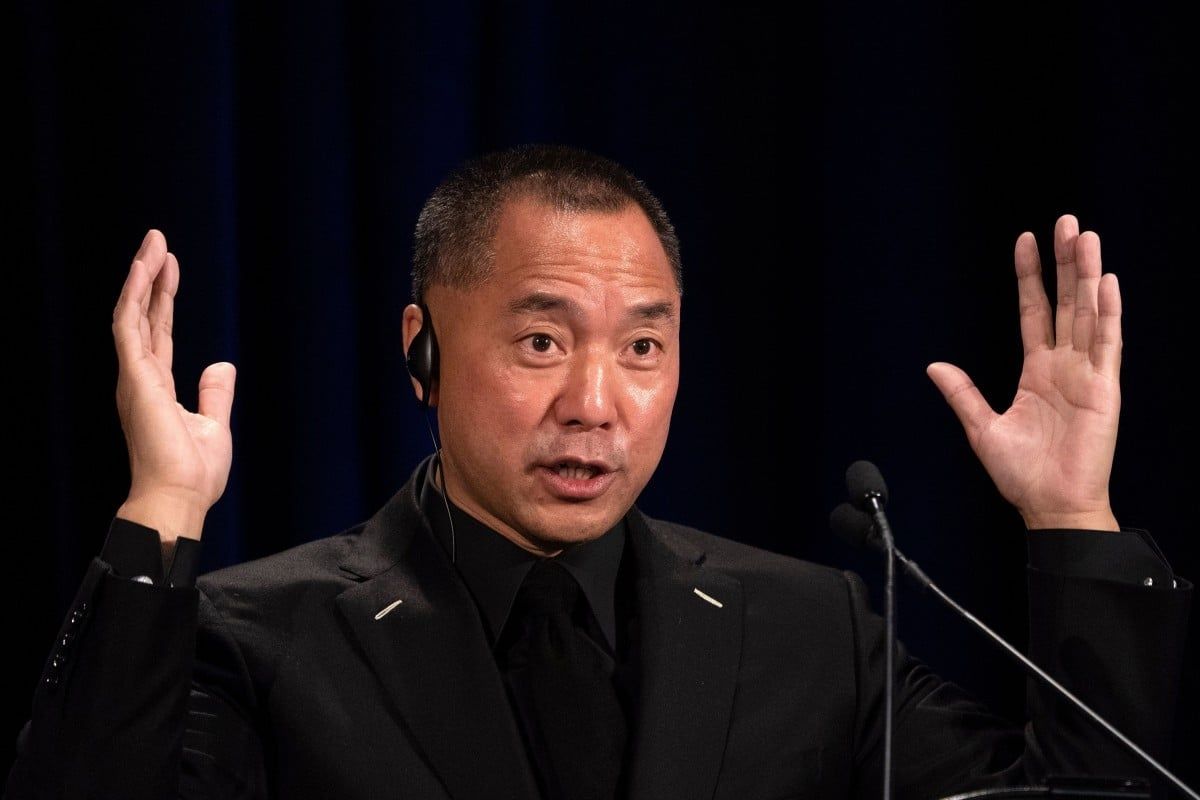
A self-exiled Chinese billionaire once considered among his country's wealthiest men has been sentenced to three decades in a United States federal penitentiary for perpetrating one of the country's most expansive financial fraud schemes. Guo Wengui received the 30-year sentence on Monday from Judge Analisa Torres in a Manhattan courtroom, with prosecutors describing the operation as having devastated over 1,000 victims across multiple continents through the systematic theft of hundreds of millions of dollars. The sentencing marked a dramatic fall from grace for a man who had cultivated an influential presence in American conservative circles and positioned himself as a prominent critic of Beijing's ruling Communist Party.
The narrative of Guo's transformation spans roughly a decade, beginning when he departed China and subsequently reinvented himself within the United States as a vocal dissident and political activist. His ascent in American society accelerated considerably through strategic alliances, most notably with conservative political strategist Steve Bannon, with whom he announced an ambitious 2020 initiative ostensibly aimed at destabilizing the Chinese government. During this period, Guo established himself in the American elite landscape, acquiring a luxury Manhattan residence with panoramic views of Central Park and obtaining membership at Donald Trump's exclusive Mar-a-Lago golf club in Florida. His apparent wealth and political connections lent credibility to subsequent investment schemes that would ultimately form the foundation of his criminal liability.
Torres's sentencing remarks painted a damning portrait of deliberate predation and exploitation. The judge emphasized that Guo specifically targeted individuals motivated by aspirations for democratic reform in China, extracting their money while maintaining an extraordinarily luxurious lifestyle financed entirely through fraudulent means. The court documents detailed an existence characterised by accumulated mansions, yachts, high-performance vehicles, bespoke designer garments, and exclusive furnishings—all acquired through deception of thousands of investors. Most significantly, Torres underscored what she characterised as Guo's complete absence of remorse, noting that he not only denied responsibility but had allegedly mobilised supporters to harass and intimidate those willing to testify against him or speak publicly about their experiences.
The fraud operation itself unfolded between 2018 and 2023, with prosecutors estimating total defrauded investments exceeding one billion dollars across multiple entities under Guo's control. The scheme encompassed his media enterprise, GTV Media Group Inc., as well as entities bearing the name Himalaya Farm Alliance and the Himalaya Exchange, structures designed to appear legitimate while serving primarily as vehicles for wealth extraction. Guo's conviction on nine of twelve criminal charges followed a seven-week trial that exposed the sophisticated mechanisms through which he deceived hundreds of thousands of potential investors, leveraging his cultivated image as a dissident businessman to establish trust that he systematically betrayed. The breadth of the deception extended across international boundaries, with victims scattered throughout multiple countries who collectively lost their life savings to his operation.
Victim testimony during sentencing provided compelling evidence of the scheme's human consequences. Wei Chen, among those who addressed the court, described how Guo's fraudulent activities had fundamentally destroyed her existence and that of her family members. Judge Torres received correspondence from numerous victims detailing the psychological devastation accompanying their financial losses—descriptions of acute anxiety, profound shame, and familial relationships fractured by investment decisions made in good faith. These accounts transcended mere financial loss, documenting instead the disintegration of retirement security, educational opportunities for children, and the emotional toll of betrayal by someone they had believed represented a legitimate investment opportunity grounded in principled opposition to authoritarianism.
Guo's courtroom behaviour during sentencing proceedings revealed his continued resistance to accepting responsibility for his actions. He protested his detention conditions, claiming medical distress and disputing prosecution characterisations of him as feigning illness. Through an interpreter, he made only oblique references to the criminal case itself, instead emphasising his stated motivation to oppose the Chinese Communist Party. His defensive posture and apparent fixation on external adversaries rather than acknowledging his victims' suffering reinforced the judge's assessment of his unrepentant stance. Even as he departed the courtroom, supporters applauded him—a demonstration of the loyalty he had cultivated despite the devastating impact of his fraudulent schemes on thousands of individuals who had placed their faith and resources in his enterprises.
Guo's defence team constructed a narrative emphasising his status as a victim of persecuting Chinese state authorities rather than an unscrupulous perpetrator of fraud. They argued that the Communist Party had orchestrated a sweeping campaign against him, allegedly recruiting influential figures across American business, entertainment, and political domains to conspire in his downfall. His legal representatives contended that the extended prison sentence would validate China's efforts to discredit him and would discourage other Chinese dissidents from seeking refuge in the United States. They highlighted scars and disfigurements allegedly resulting from physical torture endured in China during the period from 1993 to 2022, attempting to contextualise his actions within a framework of victimhood and survival. However, these arguments ultimately failed to persuade Torres or mitigate the severity of the sentence.
The judge's decision to impose the full 30-year term aligned with prosecutorial recommendations and reflected the magnitude of harm inflicted across Guo's victim population. Restitution orders requiring Guo to forfeit approximately 889 million dollars, while symbolically significant, provided limited practical recourse for individuals whose losses may prove substantially irretrievable. The sentencing occurred against a backdrop of Chinese government statements indicating that Beijing maintains active interest in prosecuting Guo for alleged crimes including rape, kidnapping, and bribery—accusations he has denied while claiming persecution. An Interpol Red Notice designation further complicates potential future jurisdictional questions and underscores the transnational dimensions of this case.
For Malaysian and Southeast Asian observers, Guo's case demonstrates the risks inherent in investment schemes capitalising on political narratives and dissidentary credentials. The apparent legitimacy granted to Guo through his cultivation of relationships with prominent conservative figures and his public positioning as an anti-communist activist created a veneer of trustworthiness that masked fundamentally fraudulent intentions. Investors throughout the region who may have encountered similar pitches or promotional materials should recognise that political activism, however seemingly sincere, provides no guarantee regarding investment legitimacy or fund safety. The case equally illustrates regulatory challenges faced by democracies in balancing asylum provision and political expression freedoms against proper oversight of financial activities—tensions particularly acute when dissidents leverage both genuine persecution narratives and fabricated investment opportunities simultaneously.
Guo's conviction and sentencing represent a cautionary narrative about the vulnerability of investors seeking to align their capital with ideological commitments or political causes. The sophistication of his operation, combined with his demonstrated capacity to cultivate credibility across influential American networks, exemplifies how fraudulent actors exploit existing geopolitical tensions and legitimate grievances regarding authoritarian governance. For regional investors and policymakers, the fundamental lesson involves the necessity of rigorous due diligence independent of charismatic personalities or apparently aligned ideological positions, coupled with heightened scepticism toward investment vehicles promising exceptional returns combined with political significance. The extensive harm documented in victim testimony and court records serves as a sobering reminder that financial prudence and critical evaluation of investment propositions transcend political allegiances or sympathies regarding the purported causes that fraudulent actors claim to represent.

