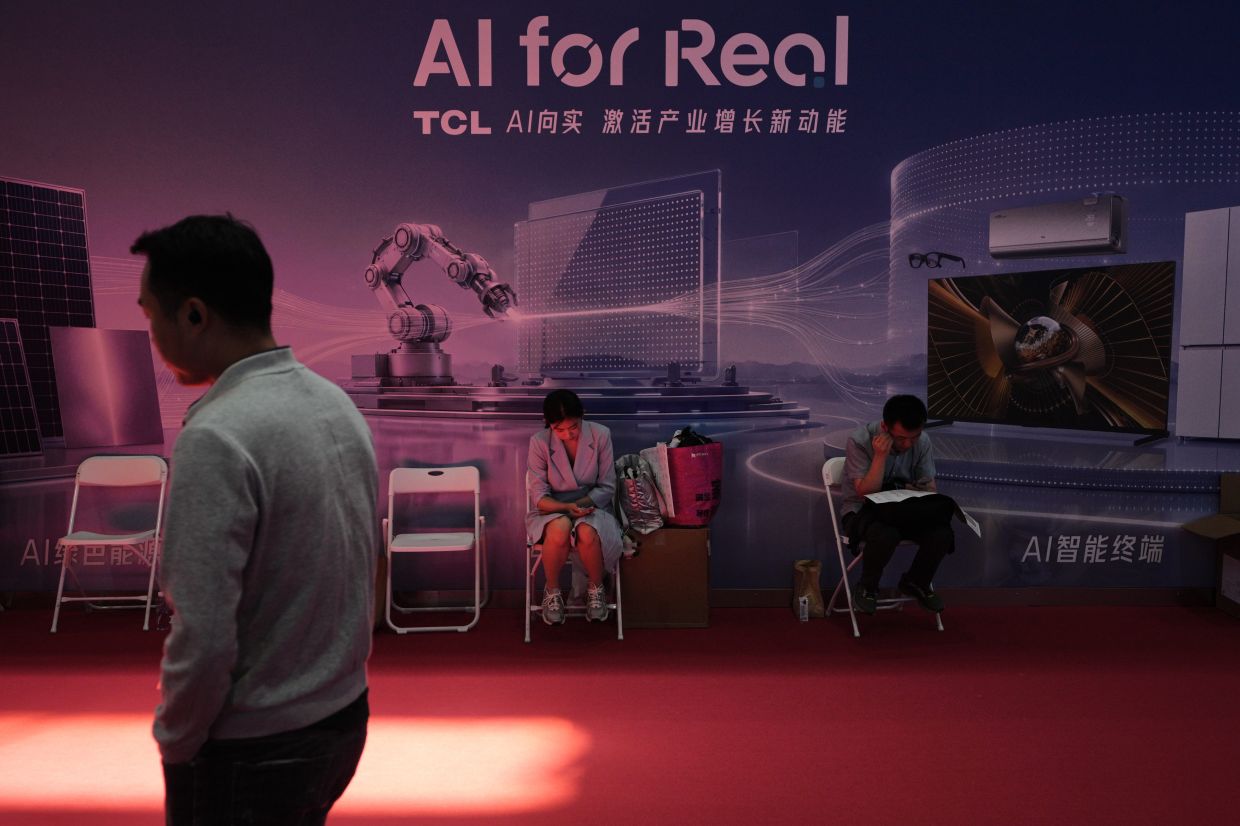
China's embrace of artificial intelligence is fundamentally reshaping its labour market in ways that reverberate beyond Asia's largest economy. As government policies actively promote AI integration across industries, millions of workers in computer programming, translation, content creation and logistics are confronting either job loss or the prospect of it. This technological transition, driven by state initiative and competitive pressures against the United States, presents a paradox: while some workers are experimenting with AI-enabled ventures and accepting technological change, broader employment concerns threaten consumer spending and economic stability at a critical moment for China's growth.
The scale of AI adoption in Chinese enterprises has accelerated dramatically. Industrial firms deploying AI models and agents surged to 47.5 per cent last year from just 9.6 per cent in 2024, according to market intelligence firm IDC. This velocity of adoption reflects deliberate government strategy. Under the "AI Plus" initiative and its five-year plan extending to 2030, Beijing is systematically infusing artificial intelligence across manufacturing, services and creative sectors. Yanze Du, an IDC research manager in Beijing, notes that China's thriving open-source ecosystem accelerates industrial AI application, narrowing the gap between theoretical capabilities and real business value. The implication is straightforward: AI deployment in Chinese workplaces will likely outpace adoption rates in other economies, compressing the adjustment period for affected workers.
Concrete examples of displacement are already visible. Fei, a 40-year-old mid-level programmer, acknowledges that AI can now handle coding work that once required human expertise. Though sceptical years ago, he has accepted the reality that mid-level coders are "essentially replaceable in most cases." Rather than resist, he is experimenting with content creation during a career break, producing short-form videos about everyday life. Similarly, Du Qinchun, a part-time translator in Chengdu, has taken work training AI translation models, yet faces the harsh reality that translation sector pay has fallen more than half compared to previous years. These individual stories illustrate a broader pattern: workers are not passively suffering but actively adapting, even as their earning potential diminishes.
Educational choices reflect these labour market shifts. Popular university programmes in foreign languages have experienced declining enrolment as AI-powered translation tools become ubiquitous. This signals that prospective students are already calculating career prospects in a transformed job market. The translation sector exemplifies how automation can rapidly deskill entire professions, collapsing both wages and career stability before workers have opportunity to transition. For Malaysia and other Southeast Asian economies with significant translation and language services industries, China's experience offers a cautionary lesson about AI's disruptive potential in knowledge work sectors.
The entertainment and creative industries are experiencing equally dramatic disruption. Generative AI now drives creation, production and distribution in China's short-drama sector. Live-action short and vertical video series designed for mobile consumption plummeted roughly 75 per cent in the first quarter of 2024 compared to a year earlier, according to Chinese media reports. Wang Zhicheng, a 32-year-old scriptwriter, used AI for brainstorming and fact-checking at his previous employer producing 3D animated educational content for children. When his company laid off roughly half its writing staff, he resigned to create illustrated children's books independently. While acknowledging AI as a time-saving tool, Wang observed that generated scripts often felt mechanical and repetitive, suggesting that human creative judgment remains essential. His transition reflects a broader pattern: workers are not simply replaced but redistributed into freelance, gig-based arrangements with less job security and benefits.
Robotics and automation extend displacement beyond digital work. Humanoid robots now sort parcels in postal centres, direct traffic and prepare beverages, expanding the scope of occupations vulnerable to automation. Food delivery robots present perhaps the most immediate threat to employment, potentially affecting millions of workers in China's vast last-mile logistics sector. The intersection of AI software and physical robotics creates compounding disruption: machines not only replicate human cognitive tasks but increasingly perform physical labour that once employed massive workforces. For Malaysia's booming e-commerce and logistics sectors, this technological trajectory should inform labour policy and workforce development strategies.
Interestingly, Chinese workers display far less anti-AI sentiment than counterparts in Western economies. Shujing He, a senior analyst at advisory firm Plenum based in Beijing, observes that most Chinese workers are positive, neutral or mildly interested in AI rather than hostile. Those already displaced or fearing displacement often eagerly pursue AI-enabled entrepreneurship and independent ventures. This acceptance partly reflects cultural attitudes toward technological change and adaptation, but also reflects pragmatic calculations that refusing AI offers no protection when competitors and employers embrace it. Workers recognise they must adopt AI technologies simply to remain employable. This resignation, while practical, masks underlying anxiety about living standards and career trajectories.
The economic consequences extend beyond individual workers to macroeconomic fundamentals. China's consumer spending has weakened considerably as households become reluctant to spend, partly driven by employment insecurity. This hesitancy coincides with a prolonged downturn in housing markets that has eroded household wealth. Consumer confidence is thus squeezed from multiple directions simultaneously. When millions of workers face wage pressure or displacement, and when housing wealth declines, aggregate demand contracts. Eswar Prasad, an economics professor at Cornell University, warns that AI productivity gains may be offset by severe employment disruption that worsens China's job growth problem and potentially destabilises social stability. This dynamic matters enormously for Southeast Asia, as Chinese consumer purchasing directly drives regional trade and economic activity.
Demographic trends add urgency and complexity. China's urban unemployment rate hovers near five per cent overall, but youth unemployment for ages 16 to 24 exceeds 15 per cent, roughly triple the aggregate rate. Meanwhile, China's population of 1.4 billion is ageing and contracting rapidly. By 2050, China is projected to have fewer than two working-age adults per retiree, compared with above 2.5 in the United States. Some economists suggest automation could partially offset workforce shrinkage rather than representing a pure employment threat. Xuenan Cao, a professor at San Francisco Bay University specialising in technology and society, posits that in the longer term, labour scarcity could make automation economically necessary rather than destabilising. However, the transition period spanning the next 10-20 years will be turbulent, as AI displacement accelerates before demographic pressure tightens labour markets.
Gender dimensions of AI displacement require particular attention. The International Labour Organization reports that women face disproportionate risks from AI automation, as they tend to concentrate in roles particularly susceptible to automation—electronics assembly, data entry, and routine administration—while remaining underrepresented in science and technology sectors. This pattern suggests that AI-driven disruption will exacerbate gender employment gaps in China and across Asia. The concentration of female workers in automatable roles means that displacement will fall unequally on women, widening gender wage gaps and potentially reducing female labour force participation precisely when China's shrinking workforce requires maximum inclusion.
Large Chinese technology companies have already begun restructuring in response to AI. Tech giants have cut or restructured tens of thousands of positions, partially attributable to AI-driven productivity improvements. These reductions have not yet generated offsetting employment growth in emerging sectors. While China's tech industries remain innovative and productive, they generate fewer jobs per unit of revenue than previous economic eras. This disconnection between productivity and employment growth represents perhaps the deepest challenge: even successful technology companies may not rehire workers displaced by their innovations.
Looking forward, China's "AI Plus" initiative reflects state commitment to rapid AI diffusion across the economy as strategic competition with the United States intensifies. However, this approach risks prioritising competitive advantage over employment stability and social cohesion. Zilan Qian, a research associate at Oxford China Policy Lab, notes that China's government actively disperses AI across the economy more aggressively than most other countries, potentially accelerating industrial AI penetration. The human cost of this acceleration remains uncertain but potentially severe. As workers like Fei, Du and Wang adapt individually through entrepreneurship and skill reorientation, the broader challenge is whether China's policy framework and social safety nets can manage large-scale workforce transitions without exacerbating inequality or undermining the consumer demand essential for sustained growth.
For Malaysia and Southeast Asia more broadly, China's AI employment experience offers critical insights. The region's own technology sectors, manufacturing bases and service economies face similar disruption trajectories. Chinese workers' pragmatic acceptance of AI despite displacement anxiety suggests that Southeast Asian labour markets may follow similar patterns—adaptation without resistance, but with underlying income and security pressures. Policymakers across Asia should monitor China's employment outcomes carefully as the AI transition unfolds, extracting lessons about workforce retraining, social protection and technology policy before similar disruptions reach their own economies.

