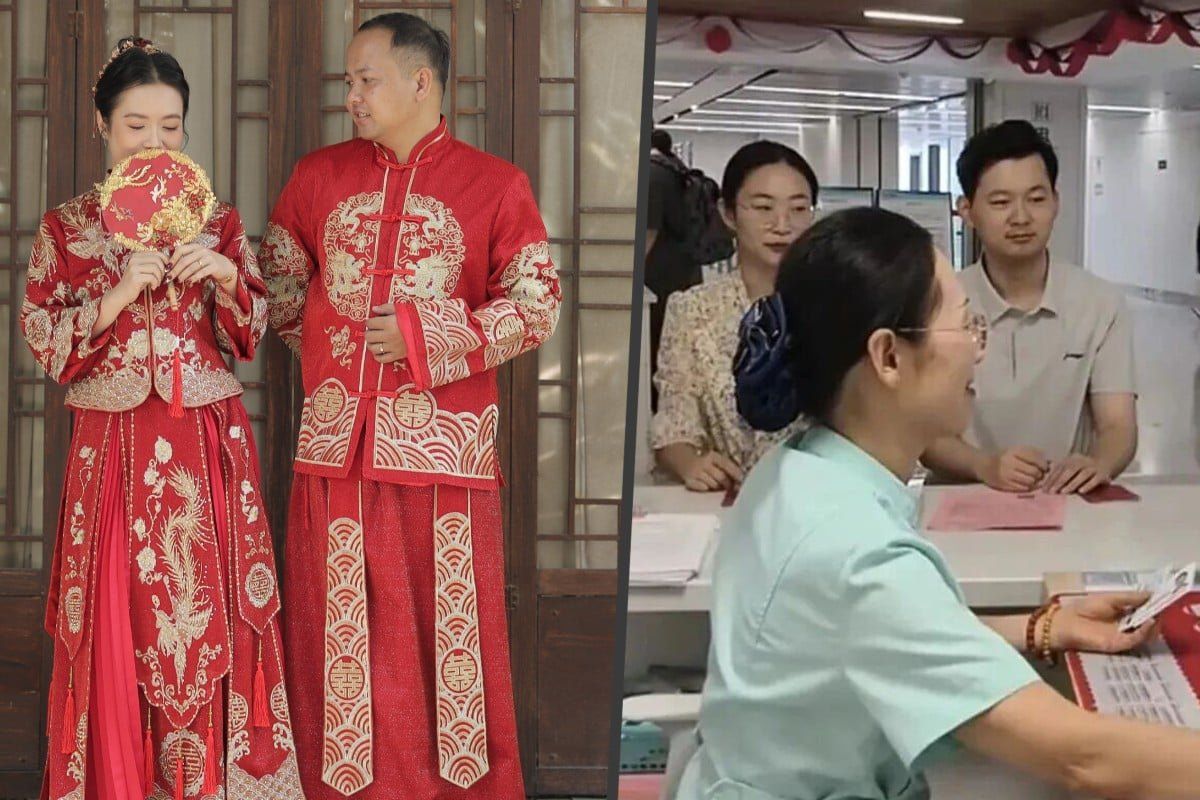
China's effort to reverse its demographic crisis has taken an unexpected turn, with authorities expanding marriage registration services to locations as diverse as hospitals, banks, nightclubs, and even airport terminals. The trend reflects mounting government concern over declining marriage rates, which have triggered a domino effect of population decline and reduced birth rates that threaten the nation's long-term economic vitality and social stability. What began as isolated experiments has evolved into a nationwide push to remove procedural barriers, though recent data suggests the underlying crisis runs far deeper than bureaucratic inconvenience.
The expansion accelerated following regulatory changes in May of last year that fundamentally transformed how couples marry in China. The revised marriage registration regulations eliminated the requirement for couples to present their hukou, or household registration documents, and allowed marriages to be registered outside a person's registered location. These changes opened the floodgates for creative partnerships between civil affairs bureaus and unexpected venues. Within a single year, China established over five hundred dedicated marriage registration sites beyond traditional civil affairs offices, while more than thirteen hundred outdoor locations began collaborating with authorities to issue marriage certificates.
The novelty of these initiatives has captured public attention and generated considerable social media discussion. In August, the Postal Savings Bank of China's Tianjin branch became the nation's first bank to offer marriage registration, pairing financial services with romantic commitment in an arrangement that struck many observers as absurd. Yet what seemed like the pinnacle of unconventional pairings was quickly surpassed when the Maternal and Child Health Hospital of Linzi District in Zibo City, Shandong province, launched its own marriage registration service during the Qixi Festival, also known as Chinese Valentine's Day. The hospital justified the initiative by emphasizing efficiency—couples could complete marriage registration, premarital examinations, and preconception counseling under a single roof, theoretically reducing administrative burden.
Other venues have followed suit with equal creativity. Guangzhou Baiyun International Airport in Guangdong province became the nation's first airport to issue marriage certificates, sweetening the deal with complimentary access to its observation deck where newlyweds can watch aircraft operations. In Beijing and Nanjing, centuries-old temples now accommodate couples seeking to marry in traditional attire, blending cultural significance with administrative necessity. Shanghai's nightclub partnership with local civil affairs authorities represents perhaps the most culturally daring experiment, hosting special certification ceremonies in an environment traditionally associated with bachelor and bachelorette celebrations. A metro station in Hefei, Anhui province, became the first transportation facility in the country to offer marriage registration this August.
Initially, the strategy appeared successful. During the third quarter of last year, 1.61 million couples registered marriages nationwide, representing a robust 22.5 percent increase year-on-year. Over the full year, China recorded 6.76 million marriage registrations, an increase of 657,000 compared to the previous year. These figures suggested that reducing procedural friction and introducing novel, appealing venues might genuinely stimulate marriage rates. However, optimism proved premature. In the first half of this year, marriages dropped 7.5 percent year-on-year, with only 3.28 million couples tying the knot. This reversal indicates that convenience measures, however imaginative, address only a surface symptom of a much more profound social and economic problem.
The disconnect between procedural accessibility and actual marriage decisions has not escaped the notice of China's digitally savvy population. Social media commentary has grown increasingly skeptical of the government's approach. One widely shared quip questioned whether the shortage of marriage venues had ever genuinely deterred couples from marrying, suggesting the problem lay elsewhere entirely. Another commenter sarcastically proposed that the civil affairs bureau establish divorce services atop Mount Everest, mocking the notion that location was the limiting factor. A third observer offered more substantive critique: young people are not avoiding marriage due to registration difficulties, but rather hesitating because they lack confidence in navigating the life challenges marriage entails over decades.
Beneath the surface humor lies genuine anxiety about marriage's practical and emotional consequences. Young Chinese express simultaneous fear of financial burdens, family conflicts, and surrendered personal autonomy. Marriage, once viewed as a necessary life milestone that provided social identity and security, has lost its mandatory status in contemporary Chinese society. This represents a fundamental shift in values and priorities. The generation now of marriageable age has grown up in relative prosperity and has witnessed both the benefits and costs of traditional family structures. For many, the equation no longer balances favorably.
It is worth noting that while divorce services technically fall under the streamlined regulations, the vast majority of outdoor marriage registration sites deliberately exclude divorce services, citing the need for more extensive documentation and presumably reflecting concerns about sending mixed signals. This asymmetry inadvertently underscores the government's focus on increasing marriage formation rather than facilitating relationship dissolution, a stance that does not address the deeper apprehensions driving young people away from marriage in the first place.
For Southeast Asian observers, China's demographic challenges and attempted policy responses offer instructive parallels and contrasts. Malaysia, Singapore, and other ASEAN nations face their own marriage and fertility rate declines, though the cultural and economic contexts differ significantly. China's experience suggests that supply-side solutions—making marriage registration easier and more convenient—cannot overcome demand-side resistance rooted in genuine economic anxiety, altered social values, and rational cost-benefit analysis by young adults. Policymakers across the region grappling with similar demographic trends may find that addressing the underlying economic precarity, housing affordability, childcare costs, and workplace inflexibility would prove far more effective than procedural innovations, no matter how creative or well-intentioned.

