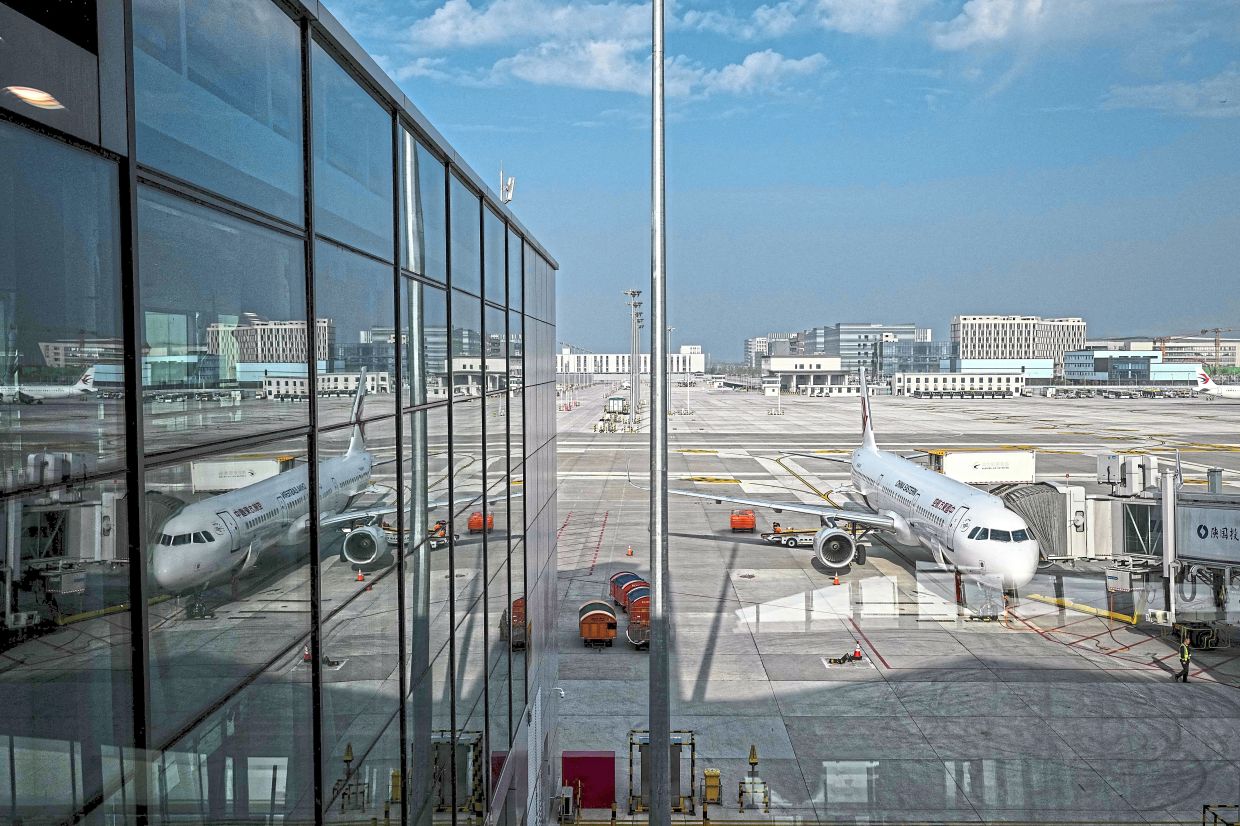
China's aviation sector continued its downward trajectory in the first half of 2026, with Air China, China Eastern Airlines, and China Southern Airlines collectively posting net losses of approximately 8.2 billion yuan ($1.22 billion USD), extending a troubling streak of annual red figures to seven consecutive years. The disappointing results underscore just how fragile the industry's recovery remains nearly two years after the pandemic's grip loosened, despite strong headline revenue growth across all three carriers.
The scale of the damage varied across the trio, with China Southern bearing the heaviest burden at a loss of 3.7 billion yuan, more than double its prior-year deficit of 1.53 billion yuan. Air China, the national flag carrier, reported a loss of 2.3 billion yuan compared with 1.81 billion yuan in the corresponding period last year, while China Eastern registered a 2.2 billion yuan loss against a 1.43 billion yuan shortfall twelve months earlier. What made these results particularly striking was the dramatic reversal from the carriers' strong first-quarter performance, when combined profits reached 4.82 billion yuan buoyed by Lunar New Year travel demand. The subsequent collapse of profitability in the second quarter prompted sharp declines in share prices across Hong Kong and mainland Chinese exchanges on the day of announcement.
The primary culprit remains the intractable problem of elevated jet fuel prices, which have persisted well above pre-conflict levels despite modest recent declines from their second-quarter peak. Each of the three carriers experienced fuel cost increases ranging between 35% and 38% during the first half, a burden that has proven virtually impossible to pass along to passengers given the competitive domestic market environment. Unlike many regional and Western counterparts, China's state-owned carriers have historically engaged in minimal fuel hedging practices, leaving them acutely vulnerable to oil price volatility. China Southern explicitly acknowledged in its regulatory filing that it currently possesses no effective mechanism to insulate itself from fluctuations in jet fuel pricing, a stark admission of operational exposure.
Geopolitical tensions remain a destabilising force on the sector's outlook. China Eastern described its profit environment as being "severely undermined" by disruptions to international routes stemming from the ongoing Middle East conflict, which has rendered certain traditional hubs less attractive or accessible to traffic. Conversely, this disruption created a peculiar silver lining: strong demand for European routes as passengers routed around affected Middle Eastern hub airports. Air China witnessed revenue expansion of 10.5%, China Eastern achieved 11.1% growth, and China Southern posted 9.7% increases, all driven substantially by international segment performance. This revenue resilience stands in sharp contrast to the profit picture, revealing that volume gains have been entirely consumed by unit cost inflation and margin compression.
The domestic market presents an altogether grimmer tableau. Chinese carriers face structural constraints in their ability to implement aggressive fare increases comparable to those successfully deployed by U.S. carriers, as weakening macroeconomic conditions combined with competition from high-speed rail networks and self-drive tourism alternatives have made the domestic customer highly price-sensitive. These competitive pressures have effectively capped yield growth even as costs spiral upward, creating an impossible arithmetic for profitability without substantial traffic growth to absorb fixed costs.
The third quarter, ordinarily the most profitable period for Chinese carriers as peak summer holiday demand materialises, has offered virtually no respite from deteriorating trading conditions. An unusually intense typhoon season in 2026 has ravaged the industry's bread-and-butter domestic operations. Meteorological records indicate that 21 typhoons have formed across the northwestern Pacific Ocean and South China Sea thus far in the year, substantially exceeding the historical norm of 12 events for the equivalent timeframe. These weather systems have systematically disrupted domestic routes precisely during the critical summer travel window when carriers typically achieve their strongest profitability.
The consequence of this convergence of headwinds is plainly visible in forward-looking traffic projections. Flight Master, a aviation data analytics firm, has projected that Chinese carriers will transport merely 142 million passengers across domestic and international routes during July and August, representing a concerning 3.6% year-on-year contraction. Should this forecast materialise, it would constitute the first decline in peak-season traffic since 2022, when Covid-related lockdowns devastated travel demand across much of the country. The significance of this deterioration cannot be overstated, as summer traditionally absorbs a disproportionate share of annual aviation profits.
Looking further ahead, the outlook appears decidedly pessimistic. HSBC analysts project that the Big Three will accumulate combined losses approaching 16.8 billion yuan throughout 2026, a scenario dramatically worse than the market's expectations for a modest combined profit of 1.3 billion yuan. This widening gap between optimistic consensus forecasts and analyst reality suggests the investment community has yet to fully price in the structural challenges facing the sector. None of the three carriers declared interim dividends, a conspicuous absence that signals management confidence in cash preservation rather than shareholder returns.
Market sentiment has turned decisively negative, with shares of all three carriers declining at least 36% across Shanghai-listed exchanges throughout 2026 as concerns regarding persistent weakness in domestic travel demand continue to erode profit forecasts and investor confidence alike. The trajectory suggests that conditions may worsen before stabilising, particularly if fuel prices remain elevated or additional weather disruptions materialise during the remainder of the year.
Amidst this challenging environment, the carriers have pursued strategic bets on domestic aircraft manufacturing through expanded operations of COMAC-built narrow-body jets. China Eastern increased its fleet of C919 aircraft to 17 units following three deliveries during the first half, whilst both Air China and China Southern each operate 11 C919s following respective deliveries of two and three aircraft. However, supply chain realities are now intruding on these ambitions. China Eastern has substantially revised downward its expected C919 deliveries between 2026 and 2028, projecting 13 fewer aircraft than previously forecast, signalling potential production constraints at COMAC. Air China has maintained its earlier guidance while China Southern declined to provide updated delivery expectations, suggesting opacity regarding their confidence in supplier timelines.
For Malaysian and broader Southeast Asian aviation observers, the struggles of China's state-owned carriers carry regional implications. The Big Three represent crucial competitive anchors for regional networks, and their financial distress may influence capacity decisions, pricing strategies, and route investments across the wider Asia-Pacific market. Whether Chinese carriers will need to reduce capacity or withdraw from marginal routes in coming months could reshape competitive dynamics that regional carriers have grown accustomed to navigating.

