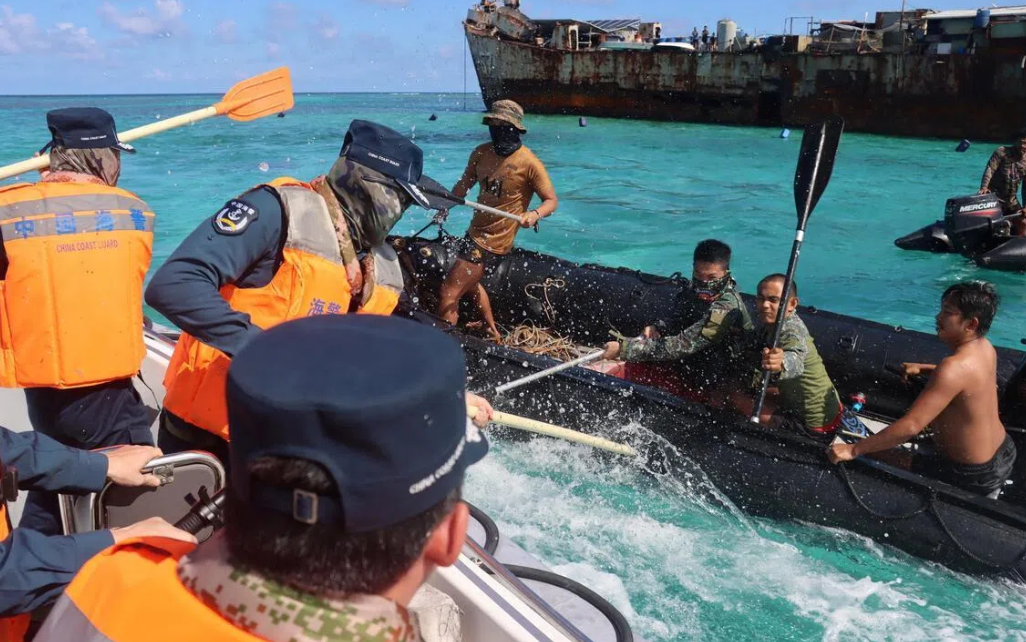
China has formally summoned the Philippine ambassador in response to a heated maritime incident at Ren'ai Reef, also known as the Second Thomas Shoal, intensifying long-running territorial disputes in the South China Sea. The confrontation, which occurred on Monday, has become the latest flashpoint in a region where competing claims and near-constant naval patrols create a volatile powder keg for potential escalation. Beijing's move to lodge an official protest underscores how quickly disagreements over this strategically vital waterway can trigger diplomatic friction among major powers.
The dispute centres on vastly different territorial assertions. China maintains expansive sovereignty claims over nearly the entire South China Sea, despite an international arbitration ruling in 2016 that found these claims lack legal standing under international law. The Philippines, alongside Vietnam, Malaysia, Brunei, and Taiwan, holds overlapping claims to portions of the sea. These competing interests have produced a pattern of maritime confrontations involving coast guards, military vessels, and civilian fishing boats, all operating in an environment where rules of engagement remain ambiguous and tensions run perpetually high.
According to Philippine military accounts, Chinese coast guard personnel struck a Filipino sailor with a baton during Monday's encounter as Philippine vessels moved toward a grounded ship that serves as a permanent Filipino military garrison on the shoal. China's foreign ministry responded by claiming the Philippines deliberately provoked the clash and has since misrepresented the facts to inflame the situation. Beijing characterized Manila's account as distorted propaganda designed to stoke international sympathy, a charge Philippine officials reject as itself a distortion of events on the water.
The diplomatic spat arrived at a consequential moment. US Secretary of State Marco Rubio was landing in Manila on Tuesday to participate in the Association of Southeast Asian Nations summit, an eleven-member gathering that has become a crucial venue for discussing regional security concerns. Rubio's presence itself represented an American statement of commitment to Southeast Asian affairs and demonstrated Washington's willingness to challenge Beijing's assertiveness in the waterway. The timing suggested the US viewed the incident not as an isolated altercation but as part of a broader pattern of Chinese coercion in the region.
Washington and Canberra responded swiftly with criticism of Beijing's conduct. The United States condemned what it termed dangerous and aggressive actions, language reflecting American concern that China's behaviour threatens regional stability and the principles of freedom of navigation. Australian Foreign Minister Penny Wong echoed this assessment, describing the Chinese coast guard's conduct as destabilizing and dangerous. These responses indicated that Australia and the US see the South China Sea as a critical arena where they must defend established international norms, with implications extending well beyond the immediate disputants to all nations relying on the waterway for commerce and security.
The confrontation also raised questions about potential high-level diplomatic engagement. Rubio indicated openness to meeting his Chinese counterpart Wang Yi, who was also attending the Asean summit, though neither side confirmed plans for formal talks. The two had previously met last year in Kuala Lumpur and again in Munich in February, establishing a pattern of engagement at major international forums. Whether such a meeting would materialise and what it might accomplish remained unclear, but the presence of both senior diplomats in Manila created a window for diplomatic communication if either side deemed it strategically valuable.
In a newspaper column published in Philippine media on Tuesday, Rubio articulated the broader stakes underlying the maritime dispute. He emphasized Washington's commitment to freedom of navigation across Southeast Asia and reaffirmed America's security commitments to regional partners. More pointedly, he warned that if these contested waters fell under the control of a power willing to weaponize trade and commerce for geopolitical advantage, both the United States and Southeast Asian nations would face unprecedented threats to their sovereignty, economic interests, and long-term security. The statement represented a clear if implicit warning directed at Chinese behaviour, framing the South China Sea dispute as part of a larger struggle over the region's future alignment.
The incident illuminates how the South China Sea remains a perpetual source of tension despite decades of diplomatic efforts to establish codes of conduct and conflict prevention mechanisms. The waterway represents one of the world's most crucial maritime corridors, with trillions of dollars in annual trade passing through its waters. Malaysia, as a Southeast Asian nation with its own maritime interests and concerns about regional stability, faces pressure to balance relations with powerful external actors while protecting its own strategic interests. The Philippines' challenges in standing up to Chinese pressure while maintaining economic ties reflect dilemmas facing all regional claimants.
For Malaysia and other Southeast Asian readers, these recurring confrontations carry direct implications. Increased militarization and confrontational rhetoric in the South China Sea raise insurance and transportation costs for regional shipping. They also create uncertainty about the region's future governance and whether ASEAN will maintain centrality in managing regional disputes or whether great-power competition will overwhelm collective regional mechanisms. Malaysia has historically advocated for peaceful resolution and implementation of the Code of Conduct negotiations that have proceeded slowly for decades.
The summoning of the Philippine ambassador represents China's standard response to criticism of its maritime conduct—diplomatic protest, denial of culpability, and counter-accusations of provocation. Whether such formal complaints successfully deter further incidents or merely mark another cycle in an endless pattern of claim and counter-claim remains uncertain. What seems clear is that the South China Sea will continue generating crises as long as competing claims remain unresolved and military vessels from multiple nations operate in close proximity under minimal transparency or agreed rules.

