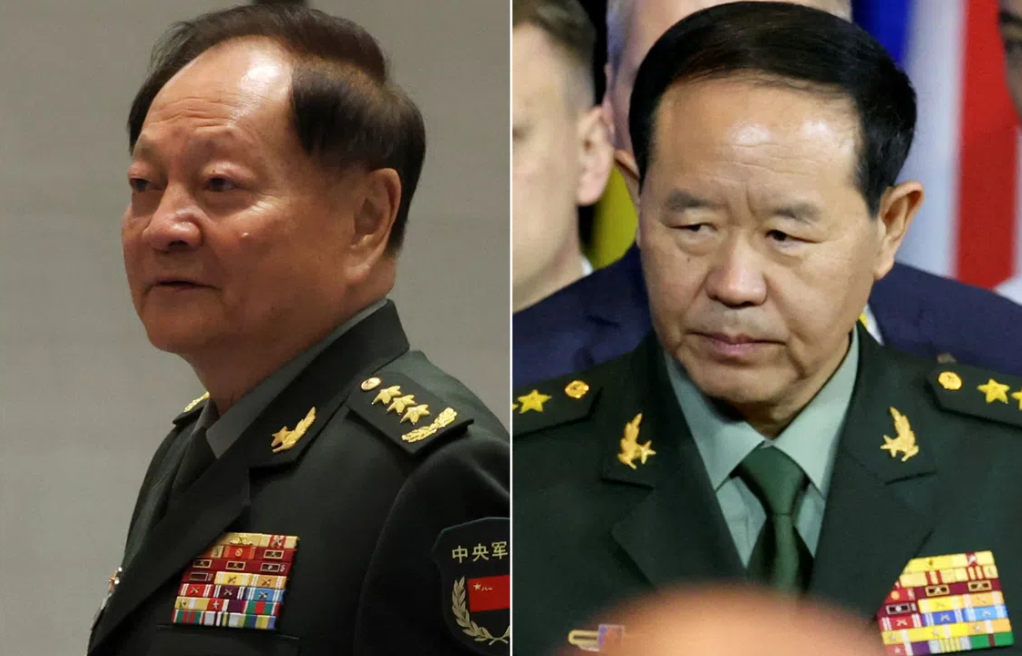
China has stripped two of its most powerful military leaders from the Central Military Commission following investigations into serious disciplinary breaches and legal violations, state media reported on Friday. The removal of Zhang Youxia and Liu Zhenli marks a significant escalation in President Xi Jinping's decade-long anti-corruption drive within the armed forces, reducing the commission's active membership to just two officials including Xi himself.
Zhang Youxia occupied one of China's most senior military positions as vice-chairman of the Central Military Commission, the nation's supreme military authority. His prominence extended beyond the military sphere, as he also held a seat on the Communist Party's exclusive Politburo, the top decision-making body of the Chinese state. Liu Zhenli served as both a commission member and head of the CMC's Joint Staff Department, a role analogous to chief of staff in other military hierarchies.
The Central Military Commission operates through a unique dual structure in which the Communist Party and state apparatus maintain parallel chains of command that function as a single integrated institution. The action announced Friday by China's National People's Congress officially removed Zhang and Liu from their positions within the state commission, though their status within the parallel Communist Party military structure remains unresolved. This ambiguity—leaving their party-side roles technically intact while stripping state titles—suggests the investigation and potential charges remain ongoing.
The resignations arrived as part of a broader parliamentary update to the roster of National People's Congress deputies. Zhang and Liu's names disappeared from the updated list published Friday, joining ten other officials and military figures who lost their seats. Among those removed were Lieutenant General Zhong Shaojun, a former director of the CMC General Office, and General Ju Qiansheng, who previously commanded the Strategic Support Force, indicating the purge extends well beyond the commission's top tier.
Xi's campaign against military corruption emerged as a cornerstone of his leadership since 2012, fundamentally reshaping China's armed forces through investigations, removals, and prosecutions. The military establishment has functioned as his primary institutional target within this broader crackdown, reflecting concerns about endemic corruption and factional loyalty networks that predated his tenure. This latest action demonstrates his willingness to remove even the most senior commanders if they fail to maintain the standards he demands.
Last month, Xi explicitly instructed top Communist Party leadership to intensify anti-corruption efforts specifically within military ranks. This directive preceded Friday's removals by weeks, suggesting these actions formed part of a coordinated campaign rather than isolated disciplinary decisions. Over the course of the multi-year crackdown, scores of senior officers and military officials have faced investigation, demotion, or complete removal from their positions.
The removal list included other significant figures beyond the military sphere, such as Gao Shiwen, former mayor of Nanchang in southern China. Gao's inclusion reflects how corruption investigations frequently uncover connections between civilian government, state enterprises, and military structures. His previous employment at China Aerospace Science and Technology Corporation, a major defense contractor, illustrates how graft networks operate across state institutions.
In a related development, China's top political consultative body, the Chinese People's Political Consultative Conference, stripped Zhao Zongqi of membership this week. Zhao commanded the Western Theatre Command during the 2020 border clashes with India along the contested Line of Actual Control, a conflict that inflicted significant casualties on both sides. His removal suggests that military failures and policy decisions during that period continue to generate consequences within China's political establishment.
The implications for Southeast Asia warrant careful consideration. Regional governments monitoring China's military leadership transitions must evaluate how these changes affect command stability, nuclear capabilities, and cross-border military doctrine. A destabilized high command could theoretically create unpredictability, though Xi's consolidation efforts typically enhance rather than diminish centralized control over force deployments. The purge reinforces that loyalty to Xi's vision supersedes factional or professional military considerations in determining career trajectories.
Moreover, the scale and publicity of these removals signal to remaining senior officers the risks of deviation from Xi's expectations. Military leaders throughout Asia's strategic competition with Beijing will interpret these actions as confirmation that position and rank provide no immunity from investigation. For Malaysia and other regional states, this centralization of military authority under Xi eliminates alternative power centers that might otherwise negotiate autonomously on regional disputes or military cooperation.
The continuing nature of the anti-corruption drive, punctuated by high-profile removals of sitting commissioners, indicates the investigation apparatus remains active and unconstrained by hierarchy or tenure. This sustained pressure on the military establishment serves Xi's dual purpose: eliminating potential rivals while simultaneously extracting resources and eliminating waste that detract from military modernization efforts. The Strategic Support Force, from which General Ju emerged, has attracted particular scrutiny, suggesting concerns about cyber warfare, space operations, or intelligence capabilities within that branch.
These developments arrive as China navigates complex security challenges across multiple fronts, from Taiwan tensions to South China Sea disputes to border management with India. The timing of removals at such a strategically delicate moment underscores Xi's confidence that the purge strengthens rather than weakens overall military effectiveness by ensuring unquestioning subordination to civilian party leadership. Whether this approach ultimately enhances or undermines China's military readiness remains a question regional strategists continue to debate.

