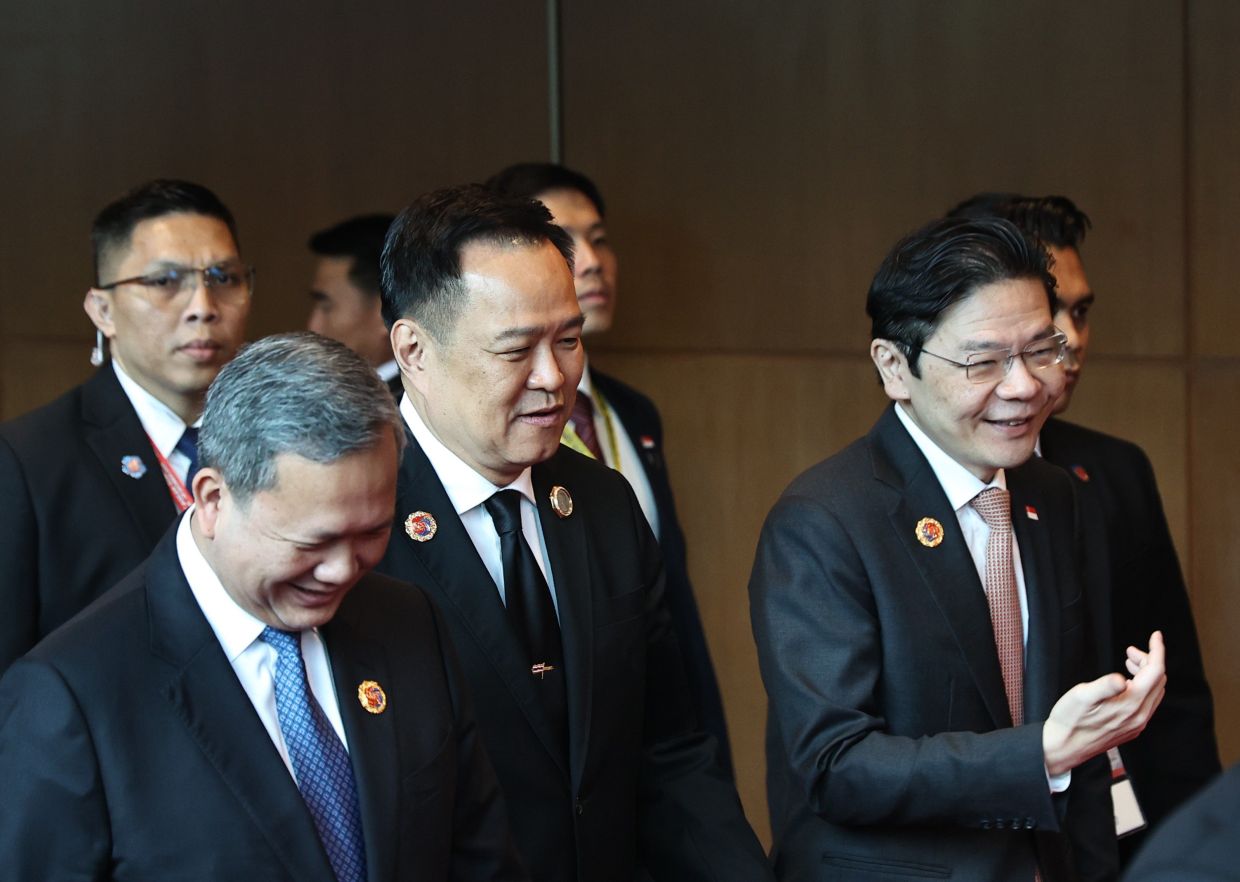
China may be moving closer to a formal mediation role in the long-running Cambodia-Thailand border dispute, as both Southeast Asian neighbours simultaneously engage Beijing's leadership with noticeably different messaging on the contentious issue. Prime Minister Hun Manet of Cambodia and Prime Minister Anutin Charnvirakul of Thailand are both currently in Beijing, where they have separately discussed the frontier tensions with Chinese officials in what observers view as a potential diplomatic opening for Chinese involvement.
Hun Manet's discussion with Chinese Premier Li Qiang on July 16 represented one of the highest-level formal presentations of Cambodia's border position to Beijing since hostilities escalated along the frontier last year. During their bilateral talks, the Cambodian Prime Minister restated Phnom Penh's commitment to peaceful resolution, emphasising adherence to international law and existing bilateral agreements with Thailand. While neither the Cambodian nor Chinese government explicitly mentioned mediation in their official statements, the deliberate decision to brief China's leadership on the border situation reflects Cambodia's strategic priority in keeping its most powerful regional ally fully informed about developments that could destabilize the kingdom.
Thai positioning on the matter reveals a notably more open posture toward Chinese involvement. Anutin told Thai media that Bangkok was "not closing the door" to China acting as a mediator should Beijing choose to pursue such a role. Crucially, however, Thailand clarified that it has not formally requested Chinese mediation and continues to prefer direct bilateral dialogue with Cambodia. This carefully calibrated statement allows Bangkok flexibility to welcome Chinese facilitation while maintaining the appearance of sovereignty and independence in dispute resolution—a delicate balance that reflects the complex regional dynamics where no nation wishes to appear subordinate to external powers.
The current diplomatic positioning builds on statements made by Chinese Foreign Minister Wang Yi during the Association of Southeast Asian Nations Foreign Ministers' Meeting last year. Wang explicitly stated China's willingness to "uphold an objective and fair position and play a constructive role for the harmonious coexistence between Thailand and Cambodia." Since those remarks, Beijing has supported implementation of a Cambodia-Thailand ceasefire and hosted trilateral discussions involving senior officials from all three countries aimed at maintaining peace and fostering confidence-building measures. These actions suggest that while China has strategically avoided formally declaring itself a mediator, it has consistently maintained diplomatic channels through which mediation could commence if both parties request it.
The geographical positioning of both leaders in Beijing simultaneously carries significant symbolic weight, even though their governments have not announced bilateral meetings between Hun Manet and Anutin. The timing underscores how regional disputes increasingly play out on the platform of major power diplomacy, with smaller nations using trips to Beijing to manage their international relationships and signal positions to peers. For Cambodia, hosting a formal border discussion with China's Premier during a state visit reinforces the relationship as one of Cambodia's anchors in regional geopolitics. For Thailand, Anutin's measured comments about non-closure to mediation position Bangkok as pragmatic and open to solutions while not surrendering negotiating leverage.
The Cambodia-Thailand border has remained a flashpoint for decades, with competing territorial claims rooted in colonial-era mapping and subsequent disputes over maritime boundaries and land demarcation. Recent flare-ups have involved military posturing and periodic clashes that threaten regional stability. Cambodia's approach has emphasised international legal mechanisms and welcomed observer missions from Asean, signalling confidence in transparent resolution mechanisms. This multilayered approach—combining bilateral dialogue with international oversight and strategic partner consultation—reflects Phnom Penh's understanding that border resolution in the modern context requires legitimacy through multiple channels.
China's potential mediation role carries implications extending beyond bilateral Cambodia-Thailand relations. Beijing has invested heavily in both countries through infrastructure projects, military cooperation, and economic partnerships. A successful mediation would enhance China's standing as a responsible great power committed to regional stability, while also protecting Chinese investments and strategic interests in an increasingly turbulent Southeast Asian environment. Additionally, managing tensions between two countries with significant Chinese interests demonstrates Beijing's capacity for sophisticated diplomatic engagement beyond bilateral relationships.
For Southeast Asia more broadly, the prospect of Chinese mediation reflects the region's complex alignment patterns. While Asean ideally manages its own disputes through consensus-based dialogue, the reality of great power competition and the reality that major powers like China possess disproportionate economic and diplomatic leverage means that regional actors must pragmatically engage Beijing on contentious matters. This does not necessarily undermine Asean unity but rather reflects the constraints that smaller nations face when larger powers have vital interests at stake.
Several factors remain uncertain as the diplomatic situation evolves. Neither Cambodia nor Thailand has formally requested Chinese mediation, suggesting both countries wish to preserve flexibility and avoid appearing entirely dependent on Beijing for dispute resolution. China has similarly avoided announcing any mediation initiative, preferring to position itself as ready to assist if requested rather than imposing itself into what remains primarily a bilateral matter. This cautious approach allows all parties to proceed without appearing to capitulate to external pressure or lose face domestically, where nationalist sentiment can constrain leadership flexibility on border issues.
The involvement of a major power in border dispute resolution carries inherent risks, particularly regarding medium-term implementation and enforcement of any agreement. Historical examples show that mediated settlements require ongoing commitment from all parties and the mediator to remain durable. China's track record as a mediator in regional disputes has been mixed, though it has shown capacity for patient diplomatic engagement when strategic interests align. The success of any future mediation would depend heavily on the genuine commitment of both Cambodia and Thailand to compromise on positions they have held for considerable time.
Looking forward, the current diplomatic engagement suggests that all three nations—Cambodia, Thailand, and China—are at least considering conditions under which mediation could occur. The simultaneous presence of Hun Manet and Anutin in Beijing provides an opportunity for informal discussions and confidence-building even without formal bilateral meetings. Such interactions at the margins of official events often prove more productive than scheduled negotiations, allowing leaders to explore possibilities without the pressure of formal commitment. Whether this window results in genuine mediation or remains merely a diplomatic interlude depends on how both Cambodia and Thailand assess their respective national interests and their willingness to make substantive concessions on border issues that carry domestic political significance.

