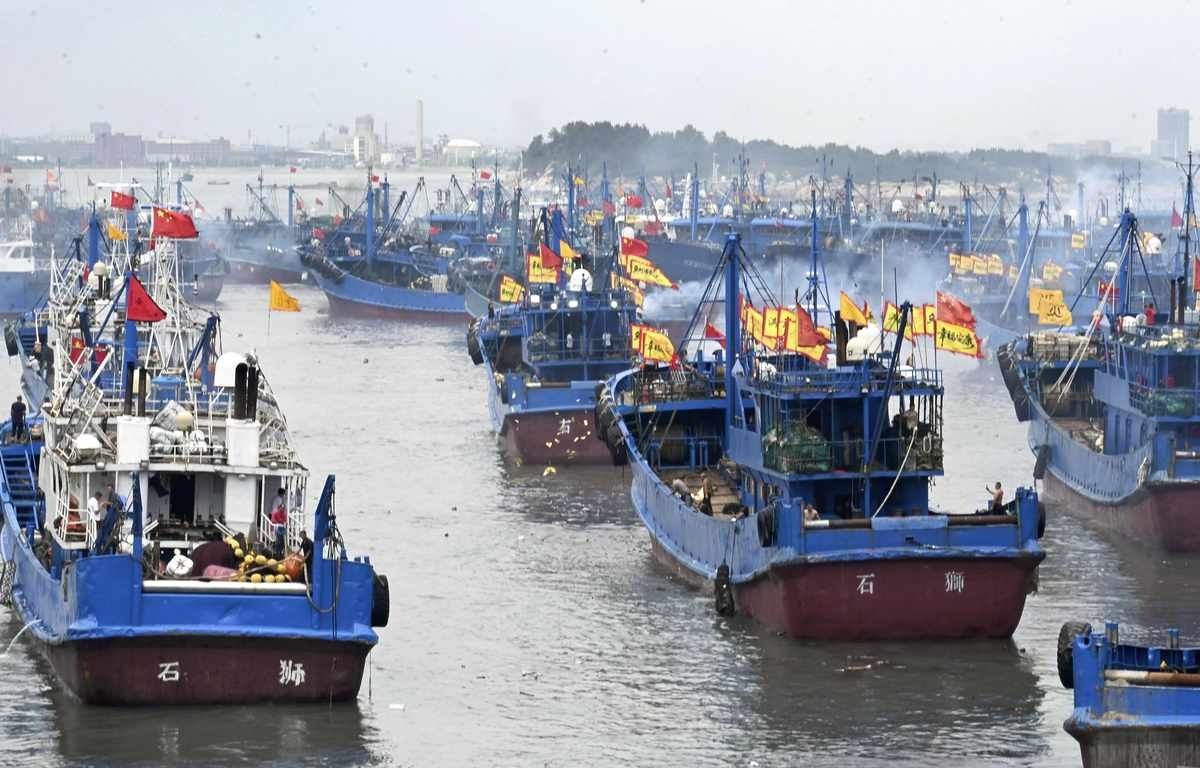
China's decision to end its seasonal fishing moratorium in the East China Sea has triggered fresh concerns about maritime tensions in one of Asia's most hotly contested regions. Beginning Saturday, Chinese fishing vessels have been permitted to resume operations in waters surrounding the Senkaku Islands, territory claimed by both Beijing and Tokyo, as well as across the Taiwan Strait. The lifting of the restriction, which typically runs from May through August, marks a critical juncture in already fraught Sino-Japanese relations and has prompted Tokyo to intensify its scrutiny of movements in the disputed area.
The resumption of fishing activities was greeted with considerable fanfare in China's fishing communities. According to local reports, 654 vessels departed from the port city of Shishi in Fujian Province on the morning of August 16 alone, their decks festooned with red and yellow flags symbolizing traditional hopes for bountiful catches and safe voyages. The sight of firecrackers exploding across the water and the rhythmic departure of hundreds of boats from the port underscored the economic and cultural significance of the season for China's fishing industry, particularly for communities whose livelihoods depend heavily on access to these productive waters.
Historically, the convergence of Chinese fishing activity around the Senkaku Islands has proven volatile. In August 2016, Chinese Coast Guard vessels accompanied by between 200 and 400 fishing boats flooded the waters surrounding the islands, with confirmed incursions into what Japan considers its territorial waters. The coordinated nature of these operations—combining civilian fishing vessels with official maritime enforcement—suggested a deliberate strategy to assert Chinese presence in disputed zones. Japan's response was swift and forceful, lodging formal protests and characterizing the incursions as unilateral escalations that threatened regional stability. Many analysts viewed these actions as retaliation against Japan's public support for an international tribunal ruling that same month, in which The Hague's Arbitral Tribunal rejected China's broad sovereignty claims across the South China Sea.
In the intervening years, Beijing appears to have calibrated its approach, at least superficially. Chinese local authorities have instructed fishing communities to exercise restraint in sensitive waters, ostensibly to prevent incidents that might further damage relations with Japan. This policy shift has yielded measurable results: Japan Coast Guard warnings issued to Chinese fishing vessels entering the territorial waters around the Senkaku Islands plummeted from 81 in 2021 to merely four in 2025, suggesting either improved compliance or deliberate avoidance by Chinese fishermen.
Yet recent signals suggest a potential thawing of Beijing's restraint. On August 7, authorities in Quanzhou, the municipality responsible for Shishi, issued directives to strengthen surveillance of sensitive waters—language that some observers interpret as preparation for increased activity rather than genuine containment. More tellingly, China's official pre-fishing season notices have undergone subtle but potentially significant revisions. Last year's directive explicitly warned against cross-border fishing in sensitive waters adjacent to South Korea, North Korea, and Japan. This year's April 30 notice, however, retained the warning for South Korea but conspicuously omitted any mention of Japan, focusing instead on enforcing restrictions in the interim measures zone shared with South Korea.
The disappearance of Japan from Beijing's official fishing guidance has not escaped the attention of diplomatic analysts and intelligence observers. The omission, whether intentional or not, could signal a deliberate softening of restrictions in Japanese waters or reflect a strategic shift in Beijing's priorities. Diplomatic sources monitoring the situation have urged heightened vigilance, recognizing that such bureaucratic changes often precede shifts in actual policy implementation on the ground.
Interviews with fishermen attempting to resume work reveal the complex calculus facing communities dependent on East China Sea resources. One fisherman in his 50s, speaking on condition of anonymity, acknowledged the exceptional richness of fishing grounds around the Senkaku Islands while noting the delicate balance between economic opportunity and state enforcement. He observed that while Chinese authorities conduct surveillance to prevent egregious violations, fishermen have received no explicit prohibition against operating in the area, creating ambiguity that permits continued activity within unstated bounds.
This pattern of tacit tolerance coupled with selective enforcement reflects Beijing's broader strategy toward the Senkaku dispute: maintaining China's position without triggering the kind of military escalation that could invite international intervention or destabilize economic relationships. By allowing fishing communities to operate with implicit permission while maintaining plausible deniability through general surveillance directives, China manages both domestic expectations and international sensitivities.
For Japan, the resumed Chinese fishing activity arrives at a particularly delicate moment. Tokyo-Beijing relations have deteriorated substantially in recent months, driven by disputes over territorial claims, defense spending, and strategic alignment with the United States. The Senkaku Islands, small and uninhabited though they may be, carry disproportionate symbolic weight in both capitals, serving as proxies for broader assertions of maritime sovereignty and regional influence. Japan's commitment to defending what it views as its territorial integrity is nonnegotiable, yet confrontations that escalate into military incidents could destabilize the broader region and impose substantial economic costs on both nations.
The weeks ahead will likely prove instructive. Japan's Coast Guard will monitor incoming fishing vessels closely, establishing a baseline for whether Chinese activity this season represents continuation of recent patterns of restraint or a meaningful shift toward the more aggressive postures witnessed in 2016. The behavior of Chinese authorities—whether they permit mass fishing incursions or continue subtle enforcement—will provide crucial insight into Beijing's broader strategic calculations regarding Japan and regional territorial disputes. Southeast Asian nations, themselves involved in overlapping maritime claims, will watch these developments intently, as outcomes in the East China Sea could establish precedents affecting their own interactions with Chinese fishing fleets and government vessels.

