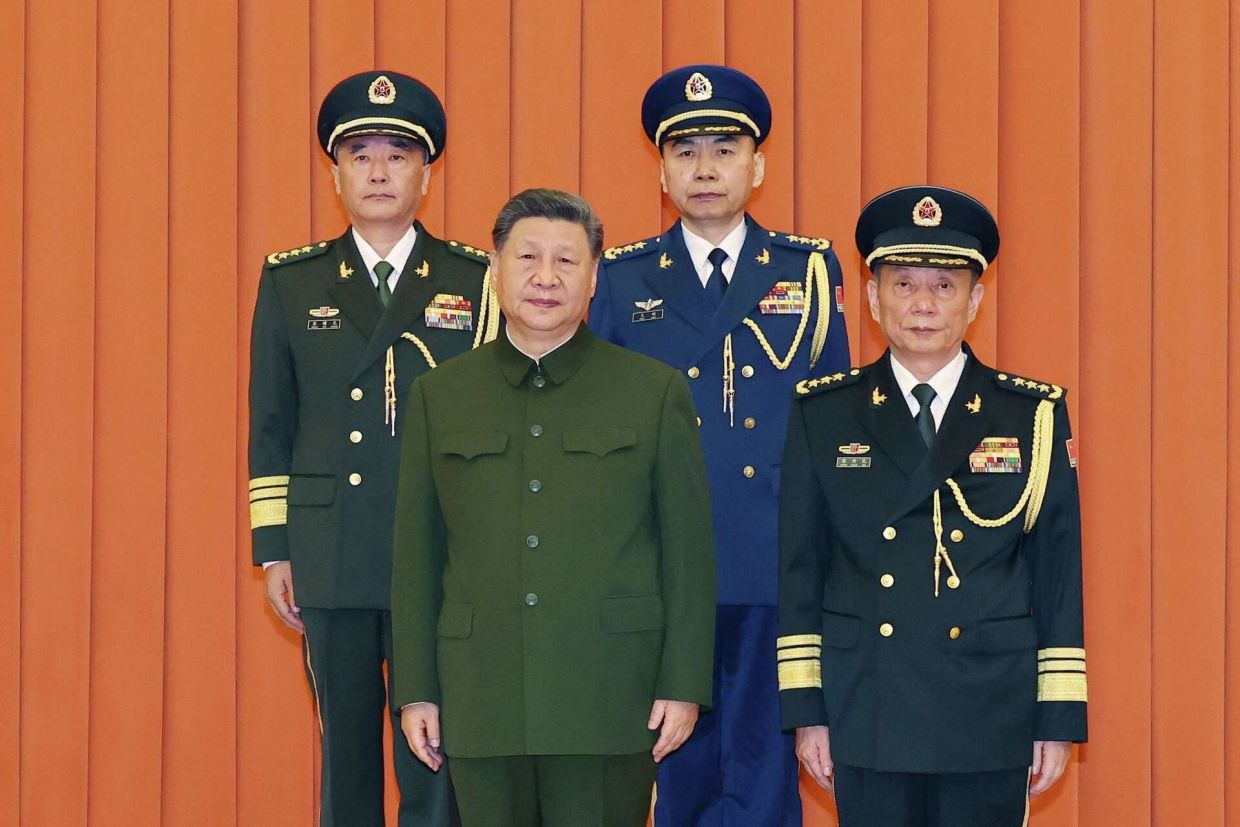
China's military has elevated two senior officers to the rank of general in a development that signals significant upheaval within the People's Liberation Army's command structure. The promotions of Zhang Shuguang and air force commander Wang Gang, formally announced during a ceremony led by Xi Jinping on July 3, come at a critical juncture for the military as it grapples with the fallout from an extensive anti-corruption investigation that has effectively gutted its leadership.
The timing and nature of these appointments suggest a carefully orchestrated transition designed to reinforce the Communist Party's grip on military affairs and, more specifically, to cement Xi's personal authority over the institution. By directly presenting promotion orders as the military's commander-in-chief, Xi emphasised his prerogative over personnel decisions—a powerful symbolic assertion at a moment when the military's internal cohesion has been tested by investigations into graft and misconduct among its upper echelons.
The anti-corruption drive has proven particularly disruptive to the Central Military Commission, the apex body responsible for overseeing all military operations and strategic decisions. This seven-member organ, chaired by Xi himself, has been substantially weakened by the removal or effective removal of several of its vice chairs, including the military's most senior ranking general. The commission's functional capacity has deteriorated to the point where only Xi and Vice Chair Zhang Shengmin remain actively engaged in its work, creating a precarious vacuum in military governance that threatens operational continuity.
Zhang Shuguang's dual appointment—to the rank of general and to head the Central Military Commission's corruption investigation division—positions him as a key figure in determining the trajectory of the purge. This assignment grants him significant influence over which officers face investigation, how those inquiries proceed, and whether sanctions are ultimately pursued. Such concentrated authority over internal discipline represents a potent tool for consolidating power within the military hierarchy and rewarding loyalists.
The structural implications of these promotions are substantial. With multiple senior positions now vacant or suspended, Zhang and Wang appear positioned as candidates to fill seats on the seven-member commission, potentially becoming the nucleus of a reformed leadership body. Their elevation suggests the Party is preparing for a comprehensive reorganisation of the military's command structure, likely to be formalised later in the year when the current commission's five-year mandate expires in autumn.
For Southeast Asian observers, the internal ferment within China's military carries significant regional implications. Military leadership transitions often coincide with shifts in defence posture, strategic doctrine, and external ambitions. A military structure rebuilt from above by Xi's appointees, with greater emphasis on party loyalty than institutional expertise, could affect China's approach to regional disputes, naval operations in the South China Sea, and broader strategic calculations affecting neighbouring nations.
The anti-corruption campaign itself warrants scrutiny beyond its stated objectives. While the Communist Party frames the purge as a principled effort to eliminate institutional corruption, observers note that such campaigns have historically served multiple purposes: eliminating rivals, consolidating power, and ensuring subordinates remain dependent on the paramount leader's patronage. The systematic removal of experienced officers creates opportunities to place ideologically aligned officers in critical positions, potentially reshaping the military's institutional culture and decision-making processes.
The timing also reflects Party anxieties about military autonomy and institutional drift. Over recent decades, segments of the military had accumulated considerable organisational independence, resources, and influence over defence-related policies. Xi's consolidation efforts, which extend far beyond these promotions, aim to subordinate military interests to party directives and to ensure that institutional loyalty flows directly to the top rather than dispersing through lateral networks among senior commanders.
The fall reorganisation will be particularly revealing. The new commission's composition will signal whether this reshuffle represents a temporary disruption or a fundamental reordering of the military's elite. If the Party appoints loyalists without deep operational experience, it could signal a deliberate trade-off of expertise for reliability. Alternatively, if experienced commanders are restored alongside Xi's appointees, the exercise may ultimately aim to strike a new equilibrium within the institution.
For Malaysia and other Southeast Asian states, monitoring these developments offers valuable insight into Beijing's strategic confidence and decision-making processes. A military leadership structure that prioritises party control over professional judgment might make unpredictable decisions on regional flashpoints. Similarly, uncertainty about how the reformed leadership will approach longstanding military roles and relationships could create friction in the region's strategic calculus.
The broader international dimension extends to how China's military partners and competitors interpret these moves. Allies assessing Beijing's reliability must factor in the degree to which policy shifts reflect institutional weakness or calculated strategic repositioning. Defence establishments evaluating the capabilities and intentions of the Chinese military face similar analytical challenges: determining whether visible turbulence indicates dislocation or represents a confident power consolidating its instruments of statecraft.
As the military awaits formal reorganisation, the actions of Zhang and Wang will provide early indicators of how comprehensively the anti-corruption drive will reshape institutional priorities and relationships. Their appointment timing, decisions regarding ongoing investigations, and positioning within preliminary reorganisation plans will collectively offer clues about the military's future orientation and the sustainability of Xi's authority within its ranks.

