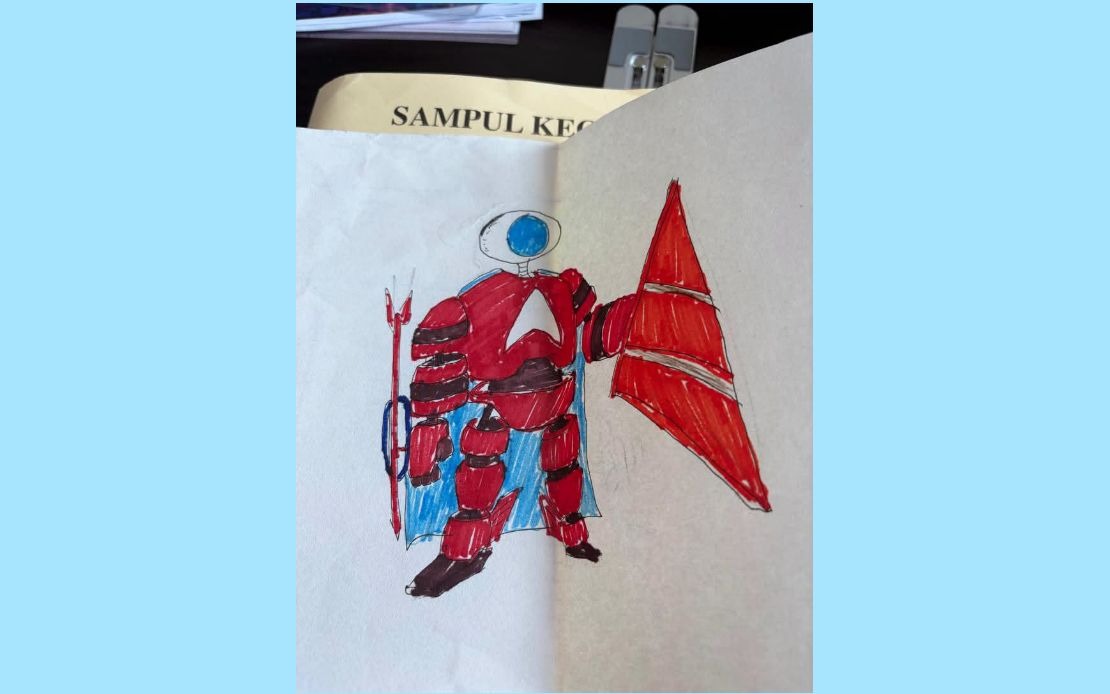
Prime Minister Datuk Seri Anwar Ibrahim has publicly acknowledged a simple yet poignant gift presented to him by a child with special needs during a recent community engagement session, reflecting the personal connections that emerge through grassroots political dialogue. The artwork, which depicts a robot character rendered in bold red and blue armour carrying a staff-like implement, has taken on significance beyond its artistic merit as a token of the direct interaction between Malaysia's leadership and citizens from diverse backgrounds.
Anwar shared the moment through a Facebook post, recalling the circumstances under which the drawing was handed to him during the Temu Anwar programme held in Negeri Sembilan. The child, who was being held by his father at the time, presented the artwork to the Prime Minister during the public engagement event. This encounter highlights the inclusive nature of such platforms, which explicitly welcome participation from citizens across the full spectrum of Malaysian society, including those with varying abilities and needs.
The Prime Minister's public appreciation for the gift—expressed through his social media statement—underscores an important message about recognition and dignity. By documenting and sharing the moment, Anwar signalled that contributions from all members of society, regardless of circumstance, warrant acknowledgement and respect. This gesture carries particular resonance in a society where individuals with disabilities and their families sometimes face systemic barriers to meaningful civic participation and engagement with government.
Temu Anwar represents an institutional commitment to direct, unmediated dialogue between the Prime Minister and the Malaysian public. The platform deliberately structures opportunities for citizens to interact with the nation's chief executive without intermediaries, creating space for organic encounters that transcend formal protocol. These sessions bring together people from disparate walks of life—representing different economic backgrounds, geographic regions, educational levels, and personal circumstances—to raise concerns, share perspectives, and forge connections with the political leadership.
The significance of this particular exchange extends beyond the personal dimension. For families navigating the complex landscape of raising and advocating for children with special needs in Malaysia, visible recognition from the highest levels of government carries practical and emotional weight. It affirms that their voices matter in the national conversation and that their experiences form part of the broader social fabric that policymakers must consider when crafting disability-inclusive initiatives and resource allocation.
The artwork itself, rendered with the imaginative flourish characteristic of children's drawings, speaks to the creative capacity and individuality that exists within every young person, irrespective of their circumstances. The robot figure, executed with apparent care and featuring distinctive colour choices, represents the unique perspective and personality of its creator. The presentation of such a work to the Prime Minister becomes a powerful symbolic act—a child offering his creative vision to the nation's leader, and that leader receiving it with genuine appreciation.
For Malaysia's ongoing efforts to build more inclusive governance structures, moments like this carry broader implications. They demonstrate that accessibility to high-level political engagement need not be limited to established interest groups, media personalities, or formally organized delegations. When ordinary citizens—particularly those whose voices are frequently marginalised—encounter genuine receptiveness from leadership, it strengthens the social contract and reinforces the principle that representative democracy functions best when diverse perspectives genuinely inform policy and practice.
The Temu Anwar initiative itself reflects a particular governance philosophy that prioritises face-to-face engagement and direct listening. Rather than relying solely on formal submissions, parliamentary processes, or media intermediaries, the platform creates structured opportunities for unscripted interactions. These sessions capture authentic human moments that cannot be replicated through conventional political channels, often revealing priorities and concerns that might otherwise remain unheard in formal bureaucratic structures.
The broader context of special needs education and support services in Malaysia suggests that such visibility matters significantly. Advocacy organisations working with children and families facing developmental disabilities have long noted that government responsiveness often correlates with public visibility and perceived political priority. When leadership visibly engages with and appreciates contributions from this community, it can catalyse increased attention to resource requirements, infrastructure gaps, and policy refinements necessary to support these populations more effectively.
Anwar's public acknowledgment also models an approach to leadership that values and preserves personal connections in an increasingly digital and impersonal political environment. The decision to document and share this moment—rather than treating it as a fleeting encounter—suggests a deliberate commitment to humanising governance and demonstrating that individuals matter to their leaders beyond aggregate voter categories or demographic statistics.
Looking forward, such encounters can serve as catalysts for broader discussions about disability inclusion in Malaysian governance and public policy. They remind policymakers that citizens with special needs and their families possess agency, creativity, and perspectives worthy of consideration. They also illustrate how accessible engagement platforms can democratise interaction with senior government officials, potentially revealing priorities and needs that formal consultation mechanisms might overlook.

