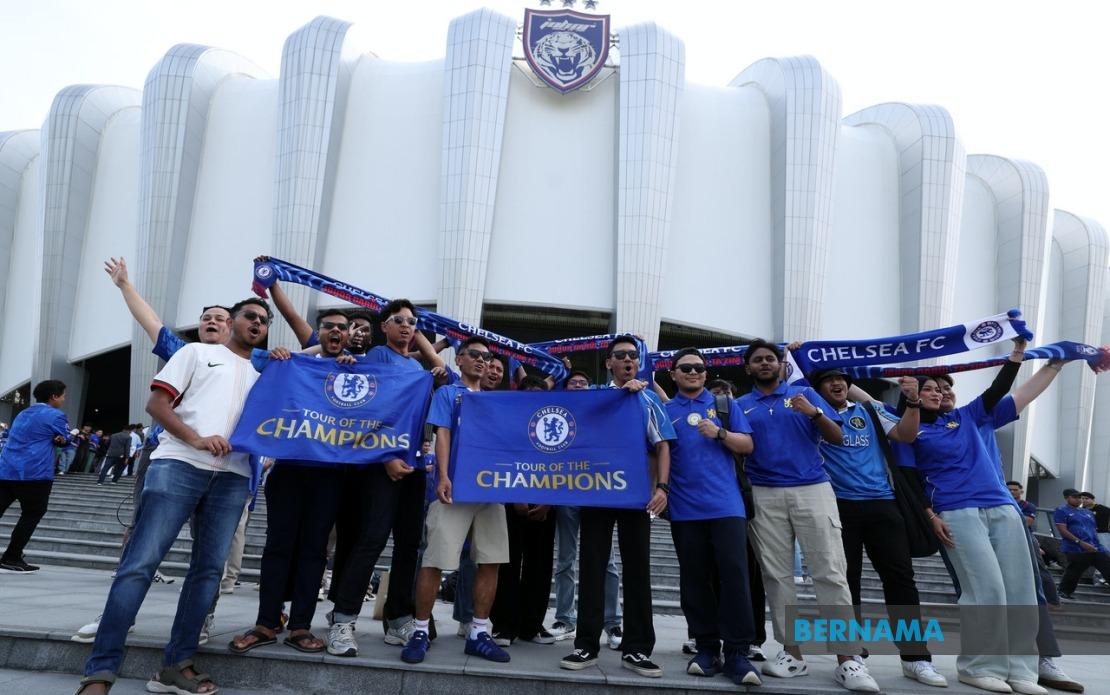
The Sultan Ibrahim Stadium in Iskandar Puteri transformed into a vibrant tapestry of sporting passion on Friday as masses of supporters clad in red-and-blue JDT colours and Chelsea's distinctive royal blue converged on the venue hours before kick-off. Beginning from mid-afternoon, waves of enthusiastic fans began arriving at the prestigious ground, creating an electric atmosphere that reflected the significance of hosting one of world football's most recognisable clubs on Malaysian turf. The visible sea of team colours underscored the universal appeal of the match, drawing devotees spanning multiple generations and geographic boundaries.
The demographic diversity of attendees illustrated the broad reach of both clubs' appeal. Seasoned supporters brought their families to share in the occasion, whilst younger fans arrived in organised groups, each cohort equally intent on celebrating the historic encounter. Beyond simply attending the match, many took advantage of the pre-match period to capture photographs and create lasting memories against SSI's distinctive architectural backdrop, transforming the stadium surroundings into an impromptu gallery of sporting enthusiasm.
Commercial activity around the stadium proved brisk, with merchandise vendors experiencing sustained demand throughout the afternoon. Official stalls offering limited-edition match memorabilia became focal points of activity, with queues of customers extending steadily as supporters sought exclusive items commemorating the occasion. The commercial dimension reflected both the economic significance of hosting such fixtures and the willingness of Malaysian football fans to invest in their sporting experiences.
The match's drawing power extended well beyond Johor's borders, with supporters from across Malaysia and neighbouring Singapore making dedicated journeys to attend. Cross-border participation underscored the rarity and prestige of witnessing a Premier League outfit performing domestically, essentially bringing world-class football to Southeast Asian audiences without requiring intercontinental travel. This accessibility factor appeared particularly compelling for fans who had previously only experienced such calibre of competition through broadcast media.
Road infrastructure around the stadium managed the influx with mixed efficiency. By early evening, traffic along principal routes leading to SSI had slowed noticeably, though authorities maintained acceptable flow conditions ahead of the 8 pm commencement. The Royal Malaysia Police deployed enhanced security measures to manage congestion, reflecting the substantial attendance anticipated for the fixture and the operational demands of hosting a match of such magnitude.
Ahmad Danial Muhammad, a 28-year-old Chelsea enthusiast from Bangsar in Kuala Lumpur, articulated the significance of the occasion from a devoted fan's perspective. Having followed the club throughout the Didier Drogba era, he had seized the opportunity to acquire tickets immediately upon learning of Chelsea's Malaysian visit. For supporters of his commitment, witnessing Premier League-calibre athletes perform live without undertaking expensive international travel represented an exceptional chance unlikely to recur regularly.
The appeal resonated equally across international boundaries. Tan Wei Sheng, a 34-year-old supporter from Singapore, had coordinated his travel strategically to avoid congestion at the Johor Causeway, departing his home country at midday to navigate the border smoothly. His appreciation extended beyond the football itself to encompass the stadium's modern facilities and the palpable sense of occasion pervading the venue, elements that collectively contributed to the event's perceived value.
For supporters of Johor Darul Ta'zim, the match carried particular significance beyond sporting competition. Mohd Khairul Anuar Ismail, a 41-year-old enthusiast from Bukit Piatu in Melaka, framed Chelsea's choice of SSI as validation of Malaysian football's growing international standing. Rather than viewing the encounter solely as a test of local capabilities against established opposition, he interpreted it as tangible evidence of elevated respect accorded to domestic clubs within global football hierarchies.
This perspective aligned with broader narratives concerning Malaysian football's developmental trajectory. Safiyah Rosli, a 32-year-old JDT supporter from Batu Pahat, explicitly connected the fixture to the strategic vision of Tunku Mahkota Ismail, the Regent of Johor, positioning football advancement as inseparable from political leadership and institutional commitment. Her framing reflected how sporting accomplishments become woven into narratives of regional progress and governance effectiveness, particularly within Johor's football-centric identity.
The convergence of passionate supporters, manageable logistics, and widespread geographic participation indicated that Malaysian football had successfully leveraged its institutional infrastructure to deliver an event of genuine international significance. Sultan Ibrahim Stadium's hosting capacity and modern amenities proved adequate for accommodating the substantial turnout, while the evident enthusiasm across supporter demographics suggested that Malaysian audiences remained deeply engaged with elite-level football regardless of domestic origins.
Beyond the immediate match outcome, the fixture represented a strategic achievement for Malaysian football administration. Securing agreements with established Premier League clubs required sustained institutional credibility and organisational competence, assets that Malaysian football bodies had demonstrably cultivated. Such matches served dual purposes: generating revenue and profile elevation domestically whilst furnishing international exposure for Malaysian football infrastructure and the nation's capacity to host world-class sporting events.
The cross-border participation, particularly from Singapore, highlighted the broader Southeast Asian football landscape wherein national boundaries frequently prove porous for sporting enthusiasts. Regional fans recognised the rarity of Premier League clubs competing domestically and prioritised attendance accordingly, generating economic activity across transportation, hospitality, and retail sectors. For policymakers monitoring sports tourism and regional soft power, such participation metrics offered quantifiable evidence of football's capacity to generate transnational movement and economic activity.
As evening descended upon Iskandar Puteri, the accumulating crowds and sustained enthusiasm suggested that Malaysian football had successfully created an occasion that transcended purely sporting dimensions, becoming instead a cultural moment reflecting broader aspirations concerning the nation's place within global football hierarchies and capacity to deliver world-class sporting experiences domestically.

