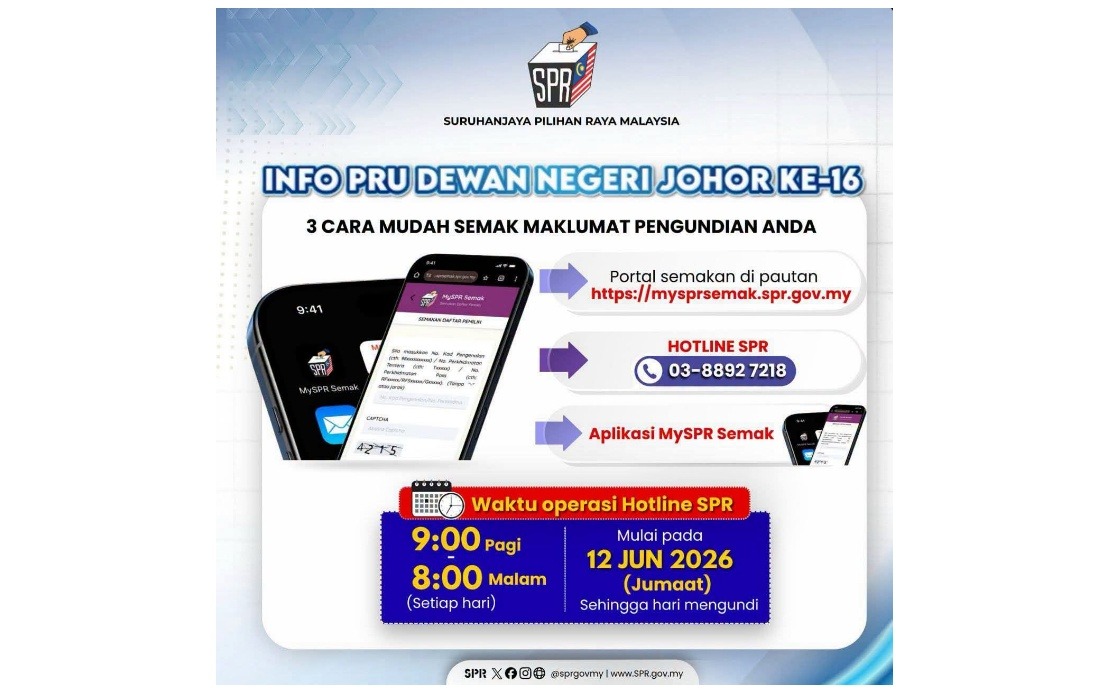
With the 16th Johor state election scheduled for July 11, Malaysia's Election Commission has launched a final push to ensure registered voters are fully prepared for polling day, urging them to verify their designated voting locations and streams through official digital channels.
The Commission announced the reminder via social media, emphasising that all eligible voters should cross-check their particulars using either the MySPR Semak online portal or its accompanying mobile application. The advisory comes as the state prepares for what is shaping up to be a closely contested election involving an unusually fragmented political landscape across 56 state assembly constituencies.
A total of 2.7 million ordinary voters are expected to participate in Saturday's ballot. The scale of participation underscores the significance of this contest within Malaysia's broader political dynamics, particularly given that Johor has traditionally served as a political bellwether for national trends. The large electorate also presents logistical challenges for the Commission, making voter awareness campaigns critical to ensuring smooth polling operations.
Early voting has already concluded, with 19,471 personnel from security forces and their families casting ballots last Tuesday. This comprised 7,960 military voters and their spouses, alongside 11,511 police personnel including members of the General Operations Force and their dependents. The early voting exercise proceeded without reported complications, setting a positive precedent for the main polling day.
The election has attracted an exceptionally wide field of candidates, reflecting the increasingly crowded Malaysian political ecosystem. A total of 172 candidates are contesting the 56 state seats, with Pakatan Harapan and Barisan Nasional each fielding complete slates of 56 candidates. Perikatan Nasional is competing with 33 candidates, while the relative newcomer Parti Bersama Malaysia has put forward 15 contenders. The Malaysian United Democratic Alliance (MUDA), which gained prominence during recent federal elections through its appeal to younger voters, is running four candidates.
Beyond the major coalitions and national parties, the ballot will include candidates from the Parti Orang Asli Malaysia (ASLI), the Parti Sosialis Malaysia (PSM), and six independent candidates operating without party affiliation. This fragmented candidacy landscape means voters face genuinely complex choices, with multiple ideological and policy positions represented across constituencies.
For Malaysian readers and regional observers, the Johor election carries particular weight given the state's economic importance and demographic diversity. As a major manufacturing hub and gateway for cross-border trade with Singapore, Johor's governance directly influences regional investment flows and economic sentiment throughout Southeast Asia. The composition of the new state assembly will therefore influence not merely local policy but potentially broader regional considerations around stability and business confidence.
The Commission's emphasis on voters using digital tools to verify their details reflects Malaysia's gradual modernisation of electoral administration. The MySPR Semak system represents an important step toward transparency and voter convenience, allowing individuals to independently confirm their registration status and assigned polling locations without visiting government offices. Such systems are particularly valuable in a diverse democracy like Malaysia, where some voters may have relocated or experienced changes to their residential addresses since initial registration.
The timing of the Commission's reminder—with four days remaining before polling—reflects best practices in electoral management. Research on voter participation consistently demonstrates that last-minute confusion about polling locations depresses turnout, particularly among first-time or infrequent voters. By highlighting the availability of these verification tools, the Commission is attempting to maximise participation and reduce potential sources of frustration on polling day itself.
As Johor voters prepare to cast their ballots, the electoral exercise represents a significant moment for Malaysian democracy. The breadth of candidates and ideological positions on offer—from established coalitions to smaller parties and independents—demonstrates the vibrancy of Malaysia's democratic contestation. Yet this same diversity underscores the importance of informed voting and adequate preparation among the electorate. The Commission's outreach efforts, therefore, serve not merely as administrative procedure but as essential support for meaningful democratic participation.

