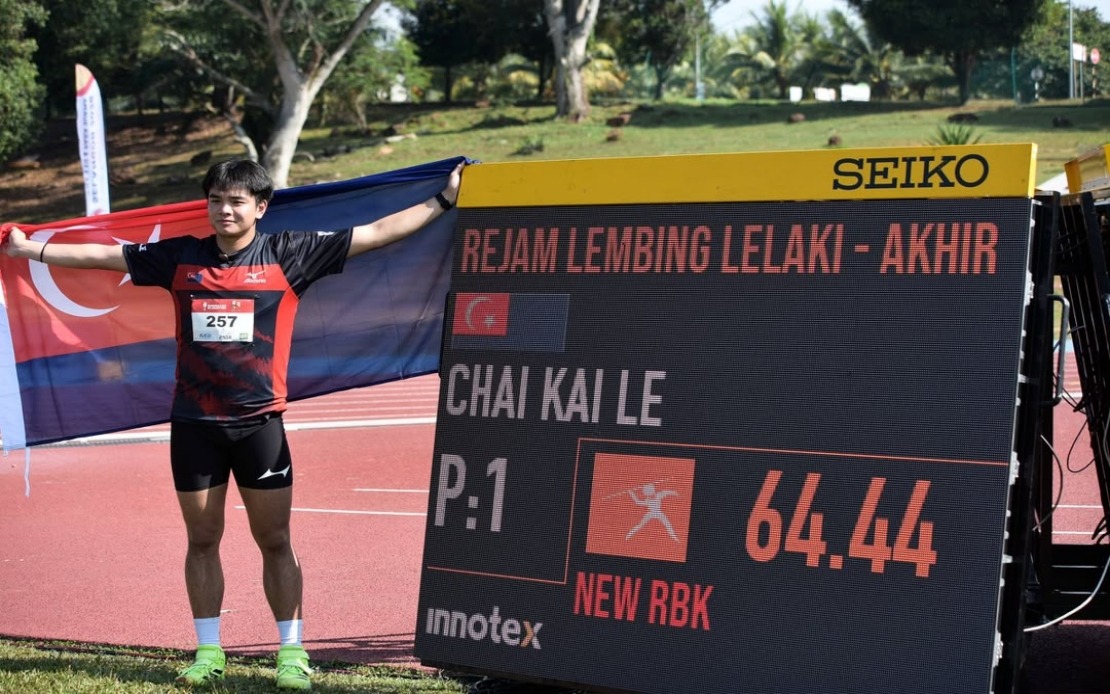
Johor's Chai Kai Le delivered a breakout performance at the Selangor 2026 Malaysia Games, launching the javelin 64.44 metres on his second attempt to claim the men's gold medal and obliterate a quarter-century-old Games record. The 18-year-old's effort at the Universiti Putra Malaysia Sports Centre eclipsed the previous standard of 62.33 metres established by Sarawak's Kho Mei Kuan at the 2000 edition held in Penang, marking a significant breakthrough in Malaysian field athletics.
Kai Le's commanding performance underscores the depth of emerging talent in Malaysian track and field, with the teenager demonstrating technical prowess and competitive maturity well beyond his years. His gold-medal throw came after two years of dedicated preparation specifically aimed at the SUKMA competition, a quadrennial showcase for the nation's best young and developing athletes. The margin of victory—over four metres ahead of the silver medallist—illustrated both his superiority in the event and the gap between elite performers and the broader competitive field.
Penang's Tan Chun Wei captured the silver medal with a throw of 60.43 metres, whilst Kai Le's Johor teammate Mohd Noor Iman Norman rounded out the podium with a bronze medal effort of 59.04 metres. The Johor contingent's dominance in the men's javelin, with two athletes securing medals, reflects the state's continued investment in field event development and athlete progression pathways. This regional strength in throwing events has become increasingly important as Malaysian athletics seeks to build competitive advantages across diverse disciplines.
In post-competition remarks, Kai Le acknowledged that surpassing the Games record fell squarely within his pre-competition objectives, having mapped out his SUKMA ambitions across the preceding twenty-four months. His candid assessment of his performance revealed the tactical and physical considerations that shape elite-level throwing, as technical execution and injury management intertwine during high-intensity competition. The teenager's acknowledgement of executing a technical error during his second attempt, which subsequently triggered lower back discomfort and fatigue, demonstrated sporting maturity and body awareness—critical attributes for injury prevention in throwing disciplines.
Kai Le carries into these Games an impressive resume that includes the national under-20 record of 65.65 metres, suggesting considerable room for future improvement and progression toward senior national standards. The gap between his personal best and today's Games record—a differential of 1.21 metres—indicates that further incremental gains remain achievable through continued training refinement and competition experience. For Malaysian athletics administrators, such records from teenage athletes signal the emergence of a pipeline capable of contending regionally and potentially at larger international competitions.
Beyond the javelin arena, track events also delivered compelling narratives at the Selangor 2026 Games. Mohammad Aiman Haikal Sahrudin of Penang secured the men's 10,000 metres race walk gold medal, clocking 47 minutes and 28.84 seconds in a discipline that demands exceptional aerobic capacity, technique, and mental resilience over extended distances. The race walk—an increasingly prominent fixture at Southeast Asian Games and Commonwealth competitions—requires walkers to maintain foot contact with the ground whilst negotiating a prescribed technical form, making it simultaneously more challenging and less accessible to casual observers than road running.
Ahmad Farish Irfan Ahmad Fahmi from Kelantan claimed the silver medal in a time of 47 minutes and 37.17 seconds, whilst Khor Jing Hong representing the Federal Territories secured bronze in 47 minutes and 49.27 seconds. Mohammad Aiman's triumph represented marked improvement upon his silver medal finish at the previous SUKMA edition held in Sarawak, indicating enhanced preparation and competitive sharpness heading into what promises to be a more demanding competitive landscape.
The 18-year-old race walker from Kampung Tanah Liat in Penang articulated ambitious objectives extending beyond the current Games environment, explicitly targeting selection for Malaysia's 2027 SEA Games contingent and recognition within the national junior squad. Mohammad Aiman's strategic pivoting toward the 20,000 metres discipline—notably absent from SEA Games programming—demonstrates pragmatic event selection aligned with regional competition calendars. Such forward planning reflects the maturation of athlete development pathways and coaching structures that help emerging competitors visualise career progression beyond single competitions.
The performances by both Kai Le and Mohammad Aiman exemplify the calibre of young talent now emerging through Malaysia's Games system, a biennial competition that serves as a crucial proving ground for athletes transitioning from junior to senior categories. Both competitors inhabit the eighteen-year-old age bracket, suggesting that the next five to ten years could witness sustained excellence in field athletics and race walking disciplines, provided appropriate competitive opportunities, coaching support, and infrastructure investment remain accessible. The SUKMA platform continues validating its importance as the primary national mechanism for identifying and nurturing athletes capable of representing Malaysia's sporting interests at regional championships including the SEA Games, Asian Games, and potentially Olympic qualification pathways.

